
TECHNIQUE · GUIDE
Etching
The intaglio technique in which acid bites an image into a metal plate — how an etching is made, how to recognise one, and how it differs from engraving.
An etching is an original print made by biting an image into a metal plate with acid. The artist coats the plate with an acid-resistant ground, draws through it with a needle to expose the bare metal beneath, and lowers the plate into an acid bath; the acid eats — “bites” — the drawn lines down into the surface. Those bitten lines are then filled with ink, the flat of the plate is wiped clean, and plate and dampened paper are run together through a press under enough pressure to lift the ink up out of the recesses and onto the sheet. Every impression is pulled by hand from that one worked plate. An etching is the work itself, not a reproduction of a picture that exists in some other medium.
What is an etching?
Etching belongs to the intaglio family — the printmaking techniques in which the image is cut below the surface of the plate, so the ink is held down in incised lines rather than resting on the raised face (intaglio, from the Italian intagliare, to incise). That sets the whole family apart from relief printing, where the ink sits on the raised surface of a block, as in a woodcut or linocut, and from planographic printing, where the image lies flat and level with the surface, as in a lithograph.
What separates etching from its intaglio siblings — engraving, drypoint, aquatint, mezzotint — is the acid. An engraver cuts every line directly into the metal with a burin, forcing the tool through the plate by hand. An etcher lets the acid do the cutting: the needle only has to scratch through a soft ground, which takes almost no pressure, so the drawing hand moves as freely across the plate as a pen moves across paper. It is a large part of why etched lines can look so alive and unlaboured — the reason Rembrandt could treat a sheet of copper much the way another artist treats a sketchbook. The plate itself is the matrix: the single worked surface every impression in the edition is printed from.
The plates were traditionally copper; today zinc is just as common. The one contemporary etching in our own collection — Murmure’s Cast Shadow — is bitten into a zinc plate, and we return to it below.
How is an etching made?
The plate begins under a skin of acid-resistant ground — traditionally a hard, waxy varnish. Working with a blunt point called an etching needle, the artist scratches through the ground wherever a line is wanted, exposing the bare metal beneath. Almost no force is involved: the needle is clearing a path for the acid, not cutting the plate. When the drawing is finished, the plate goes into the bite.
The bite is the acid — the mordant, to give it its proper name — eating down into every exposed line while the ground protects everything else. How deeply a line bites comes down to two things the etcher controls directly: the strength of the mordant and how long the plate stays in it. The longer it sits, the deeper the line, and the more ink that line will later hold and the darker it will print. An etcher can lift the plate partway through, paint a stop-out varnish over the lines that are already deep enough, and return the rest to the bath — biting a single plate in stages to grade it from the faintest hairline to full black. The mordants themselves have shifted over five centuries: the old studios bit their plates in nitric acid or the hydrochloric-based “Dutch mordant,” both fierce and fuming, while most workshops today favour ferric chloride, a corrosive salt rather than an acid — slower, cleaner, and far less hazardous.
Once the ground is stripped away, the plate is the matrix: it carries the drawing as a shallow web of incised lines, and every impression is printed from it by hand, one at a time. The whole plate is charged with stiff ink and the ink is worked down into the lines; then the flat of the plate is wiped back — first with a stiffened gauze called tarlatan, finally with the side of the hand — until ink remains only in the recesses. The plate is laid face-up on the bed of a roller press, a dampened sheet of paper is set over it (damp so its fibres are supple enough to be driven into the lines), felt blankets are laid on top, and the whole sandwich is rolled through under great pressure.
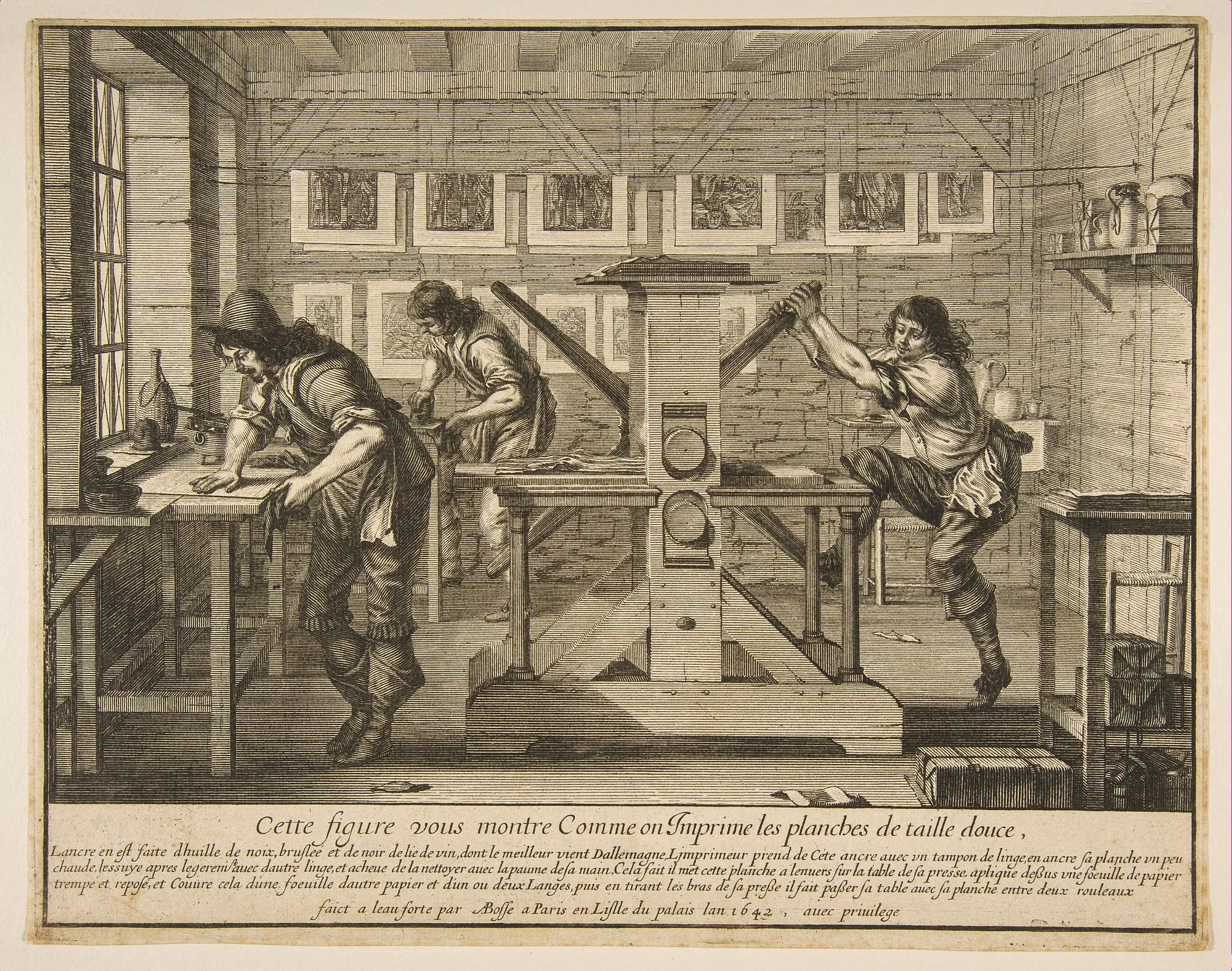
That pressure is what prints the image, and, as the Met describes in its Materials and Techniques series, it leaves two marks worth knowing. It drives the damp paper down into the bitten lines and lifts the ink up out of the metal, so the ink of a finished etching stands very slightly proud of the sheet — held in faint relief rather than lying flat on the surface the way a reproduction’s ink does. And it embosses the outline of the plate’s edges into the paper: the plate-mark, the shallow bevelled rectangle that frames so many intaglio prints. One further consequence follows from plate and paper meeting directly — the image prints in reverse, a mirror of the drawing on the plate. Each sheet is inked, wiped and pulled on its own, and the plate wears a little with every pass, which is why etchings come in numbered editions rather than endless runs — a point we take up under edition numbering.
How can you tell an etching from a reproduction?
An etching carries a few physical signs that a printed reproduction usually cannot, and they are worth learning to read. But the honest answer is that no single visual tell is proof on its own. Some collectors examine a print closely, even under a loupe, and the surface does hold real information; but what matters more is knowing how a print was made and where it came from — and that is what we lean on.
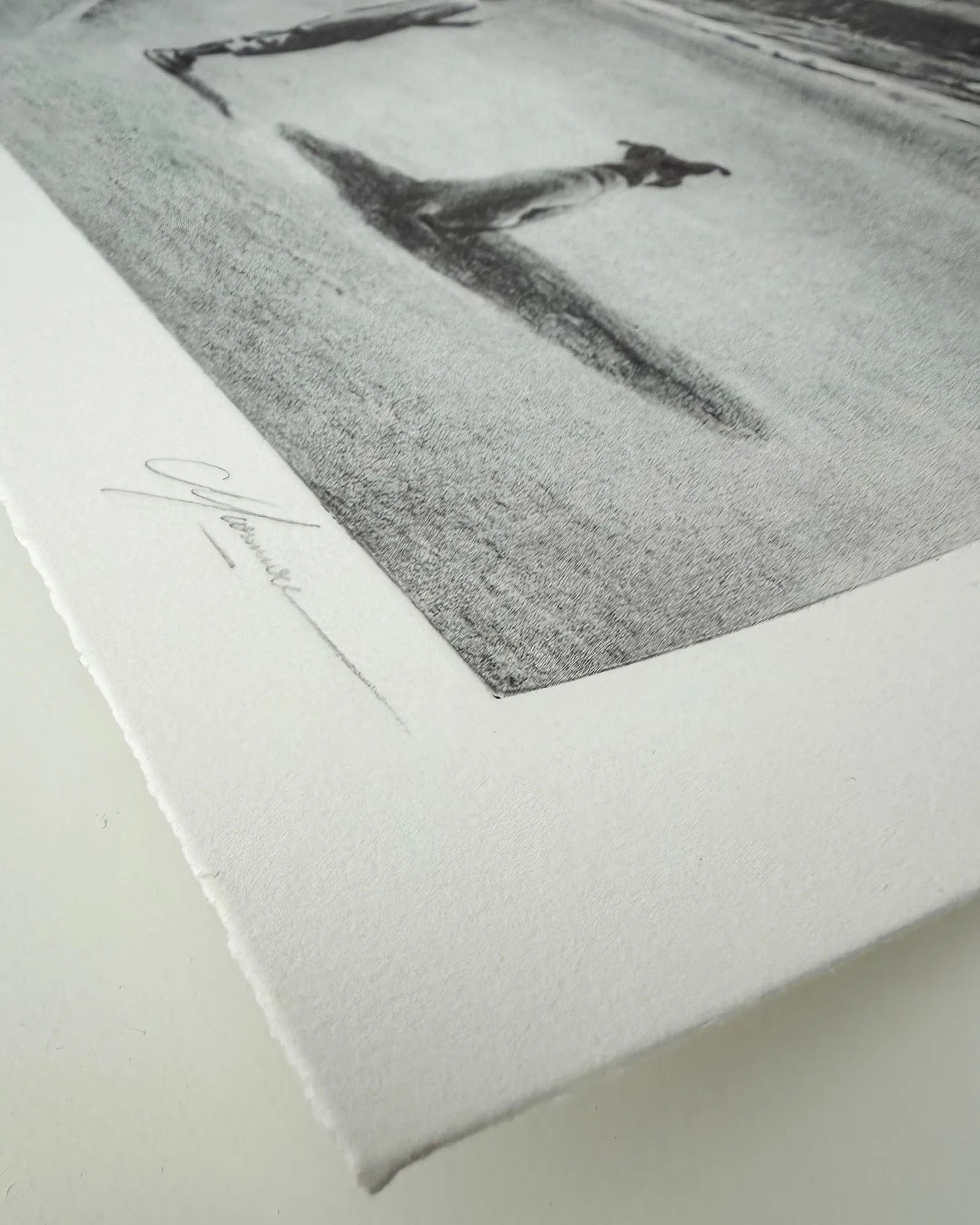
The first sign is the one the press leaves behind: the plate-mark. Because the metal plate has real thickness and meets the paper under great pressure, it embosses the outline of its own edges into the sheet — a shallow bevelled rectangle framing the image that you can both see and feel. It is a byproduct of the intaglio process itself, which is why it belongs to etchings, engravings and aquatints and not to an image printed flat onto a page. It is a strong sign, but not a decisive one on its own: a reproduction can be given a false plate-mark by embossing, so its presence points towards an intaglio print rather than settling the matter.
The second sign is in the ink. Because the damp paper is driven down into the bitten lines and draws the ink back up out of the metal, an etched line sits very slightly raised on the surface of the sheet, and it behaves like a drawn line — swelling, tapering and breaking the way a hand moves, massing into the deep bitten passages and falling away to a hairline. A photomechanical reproduction does something different in kind: it re-photographs a finished image and lays it back down as an even, mechanical pattern, flat against the paper. That difference — a made line set against a reproduced one — is the whole of the original-versus-reproduction question, and we give it an essay of its own in the journal.
So the signs help you read a print; they don’t close the case. What settles it is the print’s own paper trail: the publisher and the blind stamp it embosses into the sheet, the edition size with its pencilled fraction and signature, the paper the impression was pulled on, and — for artists who have one — the catalogue raisonné, the scholarly catalogue of an artist’s complete printed work, in which a documented edition is recorded. Provenance, in other words, before forensics. That is the ground Paper Matters stands on, and it is where the rest of this guide — and our writing on real prints and on reading an edition number — will take you.
Etching, engraving, and the rest of the intaglio family
Etching’s nearest relative is engraving, and the two are confused more often than any other pair in printmaking. The difference is the whole key to the family. An engraver cuts each line directly into the metal with a burin — a lozenge-tipped steel tool pushed through the surface by hand, lifting a fine shaving of metal as it goes. There is no acid and no ground; the line is the furrow the tool leaves. Engraving is the older art, worked since the fifteenth century, and Albrecht Dürer brought the burin line to a control and density that etching, for all its freedom, does not chase. Because the burin is driven by muscle and cannot easily change course, engraved lines have a crisp, tapering exactness. Etched lines, drawn with a light needle through a soft ground and then bitten by acid, run freer — closer to the movement of a pen. That is the working distinction: engraving is cut, etching is bitten.
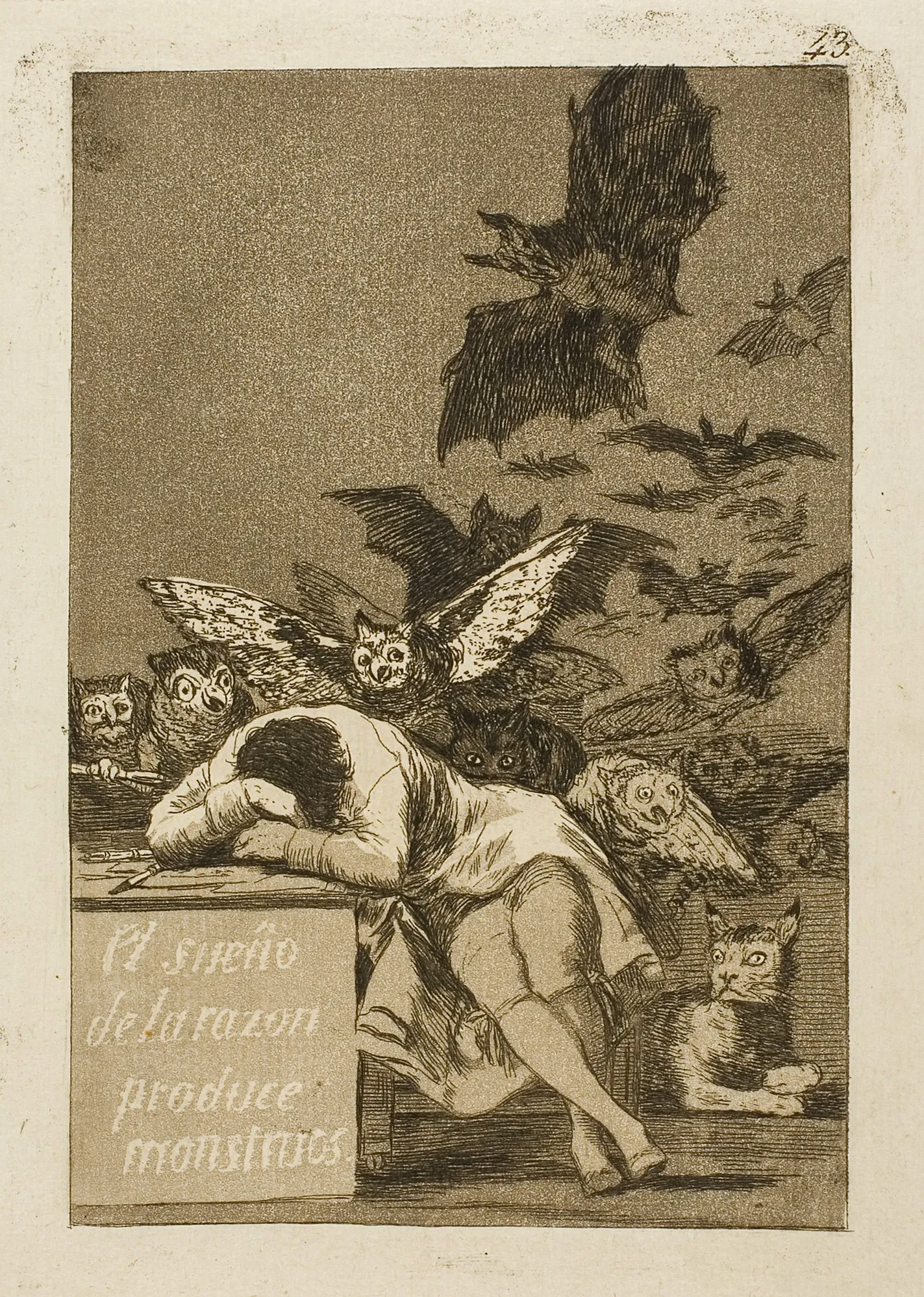
Both belong to the intaglio family, along with three further techniques built on the same foundation — an image sunk below the surface of a metal plate, printed under pressure, framed by a plate-mark — differing only in how the plate is worked. Drypoint scratches the line straight into the bare plate, and the ragged burr of metal it throws up prints a soft, velvety line that wears away fast, keeping its editions among the smallest in printmaking — a mark Rembrandt loved. Aquatint trades line for tone, letting the acid bite around grains of powdered rosin so the plate prints a wash rather than a mark: the technique behind Goya’s Los Caprichos. Mezzotint reverses the logic entirely — the plate is roughened to a solid printable black with a toothed rocker, then burnished back towards light — for velvety tones nothing else can reach; Ludwig von Siegen devised it in the 1640s. It is the one intaglio technique M.C. Escher ever took up — eight mezzotints in a lifetime of some 448 prints.
In practice these rarely stay separate. An etcher lays in an aquatint to shade a passage, or bites a plate and then works back into it with a drypoint needle; Goya’s plates are etching and aquatint together, Rembrandt’s fold in drypoint and engraving. When a print is called an etching, it usually means etching leads — as it does in Murmure’s Cast Shadow, an etching the two artists then finish by hand, one impression at a time. Each of these techniques earns a page of its own here as it is written; together they make up the intaglio side of what Paper Matters collects.
A brief history of etching
Etching did not begin as art. Craftsmen had long used acid to bite decoration into steel — armour, sword blades, cups — and around 1500 Daniel Hopfer, an armour decorator in Augsburg, first turned that craft to printmaking, biting his designs into iron plates and printing them on paper. The appeal was immediate and, for the time, radical: where an engraving demanded years of training with the burin, etching asked only that you could draw. Albrecht Dürer tried it — his dated iron etchings of 1515 are the earliest that survive — before returning to the burin, and the move from hard iron to softer copper, made in Italy, gave the bitten line the suppleness it had wanted all along. The Met told this story in its 2019 survey The Renaissance of Etching: a craft of the armoury becoming, within a few decades, a medium artists could think in.
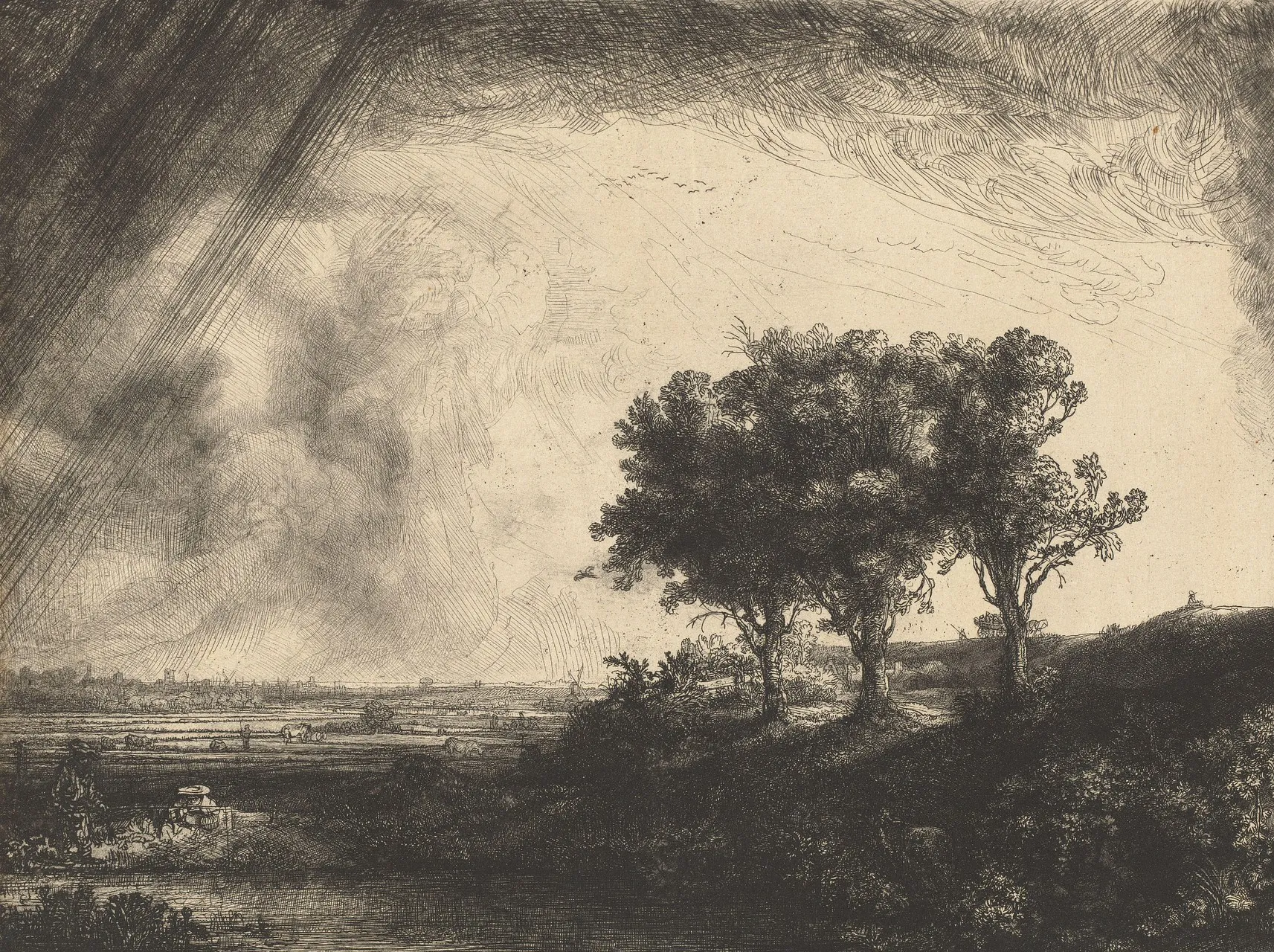
The seventeenth century made it one of the great mediums. In France, Jacques Callot refined a tool called the échoppe that let the etched line swell and taper like an engraver’s, and turned it on the horrors around him — his Grandes Misères de la Guerre of 1633, eighteen small plates, is often called the first anti-war statement in European art. In the Dutch Republic, Rembrandt made the plate a place to think, drawing, wiping, biting and reworking across close to three hundred etchings, pulling proofs at each state as the image changed and reaching for the drypoint needle to darken a passage. Every etcher since has measured themselves against him.
Goya carried the medium into the nineteenth century and gave it a conscience, biting whole fields of tone with aquatint for Los Caprichos (1799) and, later, the Disasters of War. Then, around the middle of that century, the medium turned self-aware: an Etching Revival in France and England — Whistler at its head, Rembrandt its patron saint — set out to reclaim etching as an original art in its own right, expressly against its long use as a way of merely reproducing paintings. That argument — that a hand-made print is its own work and not a copy of one — is the argument this whole site is built on. Etching held its place through the twentieth century in the hands of Picasso and Hockney, and in 1962 Kathan Brown founded Crown Point Press in California to keep intaglio alive among living artists, doing for etching much what the Tamarind workshop did for lithography.
Which is the point worth carrying out of all this. When Murmure bite an image into a zinc plate in 2026 and pull it by hand, they are working a line that runs unbroken back through Crown Point and Whistler and Goya and Rembrandt to an armourer in Augsburg. The materials have moved on — the mordants are gentler now, the presses more refined — but the essential act has not: an image bitten into a metal plate, inked, and pulled by hand onto paper, one impression at a time. Nor has the wager behind it — that a thing made this way is worth more than a thing merely reproduced. Cast Shadow is a small, recent link in a very old chain.
An etching in our collection
The etching we know best is one in our collection. Cast Shadow is a hand-finished etching by Murmure, the French duo, published in 2026 by Graffiti Prints in an edition of fifty; our impression is number 27. It is bitten into a zinc plate rather than the traditional copper, inked in black, and printed on Fabriano Rosaspina, a soft mould-made paper made for intaglio. It is signed and numbered in pencil, carries the publisher’s embossed stamp, and came to us with a certificate of authenticity.
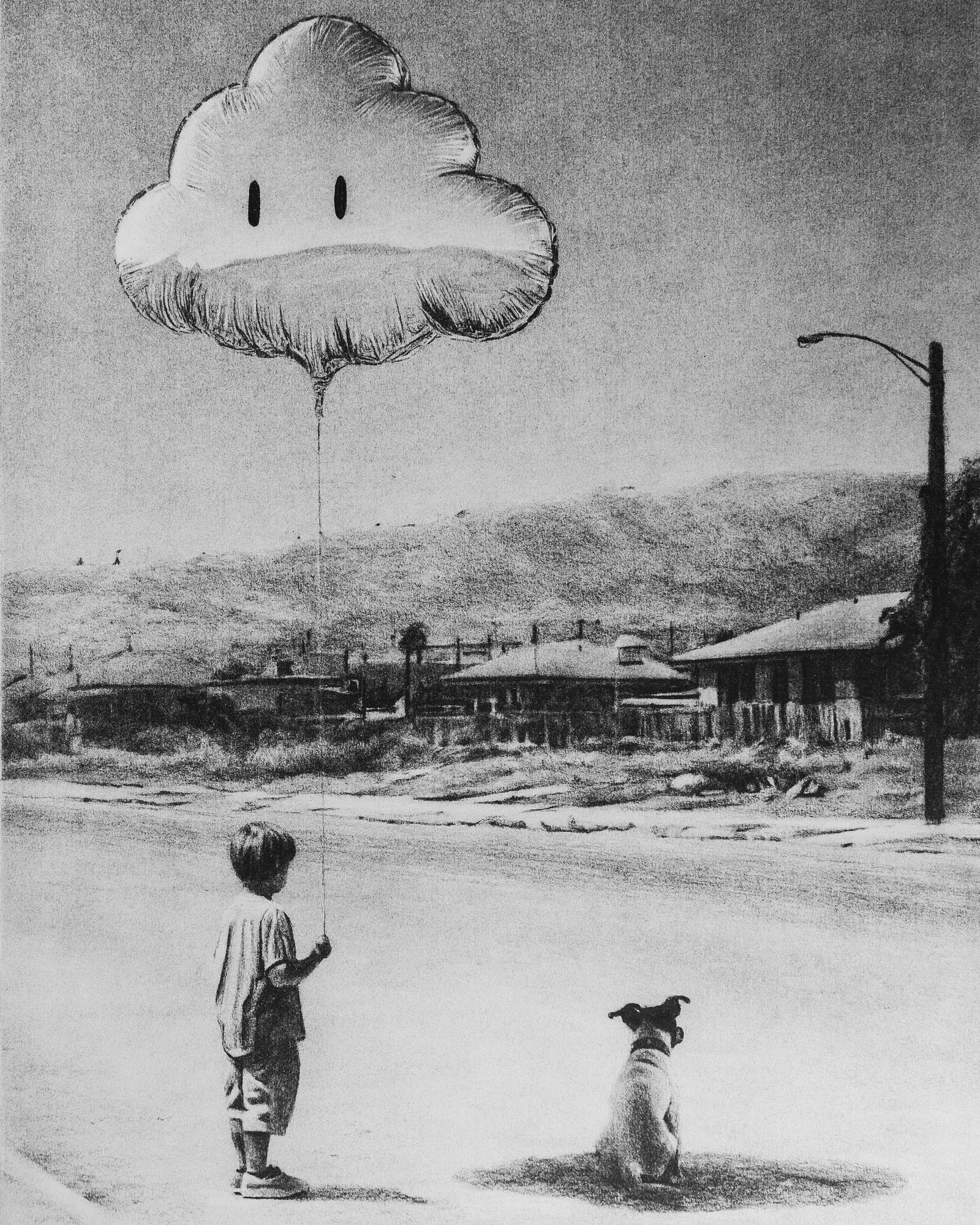
Almost everything this guide has described is present in the sheet. There is the plate-mark, embossed cleanly around the image where the zinc pressed into the damp paper. There is the slight relief of the ink, standing up off the surface where the press drew it out of the bitten lines. And there is the thing that makes Cast Shadow more than a straight edition: after each impression is pulled, the two artists work back into it by hand, so that no two prints in the fifty are quite identical — the sky in particular shifts from one to the next. The plate makes it an edition; the hand makes each one singular. It is the whole argument of our manifesto standing in a single frame — a thing made, not generated.
We can also say exactly where it came from, which is the point we made earlier about provenance. It was published by Graffiti Prints and acquired from them directly, and the edition size, the pencilled 27/50, the signature and the certificate are all part of its record. What that fraction means, and why the pencil signature and the certificate carry the weight they do, is the subject of our guide to reading an edition number. And Murmure’s own story — along with the stone lithograph of theirs we also hold, which takes the same two artists into a different printmaking tradition entirely — is told on their profile.
Where to go from here
Etching is one corner of a much larger family. Engraving, drypoint, aquatint and mezzotint all belong to the same intaglio tradition — ink worked below the surface of a metal plate — but each is a craft of its own, with its own history and its own reasons for being, and we write about each in its turn.
If you have come to etching from another direction, it’s worth seeing how differently the other families make a print: lithography, where the image lies flat and level with the stone; the woodcut, cut in relief so the ink rides the raised surface; and the screenprint, pushed through a fine mesh. From there, two paths lead deeper in. If your interest is in owning and reading prints, our guide to reading an edition number takes up the pencilled fractions, signatures and certificates this pillar has only touched. If it is in the argument underneath all of it — why a print made by hand is a work and not a copy — that is the subject of Real Prints vs Reproductions in the journal. And our own etching, Murmure’s Cast Shadow, has the rest of its story on Murmure’s profile.
FAQs
Is an etching an original print or a reproduction?
An etching is an original print, not a reproduction. The image is worked by hand directly into a metal plate — the matrix — and every impression in the edition is inked and pulled from that plate by hand, which makes each sheet an original. A photomechanical reproduction is different in kind: it re-photographs a finished image and lays it down as a flat, mechanical pattern.
What is the difference between an etching and an engraving?
Both are intaglio techniques, holding ink in lines cut below the surface of a metal plate, but the line is made differently. An engraver cuts each line directly into the metal with a burin; an etcher draws through a soft acid-resistant ground and lets acid bite the lines in. The acid frees the drawing hand, so etched lines tend to run freer, closer to a pen drawing, while engraved lines are more controlled.
What is the plate-mark on an etching?
The plate-mark is the shallow embossed rectangle you can see and feel around the image, left where the edges of the metal plate pressed into the paper under the pressure of the press. It is a characteristic feature of etchings and other intaglio prints — a useful sign of an intaglio process, though not proof on its own, since a reproduction can be given a false plate-mark.
Why are etchings printed in limited editions?
Because the plate wears with use. Each impression is inked, wiped and pulled by hand, and every pass through the press degrades the plate a little — fastest of all with a drypoint burr — so a plate yields only a finite run of good impressions. The edition is numbered to record how many were pulled, and the plate is often cancelled afterwards so no more can be printed.