
TECHNIQUE · GUIDE
Aquatint
How aquatint prints tone instead of line: the resin ground, the many bites behind a single plate, Goya's darkness, and what it means for collectors.
What is aquatint?
Aquatint is an intaglio technique for printing areas of soft, even grey, like a wash of ink or watercolour, rather than drawn lines. Intaglio covers the printmaking methods in which ink sits below the surface of the plate, in recesses cut or eaten into it, and is transferred to paper under pressure. In aquatint, the printmaker fuses a fine dust of resin to a copper plate, then lets acid eat into the bare metal in the gaps between the particles, a process printmakers call biting. What comes back is a field of tiny pits that holds ink as an even tone. The longer the acid works, the deeper the pits and the darker the tone prints.
Engraving, drypoint and etching all make marks. Engraving cuts a line into the plate with a burin, drypoint scratches one with a needle, and etching draws one through a ground, an acid-resistant coating, and lets the acid bite it. Each gives the printmaker a line, and a line is a poor tool for a grey sky. For centuries, engravers and etchers built tone from cross-hatching: parallel lines, then lines crossing them, packed closer where the shadow deepens. From across a room it reads as tone. Up close it is still lines, every one of them drawn.
Aquatint takes the drawing out of the tone. In place of hatching, the fused resin serves as the plate’s ground and lays an even tone across any area left open to the acid. The printmaker decides where a tone goes by covering everything else, and how dark it prints by how long each bite lasts.
It was not the only answer to the problem. Mezzotint reaches tone from the opposite direction: the printmaker roughens the whole plate with a rocker, a curved and toothed steel blade, until it would print solid black, then scrapes and polishes the image back towards the light. Mezzotint is mechanical; aquatint is chemical. One works from dark to light by hand, the other from light to dark with acid, bite by bite.
That distinction is worth keeping in mind whenever you look at a print. The grey in an aquatint is not shading. It is a separately engineered surface, laid down and bitten in its own right, usually many times over, and knowing that changes how you see the print. The plates and prints on this page are by Ian Brooks, a printmaker based outside Haworth, in West Yorkshire, who works almost exclusively in aquatint on copper.
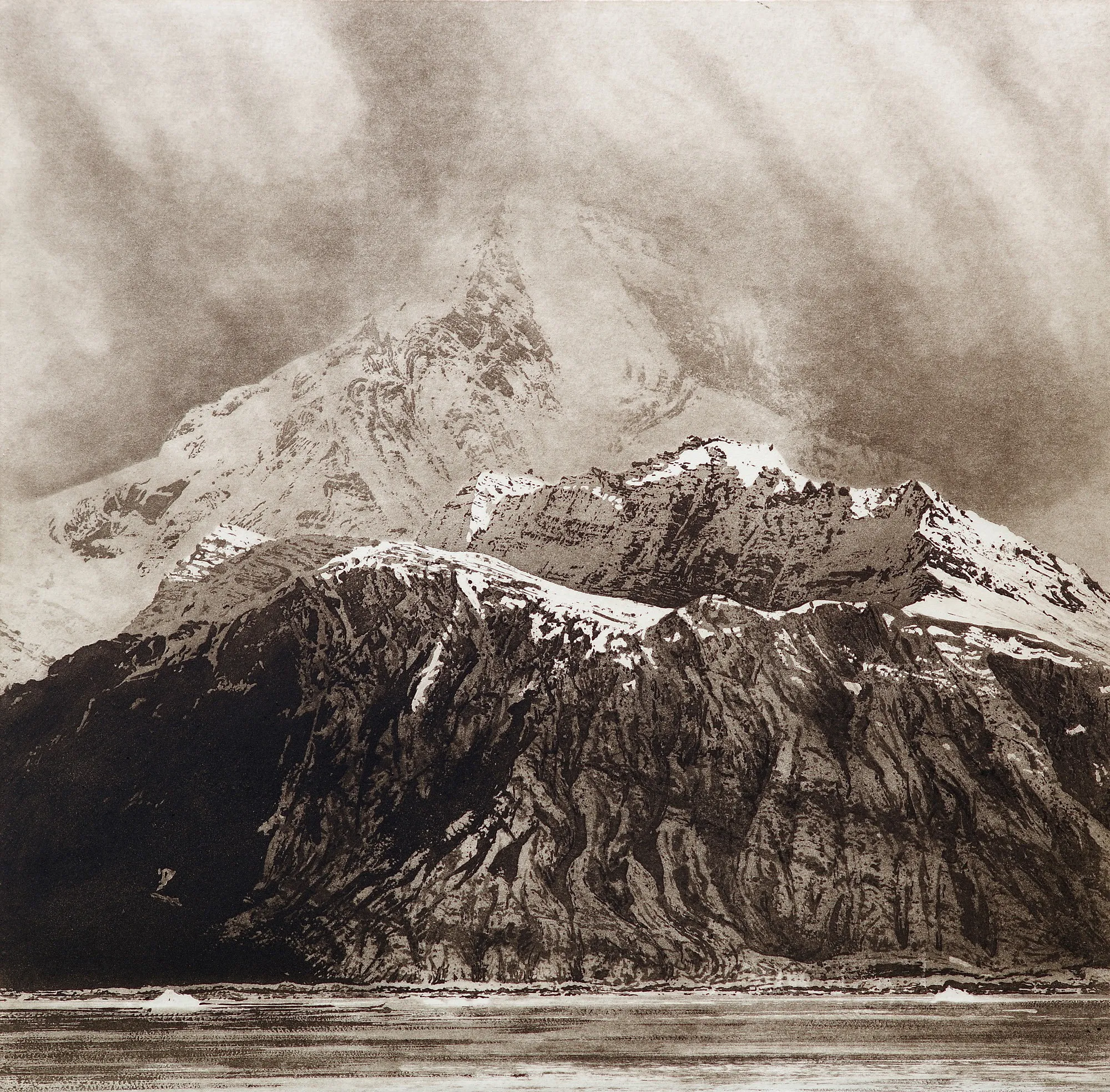
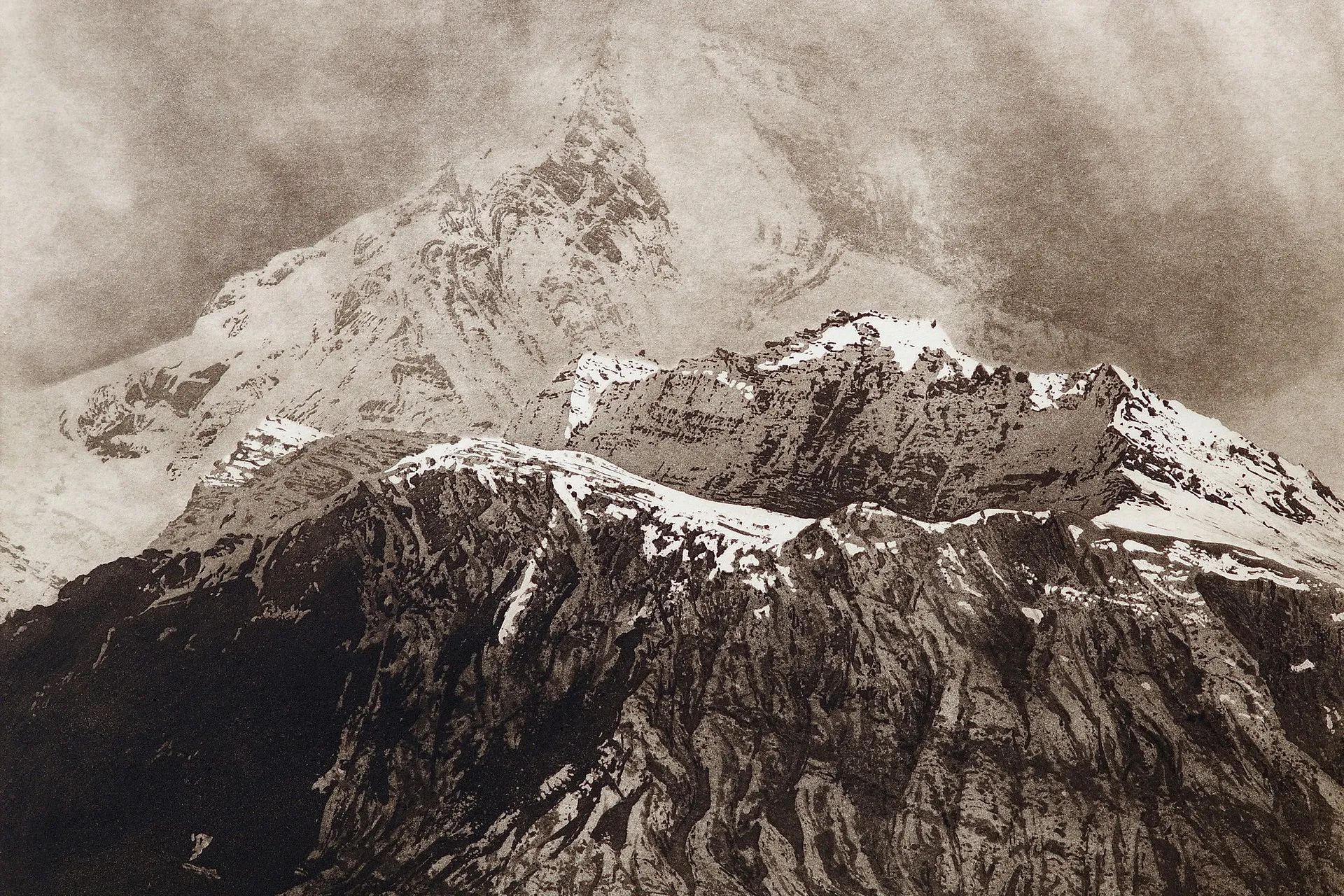
Look at the sky in Henriksen Buttress. There is no line in it anywhere. Every grey, from the pale drift of cloud to the near-black of the mountain’s shadowed flank, is a surface of bitten grain, and the rest of this page is about how that surface gets made.
How is an aquatint ground laid?
An aquatint is only as good as its ground, the layer of resin that decides where the acid can reach the metal and where it cannot. The standard tool for laying it is an aquatint box, a closed cabinet in which a fan or bellows throws resin dust into the air so that it settles over the plate in an even layer. Hand dusting has a long history too: the National Gallery of Victoria suggests Goya may have sifted his resin through a muslin bag, tapping it over the plate.
Ian Brooks works the hand-dusted way, out of necessity. He doesn’t have the space for a proper aquatint box, so he applies what he calls a “hand-shaken” aquatint, using “an old jam jar with a single layer of fine cloth stretched across the top.” He holds the jar four or five centimetres above the plate and releases the dust in small puffs. Starting at one corner, he works back and forth across the plate, overlapping each puff with the last. The room has to be still, since even a gentle draught “will cause most of the resin to drift away”, and he wears a dust mask, which also keeps his own breath from stirring the air.
He makes six complete passes and turns the plate 90 degrees between each, “to even out any bias in the dust application”. The count matters because the target is a proportion. He aims for about half resin and half bare plate once the resin is fused. The acid can only bite where the resin is not, so a ground that covers the plate completely gives it nowhere to work.
Fusing comes next. Loose dust would simply lift away once the acid reached it, so the resin has to be melted onto the plate to stay put. Ian sets the plate on an old wire cake-cooling rack hung from a hook in a ceiling beam and plays a plumber’s blowtorch across its underside, heating it only until the resin melts and no further. As each speck of dust turns liquid, surface tension draws it into a rounded droplet, and these harden into what he calls “tiny beads which bond to the plate surface.” The beads stay separate from one another, with bare copper showing in the gaps, and that scatter of protected and exposed metal is what the acid will work on. Too much heat undoes the work: the resin spreads, the beads merge, and the plate ends up sealed under a thin continuous film. He checks the result with a jeweller’s loupe before any acid goes near it.
Once the ground is fused, its pattern is what the acid records. Each bead protects the copper beneath it, and each gap between beads becomes a pit. Across a bitten area those pits read as fine, even grain, coarser or finer depending on the size of the dust.
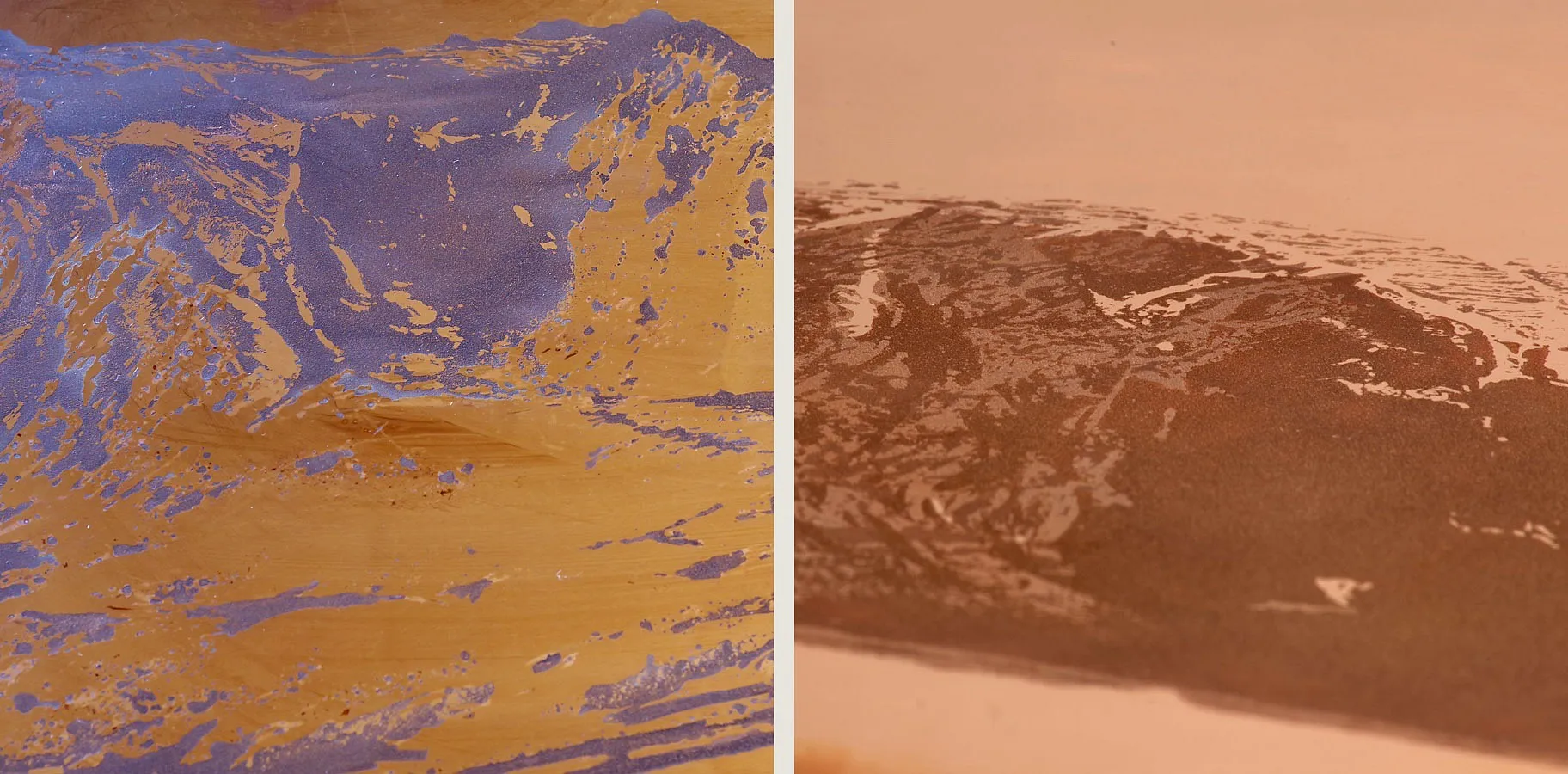
That grain is the grey of the opening section, the tone that replaces cross-hatching, and every bite that follows works through it.
How many times is an aquatint plate bitten?
Most people who know aquatint at all picture a single bite: lay the ground, apply the acid, print. Ian’s plates take far more. Even a simple image usually needs several bites, and a detailed one can take twenty or thirty, each adding a layer of detail or adjusting a tone.
A plate holds many tones because different areas spend different amounts of time in acid. Between bites, the printmaker covers any area that has reached its tone with an acid-resistant varnish, a step called stopping out, and lets the acid keep working on everything still exposed. The areas left open longest print darkest.
The timing is where the skill lies. On Ian’s test plates, the palest tones take less than a minute in the acid and the deepest black as long as fifteen. What makes it hard is that bites do not simply stack. A short bite on a pale tone darkens it predictably, much like a second coat of watercolour over a dry first one. A long bite on a dark tone behaves differently: it starts wearing down the texture the earlier bites made, and can leave the tone weaker than before. So before going back into a dark area, Ian often lays a fresh ground of resin. The new beads land in a different pattern from the old ones, and biting through both gives a finer, smoother tone. Push too far, though, and the acid eats under the beads altogether, and the tone turns coarse.
None of this can be judged from the copper itself. “It is almost impossible to tell what the print will look like from the plate,” Ian says. Every check means printing a proof, a trial impression, which also shows the image the right way round, since the plate prints in reverse. Early on he bites two or three times between proofs. As the plate nears its final state, he proofs after almost every change.
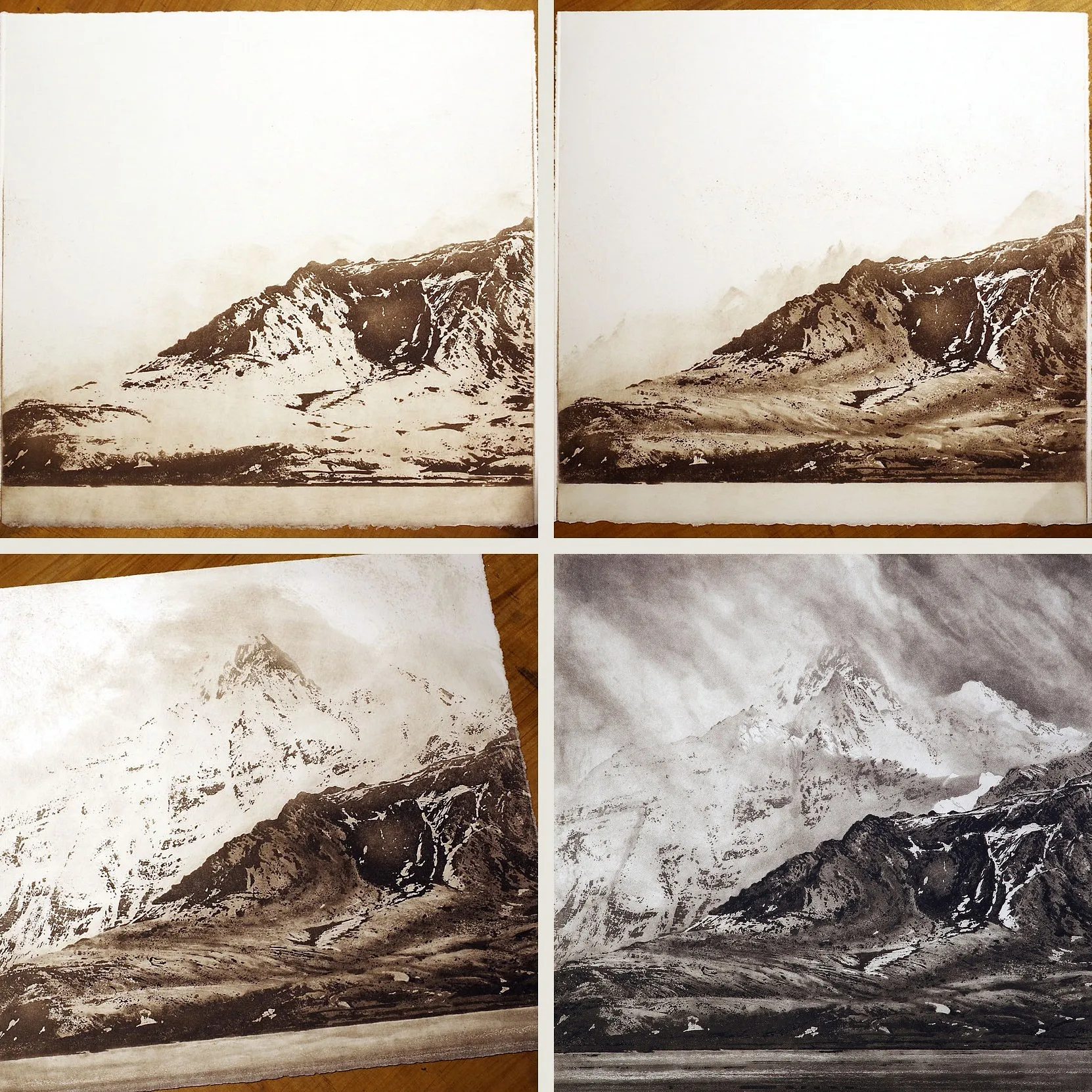
The four proofs of Mount Paget show the sequence. The first bite lays down the near ridges, the second brings in the mountains behind them as haze, and later bites build the peaks until the finished print carries a full, clouded sky.
What are sugar lift and spit bite?
Stopping out works by covering areas up, which suits broad, even tones. Sugar lift and spit bite bring the brush into aquatint, and Ian uses both.
Sugar lift lets the printmaker paint an image straight onto the bare plate. The brushwork is done in a sugary solution, left to dry and then covered, along with the rest of the plate, in an acid-resistant ground. When the plate goes into warm water, the sugar swells and lifts the ground away above it, leaving each brushmark as bare copper. Those marks are then aquatinted and bitten, so they print as tone that still carries the shape of a brushstroke. Ian began Mount Paget this way, drawing the first layer of the image in sugar before any resin went on.
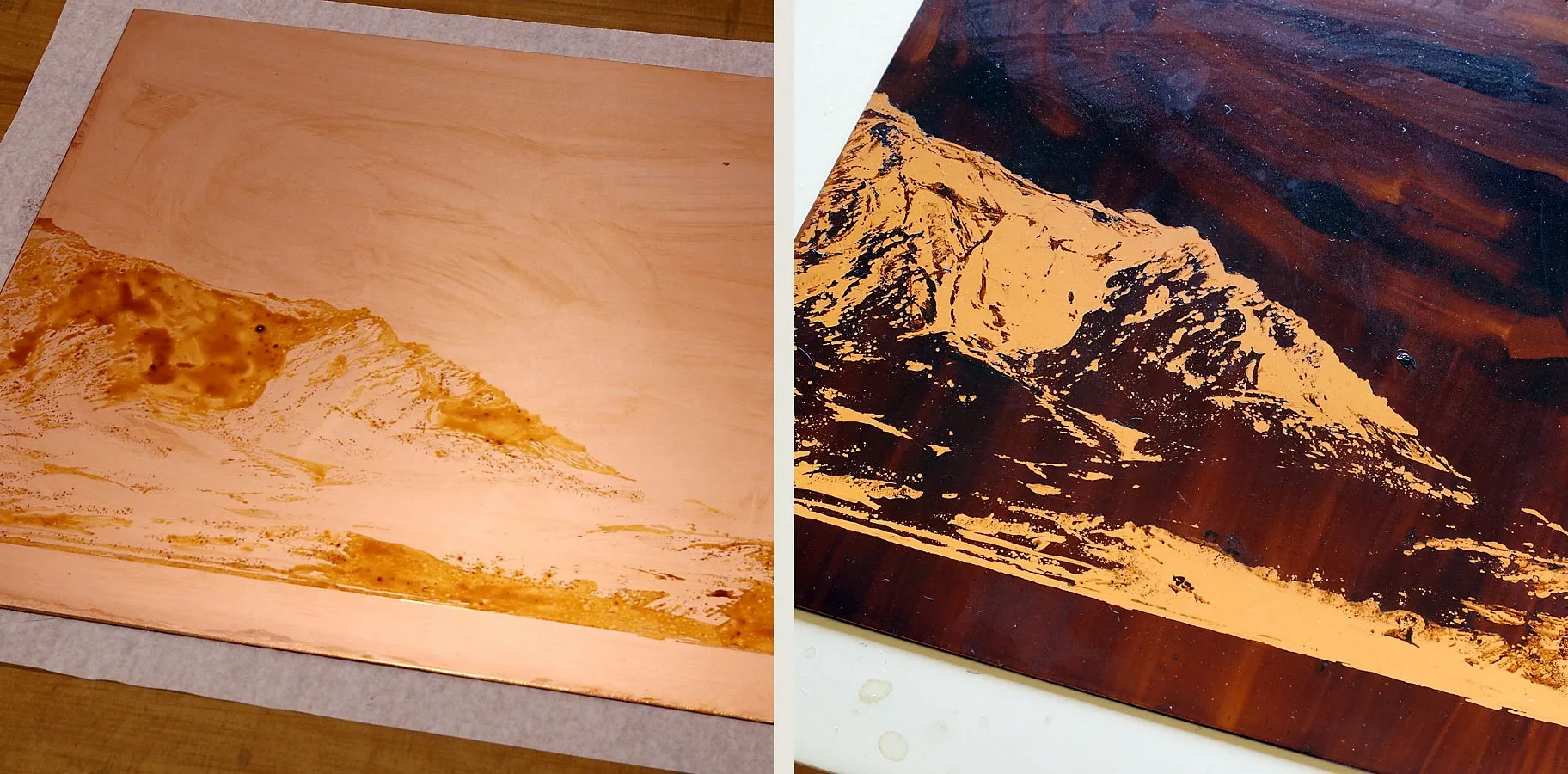
Spit bite changes how the acid goes on. Instead of lowering the plate into a bath, the printmaker brushes acid onto the aquatinted plate exactly where it is wanted, which gives soft edges and gradual transitions a bath cannot. Ian spit-bites everything, using ordinary watercolour brushes. The cost is control over timing. He knows roughly how long a tone needs and keeps an eye on the clock, but the larger the area, the less that estimate holds. Brushing acid across a wide patch for five minutes does not mean any one spot spent five minutes under it: the brush keeps moving, and the acid weakens as it works. The bite usually comes out too light, and pushing harder to compensate risks one that is too dark, which is far harder to fix.
That imbalance shapes the whole process. Darkening a tone only takes another bite, but lightening one means working backwards. On large areas, or smaller ones with soft edges, Ian can open-bite, brushing acid onto bare metal with no resin at all, which lightens the tone; it does not work on small details. Otherwise he scrapes and polishes the copper by hand, much as a mezzotint artist would, a job he admits he hates. He also lets chance in on purpose, applying acid with sponges or scraps of tissue to make textures no brush would.
Where did aquatint come from?
Aquatint is older than its reputation suggests. The Metropolitan Museum of Art credits its invention to Jan van de Velde IV, around 1650 in Amsterdam, the same city where mezzotint was being developed at the same time. Mezzotint caught on almost immediately. Aquatint did not, and for roughly a century it seems to have been forgotten.
It came back in the eighteenth century, when printed recipes for it began to appear. The most popular, published by Jean-Baptiste Le Prince in 1780, offered a way of making prints that looked like wash drawings, which is what the name promises too: aquatint comes from the Italian acqua tinta, “dyed water”. In England, Paul Sandby tried a liquid version, suspending the resin in spirits of wine and brushing it onto the plate. The dry method, resin dusted on and fused with heat, is the one Ian still uses today.
The artist who took aquatint furthest from imitating wash drawings was Francisco de Goya. In 1799 he published Los Caprichos, eighty satirical prints that take aim at superstition, marriage and the Church. The Met catalogues the set as etching, aquatint, drypoint and burin. Goya drew his figures in etched line and, as the National Gallery of Victoria notes, relied on dust-grain aquatint, the same dusted-resin method as Ian’s, as one of his main ways of adding tone around them. On many plates he also polished parts of the bitten aquatint back to bring up lighter tones, which the Met catalogues as burnished aquatint, the same kind of correction Ian still makes by hand. In his hands that tone stops imitating a wash and becomes darkness, the shadow his figures emerge from.
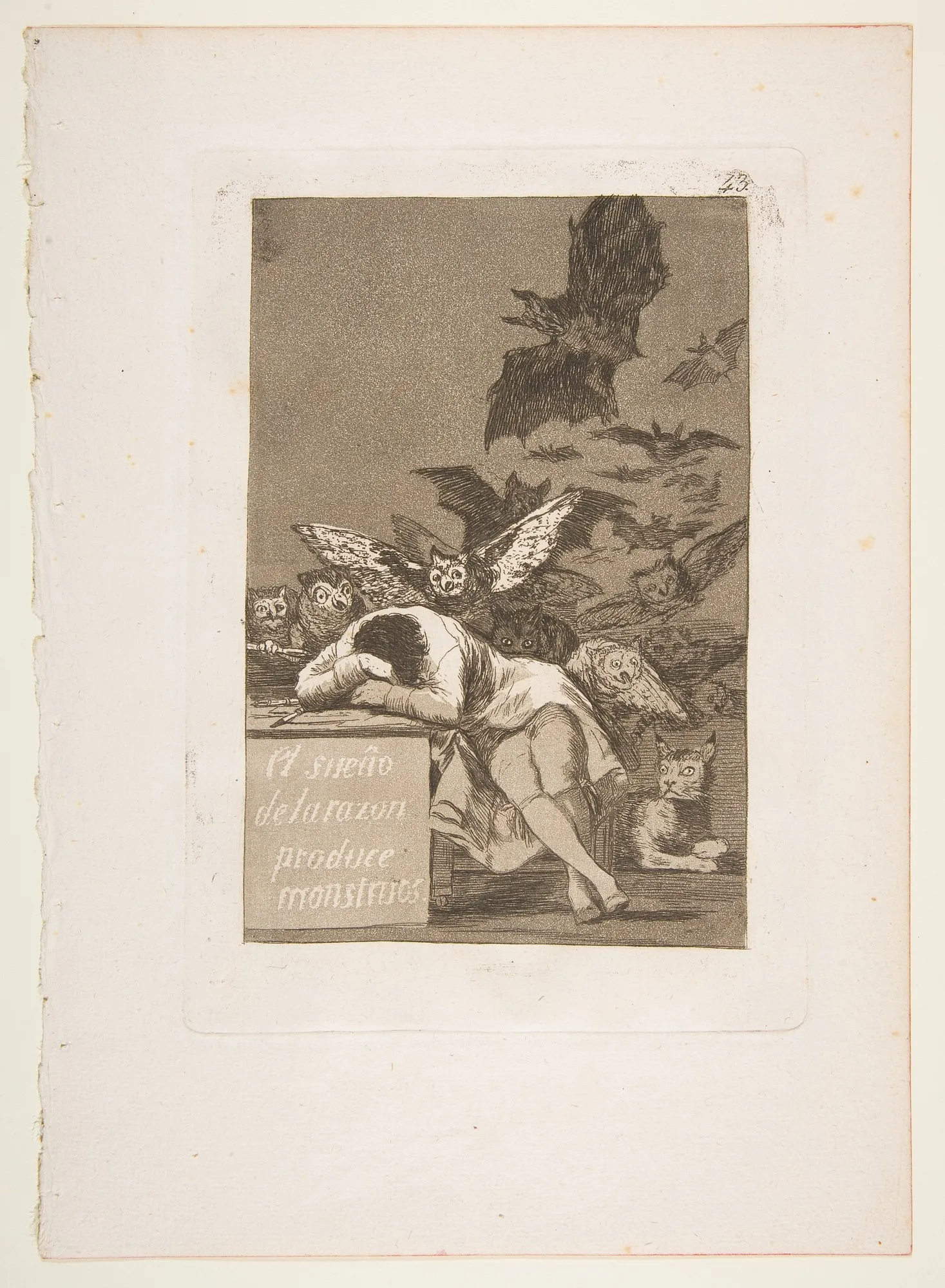
Plate 43, the forty-third of the eighty images, shows it most clearly. Goya first planned it as the title page for a series he meant to call Sueños, “Dreams”. A man sleeps slumped over his desk, and behind him owls and bats rise out of a field of aquatint grey. The etched lines give the creatures their shapes; the tone gives them somewhere to come from.
Why is a finished aquatint the attempt that survived?
The process described so far assumes every bite goes to plan. In practice, few plates go smoothly from start to finish. Ian usually knows what he is aiming for, but the process is too unpredictable to follow a plan exactly, so he responds to the plate as it develops. He describes a pattern he has come to expect: a promising start, then a long middle stretch where everything looks wrong and he is tempted to give up on the plate, then a slow fight back towards what he set out to make.
The late stages slow down. A plate can sit untouched for weeks while he studies its proofs and decides what it needs next, because by then every bite is hard to undo, and one too deep cannot simply be taken back. Deciding when to stop is its own judgement. “I’m rarely really satisfied with the final state,” he says, “but reach a point where I don’t think I can improve it any further.”
Some plates never reach that point. Ian abandons plates that are not working, or that a single bad bite has spoiled, and starts again. Several of the prints he has editioned took two or three attempts, and the plate that finally worked is sometimes a quite different size or shape from the first.
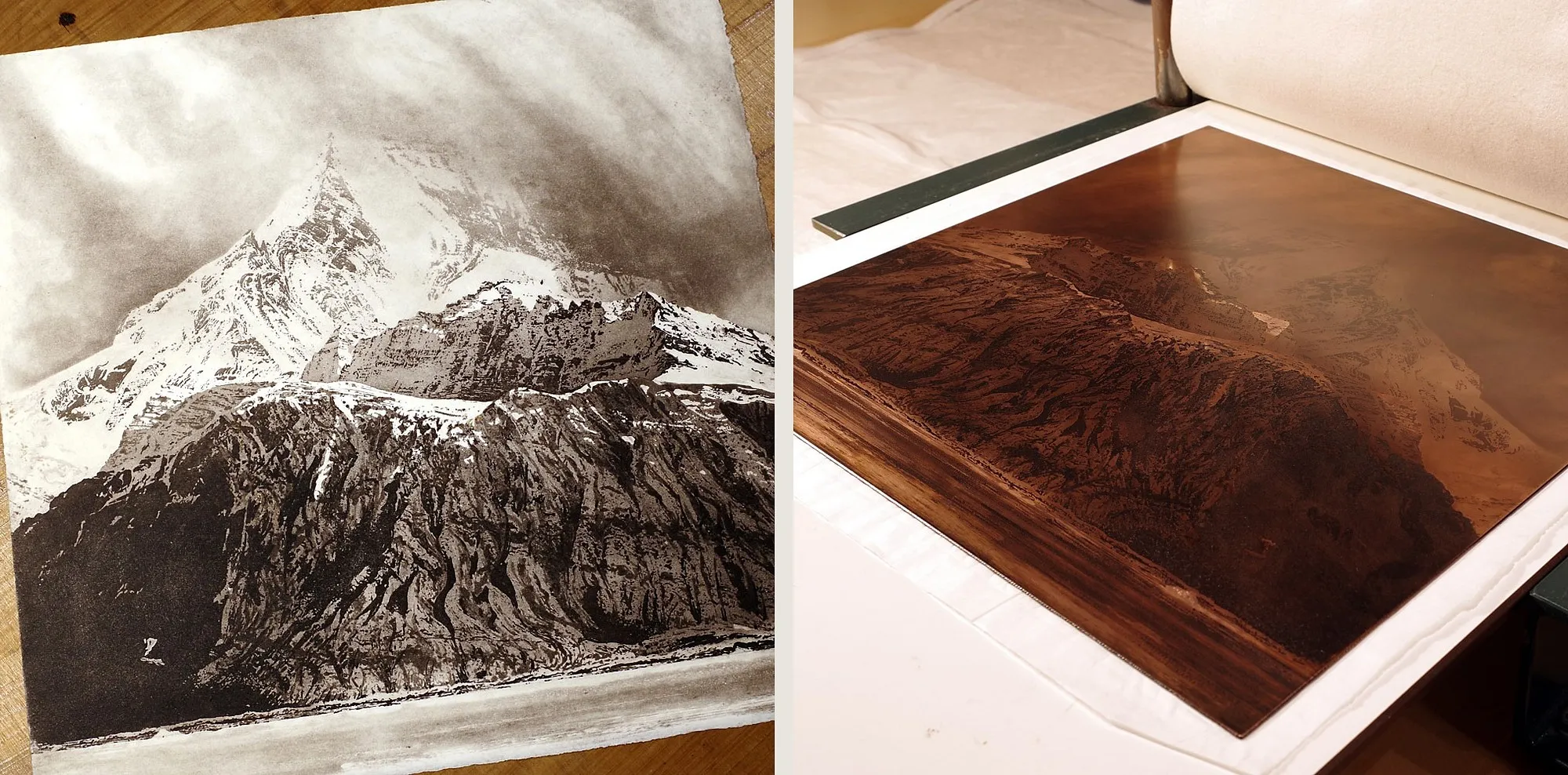
Only the plate that survives all of this is printed as an edition. Ian prints his editions himself, usually fifteen impressions from each plate, and each one is made the same way: the plate inked, its surface wiped clean so the ink stays only in the bitten grain, then run through the press against damp paper, which the pressure forces into the grain to lift the ink out. The edition number in the margin tells a collector which of those impressions they hold. What it does not show is everything behind it: the plates abandoned before this one, the weeks spent deciding, and the bites, sometimes twenty or thirty of them, that built the tone. The print a collector buys is the attempt that survived.
Where does aquatint sit among the other techniques?
Aquatint belongs to the intaglio family, and it makes most sense alongside its relatives. It shares its acid, its copper and its ground with etching, and our guide to how etching bites a line into the plate shows where it started. Mezzotint reaches tone by hand where aquatint reaches it with acid. Drypoint does without acid altogether: a needle scratches straight into the copper, throwing up a ridge of metal that holds ink and prints a soft, velvety line. At the other end, sugar lift and spit bite bring aquatint closest to painting, carrying the brushmark itself into the bitten grain. Across the whole family the copper stays the same; what changes is whether the printmaker draws a line or builds a tone. Aquatint is the technique that builds it.
Ian Brooks’s work can be seen at inkwyrm.com and on Instagram.
FAQs
What is the difference between aquatint and etching?
Both use acid to bite into a metal plate, but they make different marks. Etching produces lines: the printmaker draws through an acid-resistant ground with a needle, and the acid bites only where the needle exposed the metal. Aquatint produces areas of tone: a ground of fused resin dust leaves tiny gaps across the plate, and the acid bites a field of pits between the particles that prints as an even grey. Many prints combine the two, with etched line for drawing and aquatint for shadow.
What is the difference between aquatint and mezzotint?
Both are intaglio techniques for printing tone rather than line, but they get there in opposite ways. Mezzotint is mechanical: the whole plate is roughened with a toothed rocker until it would print solid black, and the image is scraped and polished back towards light. Aquatint is chemical: resin is fused to the plate and acid bites the gaps between the particles, building tone from light to dark, one bite at a time.
How can you tell if a print is an aquatint?
Look closely at the areas of tone. In an aquatint, a magnifying glass shows them as a fine, irregular grain rather than lines or cross-hatching, and darker areas show a denser grain. Because aquatint is an intaglio process, the print will usually also carry a plate mark, the indentation left around the image where the metal plate was pressed into the paper. Many aquatints combine this grain with etched lines.
What are sugar lift and spit bite?
They are two ways of bringing a brush into aquatint. In sugar lift, the printmaker paints the image onto the plate in a sugary solution, covers the plate in ground, then soaks it in warm water so the sugar lifts the ground away and exposes the brushmarks to be aquatinted and bitten. In spit bite, the printmaker brushes acid directly onto an aquatinted plate instead of using an acid bath, which gives soft edges and gradual tones but makes the timing of each bite hard to control.