ARTIST
Murmure
French street-art duo working in etching and stone lithography, with a wider practice in murals, charcoal drawing, screen printing, painting, and bronze.
Murmure is a French duo — Paul Ressencourt and Simon Roché — who have drawn on walls together since 2010. Their signature is a kind of hyperreal tenderness worked in charcoal-grey and black: a child, an animal, a lone figure caught in some quiet, faintly surreal predicament, rendered with the deep pencil blacks the two of them are known for and set loose across the sides of buildings from Paris to Aberdeen. That work is public, and often several storeys tall. The two Murmure works in the collection are its opposite — small, hand-worked prints — yet they carry the same imagery into two of the older techniques in the trade. Cast Shadow (2026) is a hand-finished etching; Precarious Habitat (2026) is a one-colour stone lithograph, pulled at a historic Paris atelier. A street-art duo working in intaglio and stone lithography is not what you would expect, and it is much of why they are here.
Cast Shadow, the etching
Cast Shadow (2026) is a hand-finished etching — an image bitten into a zinc plate and printed in black — in an edition of fifty; our impression is number 27. It is pulled on Fabriano Rosaspina, a soft Italian mould-made paper made for intaglio, and signed and numbered in pencil below the plate-mark, with the publisher’s blind stamp embossed in the sheet and a certificate of authenticity. The image is one of the duo’s quiet surreal scenes — a boy, a dog, and a cloud tethered on a line like a balloon — the deep charcoal register of their street work carried onto a bitten plate.
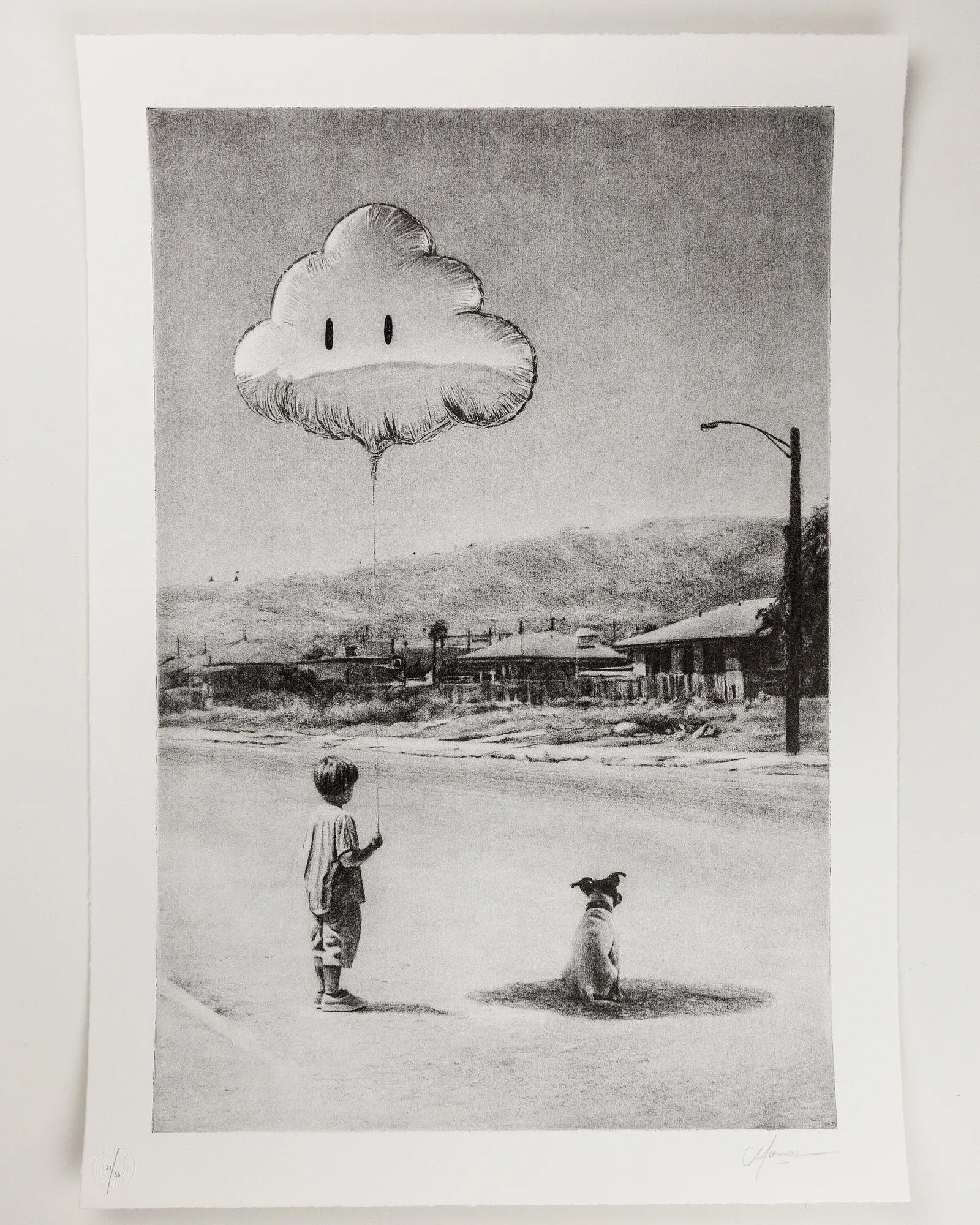
It was published by GraffitiPrints, the British print house that has produced limited editions of street art and urban contemporary work since 2012, working directly with artists across a range of print media — the same house behind Martin Whatson’s Poise, also in the collection. As with much of what GraffitiPrints makes, Cast Shadow is not a straight edition: after each impression is printed, Ressencourt and Roché work back into it by hand, so that no two of the fifty are quite identical — the sky in particular shifts from one sheet to the next. The plate makes the edition; the hand keeps each sheet its own.
Precarious Habitat, the lithograph
Precarious Habitat (2026) is the other of the pair: a one-colour stone lithograph, drawn on the stone and pulled in an edition of fifty, of which ours is number 6. It is a square sheet, 45 × 45 cm, on BFK Rives — a French mould-made cotton paper — with the deckled edges the mould leaves, signed, numbered and dry-stamped by the artists. The image keeps to Murmure’s register: a snail carrying its shell for a house, a small emblem of a precarious home, drawn in the same patient monochrome as the murals.
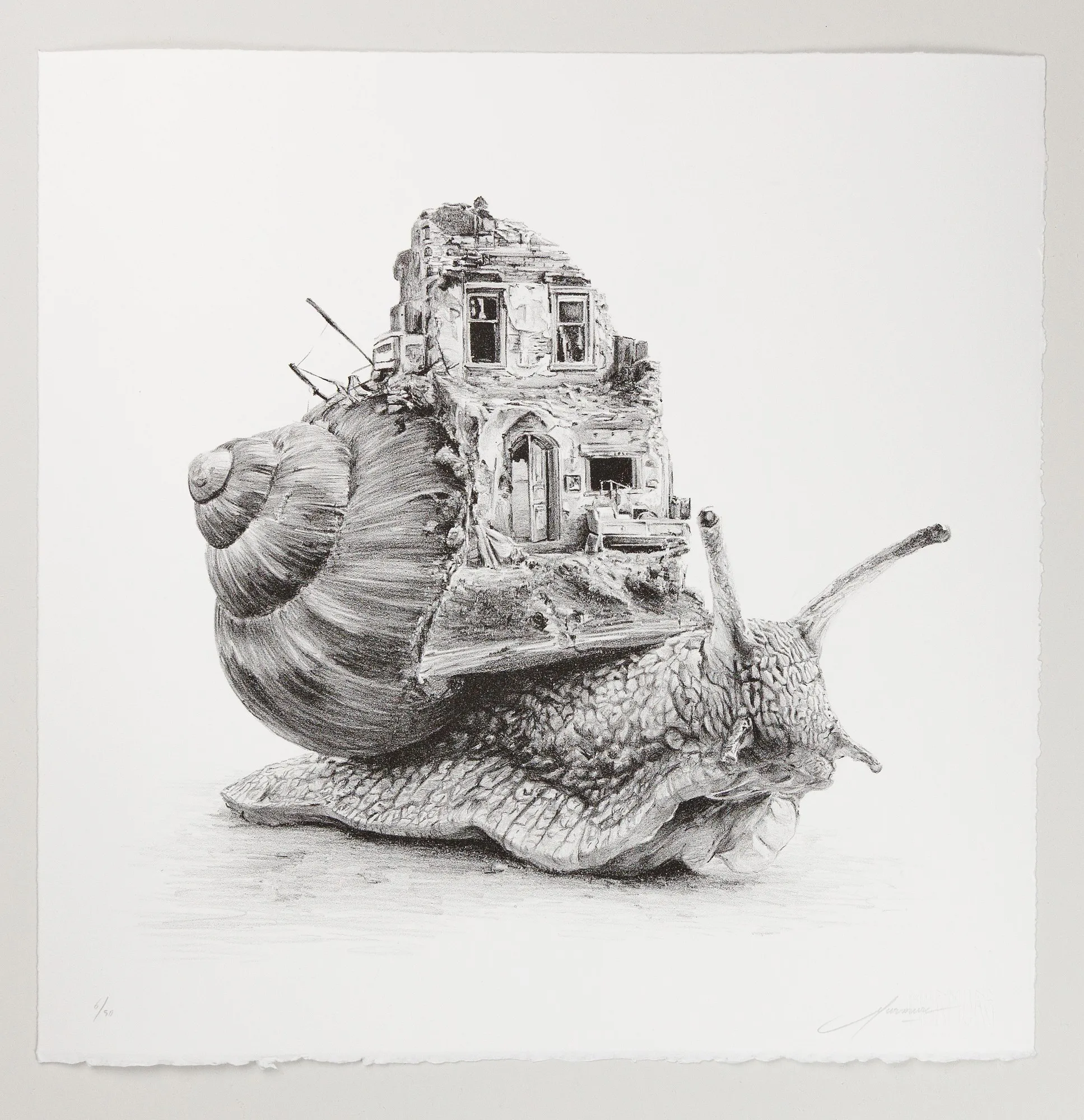
What makes it worth dwelling on is where it was pulled. Precarious Habitat was printed at Atelier Clot in Paris — the oldest lithography workshop in the city, founded in 1896 by Auguste Clot, and the house that did more than any other to make colour lithography an art. Clot was the printer the dealer Ambroise Vollard relied on for his celebrated print albums, and the stones that passed through his workshop carried Cézanne, Renoir, Redon, Munch and Rodin. The atelier is still running, on hand presses of the old kind, from premises in the Marais it has occupied since 1968 — which means Murmure’s 2026 snail was drawn onto stone and pulled by the same house, and by essentially the method, that printed those artists well over a century ago.
So Precarious Habitat carries the duo’s imagery out of the studio and onto a lithographic stone, in a tradition that runs unbroken from the fin de siècle to now. Between the two prints, Murmure reach across two of the oldest techniques in the trade — the bitten metal of intaglio and the drawn stone of lithography — and that reach, more than either print alone, is what brought them into the collection.
Why these works are in the collection
For Paper Matters, the two Murmure prints do something together that neither does alone: they take an art form built on impermanence and make it, twice over, permanent by hand. Murmure’s native medium is the wall — paste-ups and murals that weather, get painted over, and survive mostly as photographs. Cast Shadow and Precarious Habitat are the opposite of that: singular, hand-worked objects, each pulled one impression at a time and made to last. The same imagery that lives briefly on a building is here fixed into a bitten plate and a drawn stone.
They are also fixed at two very different ends of the print world. Cast Shadow comes from GraffitiPrints, a present-day urban-art publisher barely more than a decade old, releasing signed editions of street artists at accessible prices. Precarious Habitat comes from Atelier Clot, the oldest lithography workshop in Paris, pulling stone editions since 1896. That one duo works at both ends — the new, fast, public idiom of street-art editions and the slow, exacting discipline of the Parisian stone — is unusual for any artist, let alone a pair who began on walls, and it is much of why both are here.
What links them, and what the collection cares about, is that both clear the same bar: each is a signed artist’s edition, drawn and pulled by hand — made with the two of them, not merely reproduced from their work. Where the line falls between an artist’s print and a reproduction is the subject of our writing on real prints, and the fuller history of the stone-lithography tradition Atelier Clot belongs to is in our guide to lithography. Murmure spend most of their working life making images that cities erase; these two prints are the same artists making something built to stay.
Murmure’s wider practice
The two prints sit at the edge of a practice that began, and still largely lives, on walls. Murmure is Paul Ressencourt and Simon Roché, who met as students at the École Supérieure d’Arts & Médias in Caen and have worked together since 2010, covering the walls of Paris and cities well beyond it — Aberdeen, Crans-Montana, Fort-de-France — with large, patiently drawn figures in charcoal-grey and black. Their subjects are deliberately weighted: childhood, homelessness, consumer society, technology, and above all the environment and what people are doing to it. The images are hyperreal but tip, at their edges, into the surreal and the poetic — a register the two of them build first in the studio, in dense graphite drawings, before it ever reaches a wall.
That studio has widened over the years. What started as street work has become the centre of gravity: alongside the murals and paste-ups, Murmure work in charcoal drawing and screen printing, and since 2021 in painting on canvas and bronze sculpture, typically circling a single subject through a whole series before moving on. The prints in this collection belong to that studio side of the practice — the same hands, the same monochrome, carried into intaglio and stone lithography.
There is far more of it than two prints can show, and the best place to see the rest is their own: murmurestreet.fr keeps the murals, the studio work, and their current projects all in one place.