TECHNIQUE · GUIDE
Drypoint
How drypoint prints with a burr instead of a cut line: why its impressions change over the course of an edition, what Rembrandt's plates show, and how three working printmakers, drawing on cardboard, copper and plastic today, reach very different edition sizes.
What is drypoint?
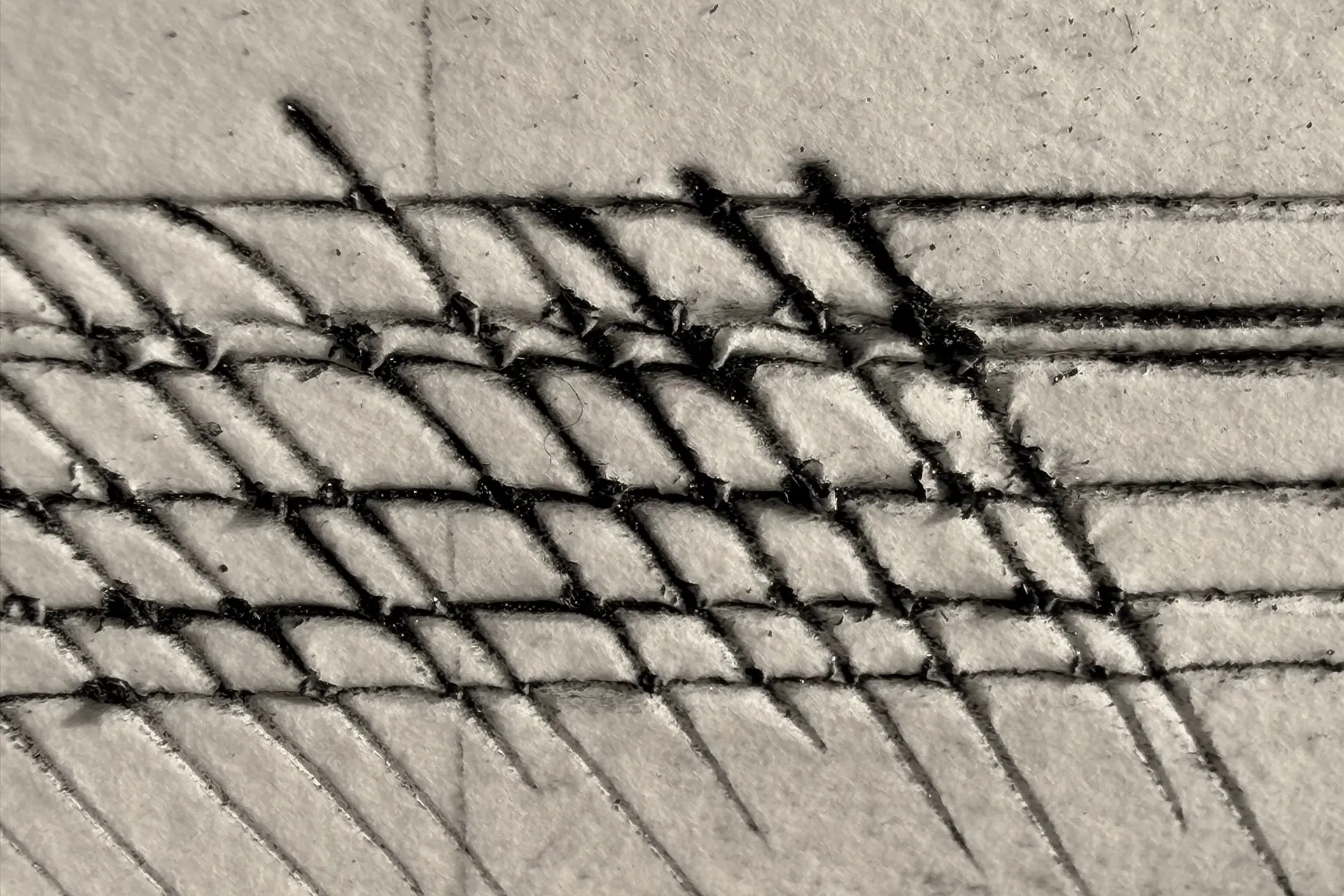
Drypoint is an intaglio printmaking technique, which means the ink that prints sits in lines below the surface of a plate. It is easiest to understand beside engraving, which it closely resembles. An engraver pushes a burin, a wedge-shaped steel tool, through a metal plate. The burin cuts a thin curl of metal clean out of the groove, and any rough edge left beside the line is normally scraped off. A drypoint needle also moves metal out of the line, but it never takes it off the plate. Drawn across the surface much like a pencil, the needle plows its groove by pushing the metal aside, and the displaced metal stays attached, standing up along the edge of the line as a rough ridge called the burr. No acid is used at any stage.
The burr shows its value at the inking. Ink is worked into the lines, then wiped off the surface with a starched cloth and the side of the hand. On an engraved plate, that leaves ink in the grooves alone. On a drypoint, the burr stands above the surface, and its ragged edges hold ink the wiping does not clear. It prints as the soft, dark, slightly furred line the Metropolitan Museum of Art describes as “a rich, velvety black.”
The burr is also fragile. Every pass through the press pushes it a little flatter, and a flatter burr holds less ink. The National Gallery in London puts it in one sentence: “This fragile curl of metal is soon worn away by the printing process.” From the first impression on, the plate is losing the very feature that gives a drypoint line its character.
That makes a sheet’s place in the printing matter more in drypoint than in other intaglio techniques. The Met notes that a well-engraved plate “can produce several hundred impressions, at times even a thousand,” so an edition of 50 uses a small fraction of what the plate can give. A collector takes it on trust that position makes no visible difference, and the number in pencil would not settle the question anyway: as our guide to reading edition numbers explains, it is normally applied after printing and does not reliably record the order in which the sheets came off the plate. A drypoint impression is different. Its lines show how much burr the plate still had when the sheet was printed, so the print itself, not the number, is what tells you roughly where it fell in the run. That does not make the first drypoint impression automatically the best. Two of the printmakers who contributed to this guide describe plates that print harshly at first and settle, and editions in which every sheet differs from the one before. What holds is that an early impression and a late one from the same plate can be different objects.
How far apart they drift depends on the plate and how it is worked and printed. Jenny Robinson, in Sydney, draws onto cardboard, and for her “an edition of 5 is about the maximum, as the lines get flattened quickly by the press.” Curtis Bartone, in Savannah, gets between 5 and 10 good impressions from a large copper plate. Fiona Hamilton, in Bristol, works on plastic and aluminum and gets around 20. A plastic plate outlasting a copper one is less of a paradox than it looks. The sections that follow take the three practices in turn, then set their numbers side by side.
Why does a drypoint change as the edition prints?
Museums hold enough impressions of Rembrandt’s drypoints, from enough points in their printing, to follow the wear across a single plate. He did not invent drypoint: the Städel Museum in Frankfurt dates the drypoints of the anonymous artist known as the Housebook Master to about 1470–1490. But the Met calls Rembrandt “the first artist to fully exploit the potential of drypoint,” and two large plates he made in the 1650s show both what the burr gives and how quickly it goes.
The first, The Three Crosses (1653), shows the wear in the image itself. The Rijksmuseum in Amsterdam, which holds impressions from several of its five states, says Rembrandt “executed the scene entirely in drypoint, which had (almost) never before been done.” Its catalogue line reads drypoint and burin, meaning some lines on the plate were also cut with the engraver’s tool, while the Met catalogues the print as drypoint alone. As the plate went through the press, the burr flattened and held less ink. The Rijksmuseum notes that the image grew lighter as a result, and that Rembrandt added new lines to bring back the darker shadows. In the fourth state he went much further. The Met describes him “scraping away large portions of the original composition,” and the Rijksmuseum says he was “left with a worn copper plate from which good impressions could no longer be pulled,” so he replaced the image with a new version. One plate produced two different prints, and wear is part of the reason.
The second, Christ Presented to the People (1655), shows how many sheets a plate can give while it wears. The Met says Rembrandt “composed this print entirely in drypoint.” The British Museum’s catalogue entry, drawing on Erik Hinterding and colleagues (2000), counts at least 71 impressions pulled across the first five states, and observes that “by the later impressions of the fifth state, little remained of the sumptuous burr.” The Met, writing about drypoint in general, puts the number of good impressions at “no more than a dozen.”
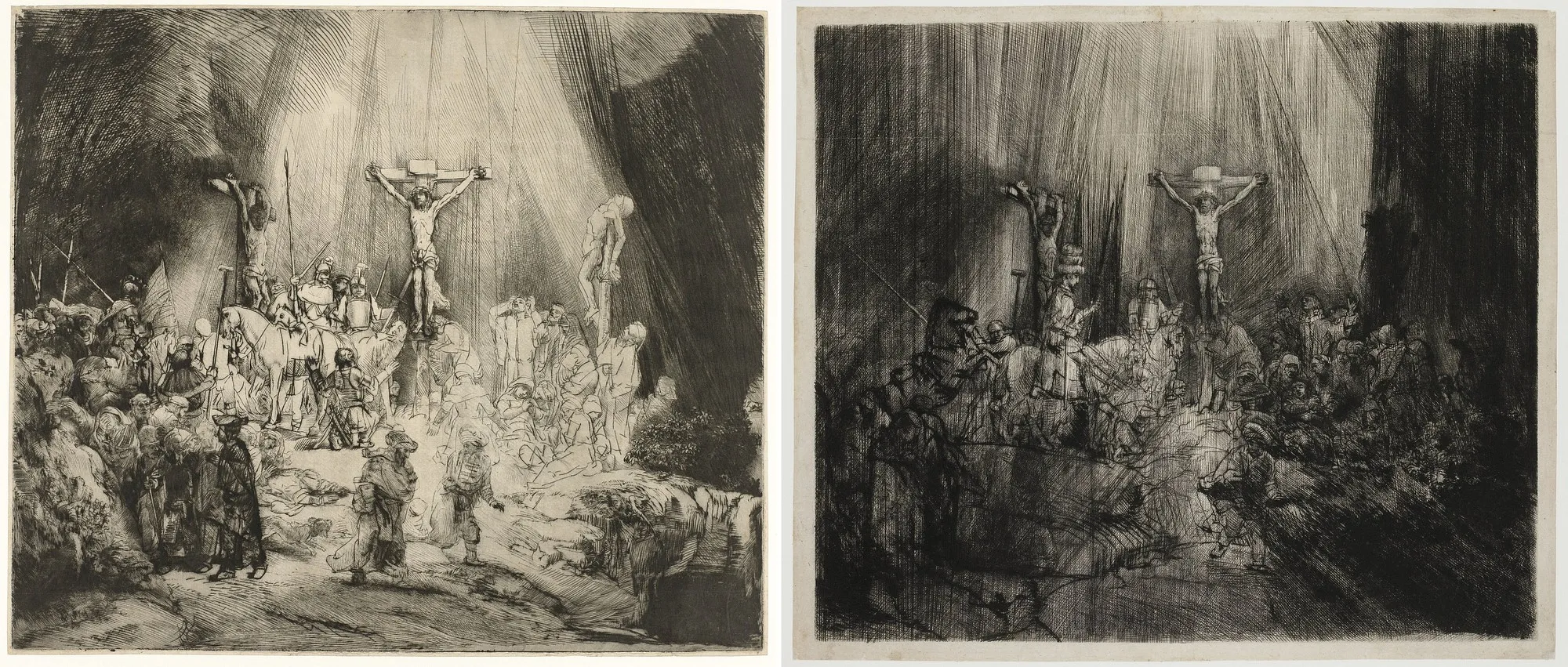
Those two figures do not contradict each other, because they count different things. The 71 is every sheet the plate gave through five states while Rembrandt kept reworking it. The dozen is the number printed while the burr was still at its best. The gap between what a plate can print and what it prints well is where every decision about a drypoint edition gets made, and it is the gap the three printmakers in the following sections work inside.
What happens on a cardboard plate?
Jenny Robinson works at the soft end of the range. British-born, she trained in printmaking at West Surrey College of Art & Design and spent many years in the San Francisco Bay Area, more than a decade of it as an artist in residence at Kala Art Institute in Berkeley, before opening her own print studio in Sydney in 2024. In 2019 the Académie des beaux-arts in Paris awarded her its Prix de Gravure Mario Avati. She makes drypoints on aluminum and plastic as well as cardboard, and finds that each “has a completely different feel and leaves a very different impression from the other.”
Finding the right board takes work. Each time she has moved country, she has had to find new suppliers for it, because the same products are not always available, and that means testing materials all over again. The illustration board she relied on in the United States stopped working when, in her account, its maker switched to cheaper glue and cheaper cotton. In Australia she settled on conservation board, passing over the pricier archival grade, because it is “cotton all the way through” and gives “a beautiful rich line.” She seals it with a couple of thin coats of varnish so the surface is smooth. The tools must be very sharp, a diamond-tipped needle for instance, or the board tears. Sandpaper gives her tone, and loose charcoal rubbed into the lines lets her see what she has drawn.
Her account of the line is where cardboard parts company with metal. On a metal plate, the velvety line comes from the burr. On sealed board, she finds, it comes “as much from the incision into the cardboard which has been sealed as from the burr that is pushed up from it,” because “the ink bleeds into the soft cardboard.” In her experience, then, cardboard reaches the look drypoint is known for partly by another route: the board itself takes up ink, not only the ridge beside the line.
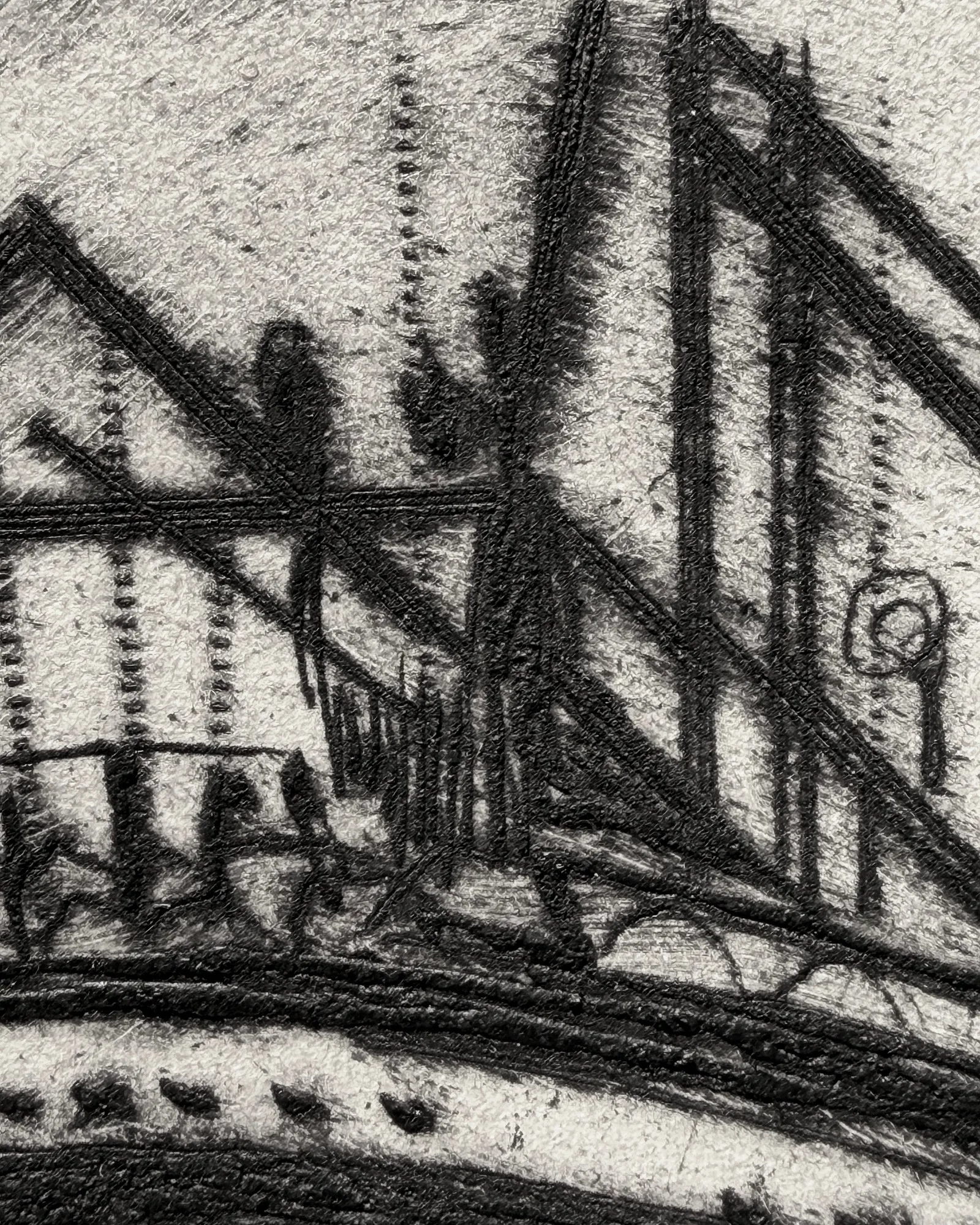
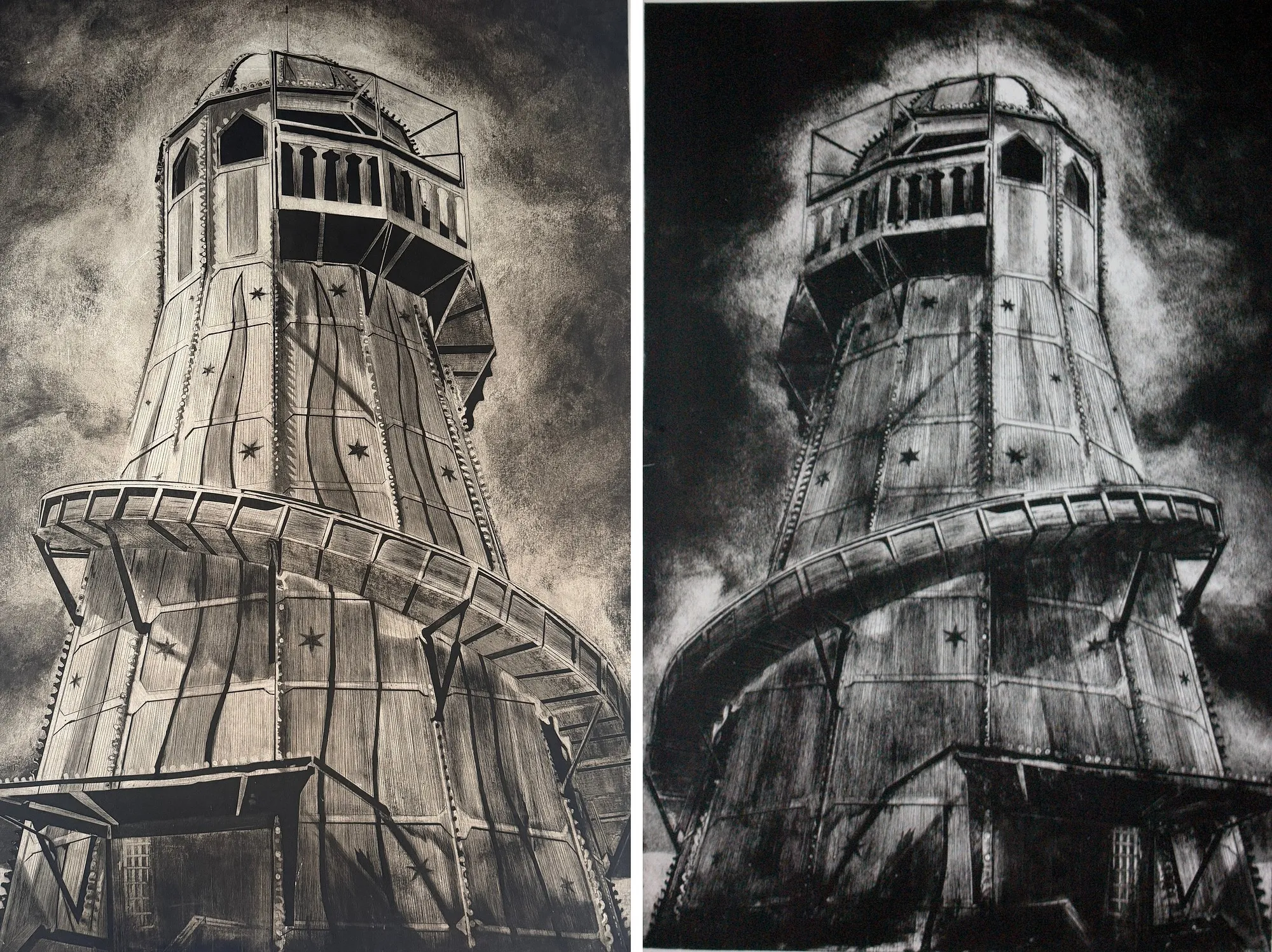
The same softness sets the edition. Her plates flatten “pretty quickly,” she says, which is why she puts the limit at about 5 impressions. Up to the fifth, she changes the wiping each time, leaving more ink in the lines and wiping more softly as they flatten. The museum accounts quoted earlier describe wear as something that happens to a plate. Robinson describes it as something the printer answers at the press, sheet by sheet. She sees the variation that follows as the appeal of cardboard, not a flaw in it. “This is the beauty of it,” she says, and it is what the artists she teaches love about the technique: “each print in that small edition is completely different and varied from the last. So you basically end up with a small, varied edition of unique impressions.”
That phrase tests the definition of an edition. A conventional edition implies a set of matching sheets, and edition numbering is the system for counting them. Her 5 impressions come from one plate, and she expects them to differ; Helter Skelter is issued as an édition variée, the formal term for an edition whose impressions are meant to vary. For a collector, comparing them is not a check on consistency. It is the point of the work.
What does a large copper plate give?
Curtis Bartone works on copper, the traditional metal for drypoint. He teaches printmaking at the Savannah College of Art and Design in Georgia. His current project, the Remnants suite, will be seven prints pulled from a single copper plate measuring 36 by 24 inches. Each print is a state, meaning the image as it stands at one stage of work: between prints he reworks the plate, lightening, changing and removing passages, and each state is printed as an edition of 6. Once Given and Pastoral, both from 2025, are the first two. He is now working on the fifth.
In Remnants, the wear is part of the subject. “Normally the transient and delicate nature of a copperplate drypoint can be frustrating when one makes an edition, as the tones lighten and even disappear as a plate is repeatedly printed,” he writes. “I decided to make this work to my advantage.” A reworked copper plate keeps traces of its earlier layers, and the suite uses those traces to show a landscape being remade, with what was there before still showing through.
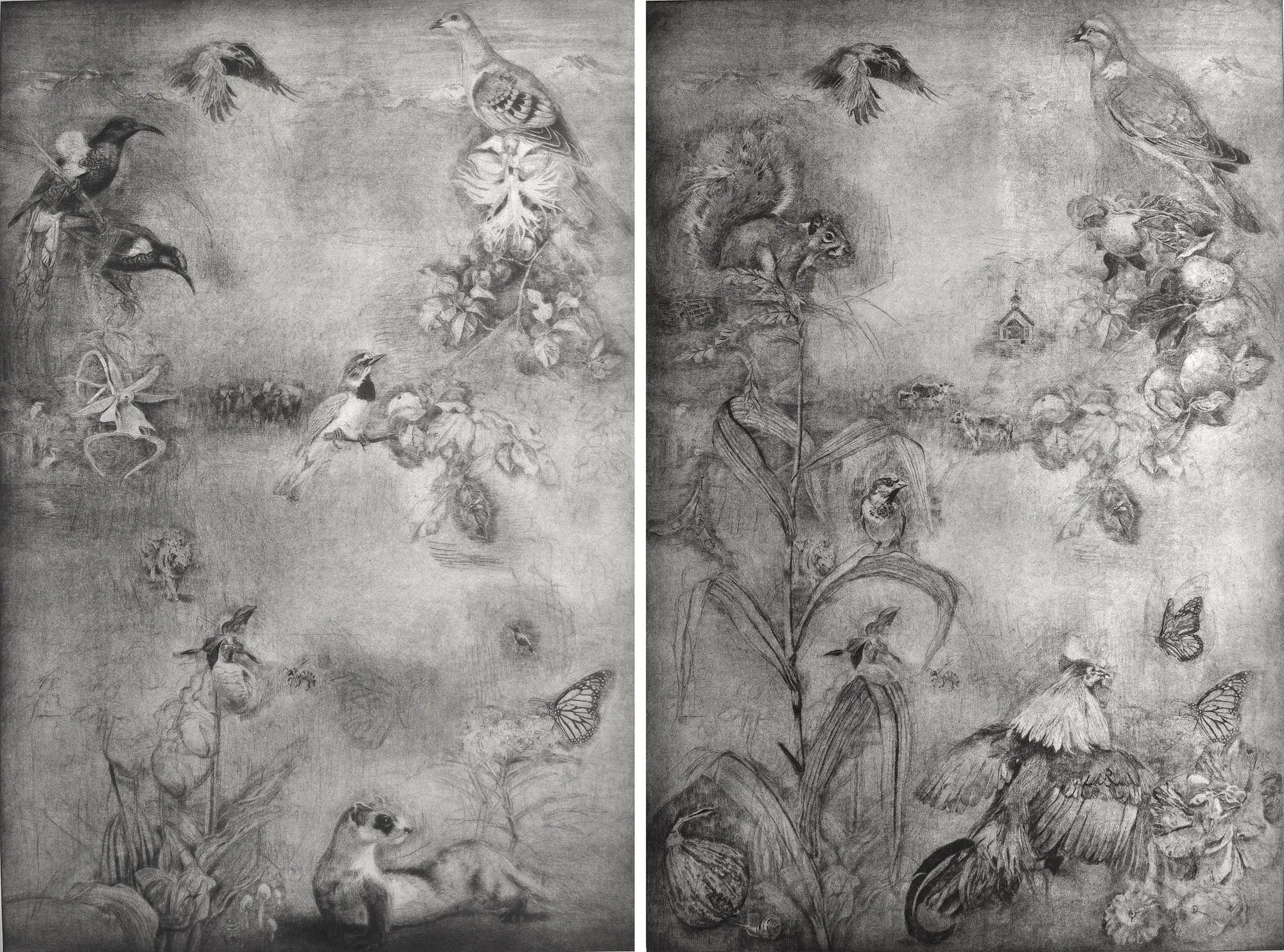
Comparing passages he left untouched from one state to the next, he points to what goes first: “many of the light tones and subtle tonal shifts have dropped out and the richness of the black has diminished.” A later impression looks “salty,” as he puts it, because the worn burr holds less ink and the ink does not sink into the paper as deeply.
Without steel-facing, a protective plating covered later in this guide, a copper plate gives him “between 5 and 10 good impressions.” The first two or three are usually the best, the ones he would frame for exhibition or sale. Not always, though: “sometimes the plate is too harsh at first and it softens after a few printings, so the middle of the edition may have the best impressions.”
Where he lands in that range depends largely on choices he makes. A needle held at a slant raises a weaker burr than one held nearly upright, and the weaker burr breaks down sooner. Deep, layered scribing outlasts delicate tones like the ones he makes with sandpaper, and marks made with a power tool such as a Dremel last much longer than lines drawn by hand. At the press he uses as little pressure as he can get away with, less than he would use for an etching. He prints on Hahnemühle Copperplate or German Etch, because Rives BFK and Somerset Satin, the papers he uses for his etchings, do not pick up all the tones of a drypoint plate. And he uses a stiff, tacky Charbonnel ink, unheated, which takes him 45 to 60 minutes to wipe from a plate this size.

Copper also lets him “lighten, change, and even remove entire areas fairly easily,” which is what makes a suite like Remnants possible. Plexiglass, which some of his students use, gives far less. He finds its burr “brittle,” usually gone “after one or two impressions.” Not every plastic behaves that way, as the next section shows.
Why can a plastic plate outlast copper?
Fiona Hamilton, who makes drypoints in Bristol, gets more good impressions from her plates than Curtis Bartone gets from copper. She holds an MA in Multi-Disciplinary Printmaking from the University of the West of England and works mainly in drypoint, often combined with chine collé: a thin sheet of paper bonded to the heavier printing paper in the press, in the same pass that prints the image. Her plates are not copper. She draws mostly on plastic and aluminum, which she chose as softer materials: drypoint, she says, is “very hard on the hands.” Her plastic is PET-G, a polyester, not the acrylic sold as plexiglass, and the difference matters. Laird Plastics, a plastics distributor, rates PET-G as two to three times more impact-resistant than acrylic, which it calls “notorious for cracking and shattering.” At the press, Hamilton finds that her plastic plates “can take a bit more pressure without losing the burr.”
From either material she gets “around 20 decent impressions plus a couple of proofs,” and she tends to keep her drypoint editions within 20. The two materials last about as long, but they print differently. Aluminum seems to hold the burr better, she says, but needs more blankets and cushioning in the press. PET-G can be polished to a clean white but scratches easily, while aluminum leaves a light film of tone across the plate, and a scratch in it can be burnished out.
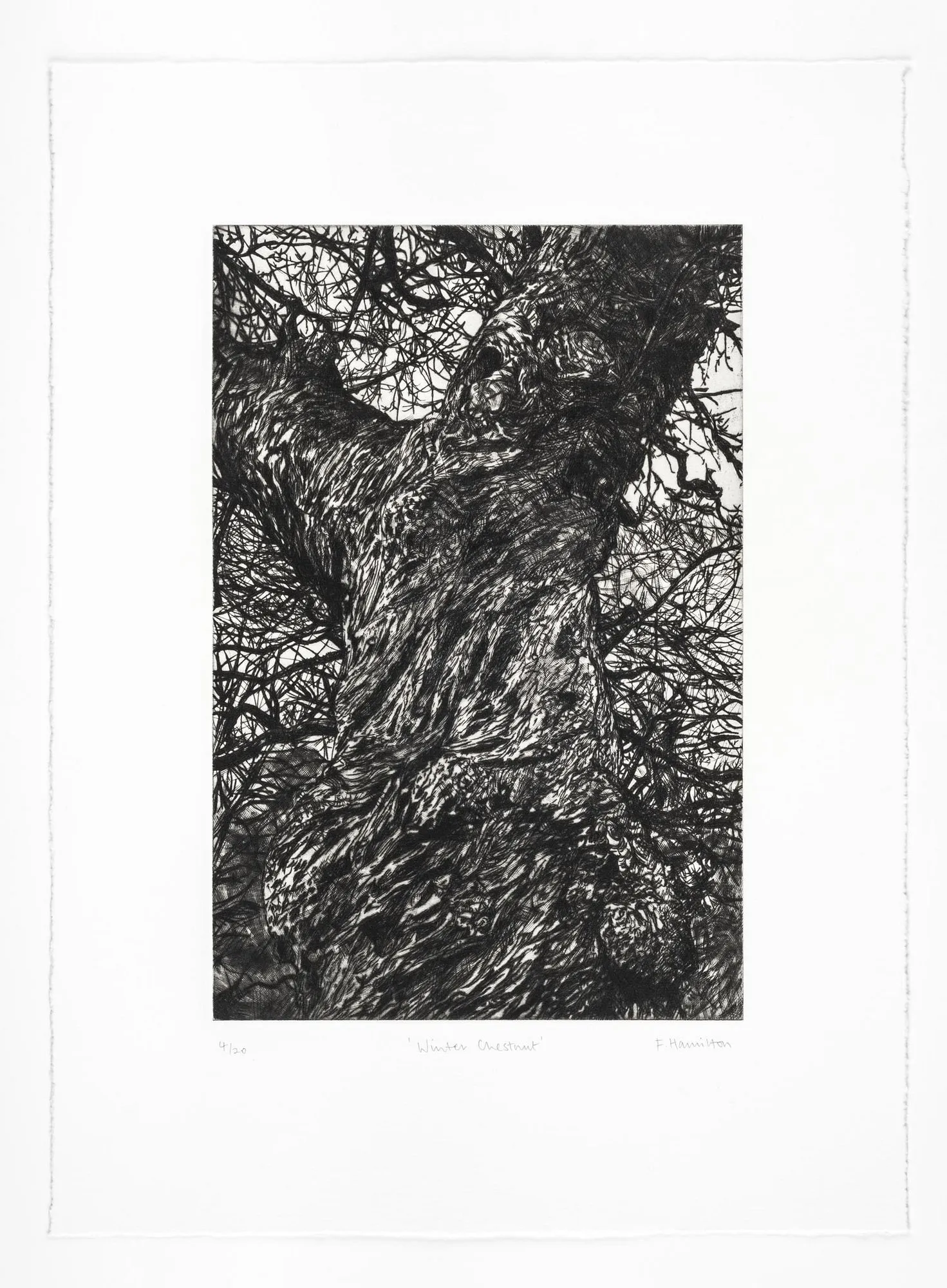
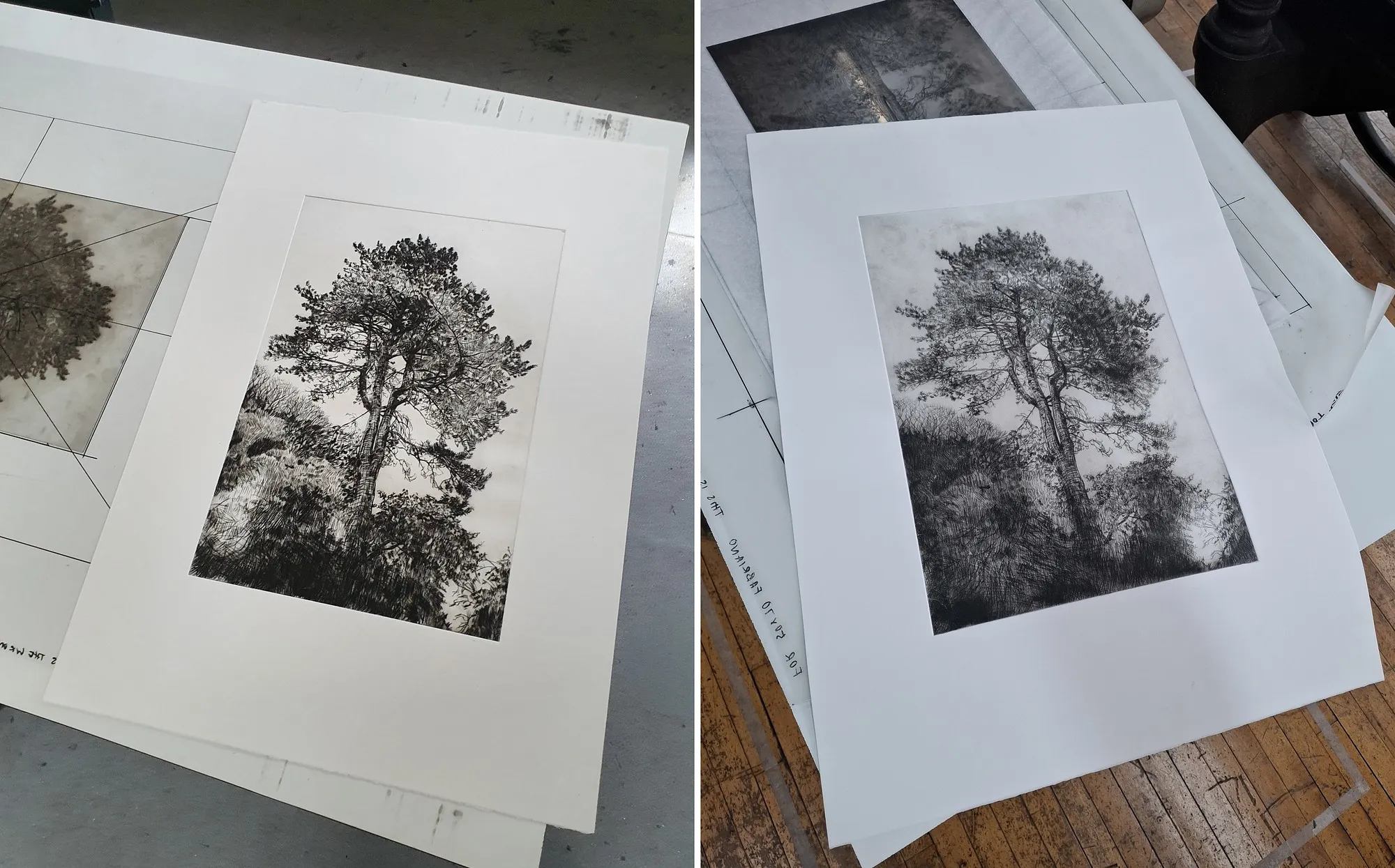
Proofing comes out of the same supply of good impressions as the edition. When she makes a lot of changes to a plate, or proofs heavily, she may cut the edition to 10 or 15. Greville Smyth Pine (2022) is her example. For the chine collé on this plate she tested 10 papers before settling on a 12gsm gampi, a very thin Japanese paper, and she changed the plate for the final edition. The edition became 10.
Her photographs of the first and last impressions show both changes at once. The first was printed on Fabriano Rosaspina alone; the last carries the gampi, and the plate behind it had been worked further. It is not a controlled comparison, and that makes it closer to what a collector meets in practice: two sheets from one plate that differ for more than one reason.
Her choice of plate is not only about how many impressions it gives. Scraping a PET-G plate releases microplastics, so she vacuums and sweeps up the dust and seals it before disposal, and she is gradually moving to aluminum, which she describes as “infinitely recyclable.” Because she finds the two materials last about as long, she can make that move without giving up impressions. The plate, in other words, is one decision among several, made for her hands, her studio and the print. Set beside Jenny Robinson’s cardboard and Curtis Bartone’s copper, her plates complete a range that runs from about 5 good impressions to about 20.
How many good impressions does a drypoint plate give?
Put the figures in this guide side by side and no single answer survives. Robinson puts the limit for cardboard at about 5. Bartone gets 5 to 10 from copper that has not been steel-faced, and finds that plexiglass gives 1 or 2. Hamilton gets around 20 from PET-G or aluminum. The Met, writing about drypoint in general, says “no more than a dozen,” while the print dealer Elizabeth Harvey-Lee puts the figure for an unfaced plate at “from twenty to forty.” None of these is wrong. Each describes a particular plate, worked and printed in a particular way.
The plate material is the most obvious variable, but the accounts above name several others. How the marks are made matters: Bartone finds that a burr raised with the needle held upright outlasts one raised at a slant, and that deep, layered lines outlast delicate sandpaper tones. Then there is the press: how much pressure and cushioning the printer uses, how stiff the ink is, how hard the plate is wiped, and which paper takes the impression. Finally there is proofing, which, as Hamilton’s edition of 10 shows, comes out of the same supply.
One further variable changes the numbers entirely. Steel-facing deposits a thin layer of iron over a finished copper plate. The Grolier Club in New York notes that “by 1858, copper plates could be engraved and then electroplated with a thin coating of iron.” Harvey-Lee ties its introduction to the etching boom, “when larger editions were in demand,” and puts a steel-faced drypoint at “a hundred or so impressions without signs of deterioration,” though she adds that “proofs prior to steel facing are always richer.”
For a collector, this changes the questions to ask of a drypoint. A large edition is not a warning sign in itself, but it calls for an explanation: was the plate steel-faced, or made of a material that holds its burr longer? A small edition may reflect the plate as much as any wish for scarcity. And where you can see more than one impression, compare the darkest passages and the soft edges of the lines, because that is where the wear shows first. Proofs belong in the same count, and our guide to proof marks explains what the marks on them mean.
Where does drypoint sit among the other techniques?
Drypoint belongs to the intaglio family, and its nearest relatives explain it best. Etching reaches a similar freedom of drawing by another route: the artist draws through an acid-resistant ground, and acid bites the lines into clean grooves with no burr standing beside them. Rembrandt worked in both, sometimes on the same plate, and our guide to how etching bites a line is the natural next read. Aquatint uses acid too, to build tone rather than line. The closest match for drypoint’s fragility is mezzotint, where the whole plate is roughened into burr before the image is scraped out of it, and where editions stay small for the same reason. Engraving, the technique this guide began with, has a guide of its own.
Much of what this guide can show comes from three printmakers who shared their plates, their working notes and their numbers with us. Their work is worth seeing in full, and at more than the size of a screen allows. Jenny Robinson’s work can be seen at jennyrobinson.com and on Instagram, and her Sydney print studio has an Instagram of its own. Curtis Bartone’s work can be seen at curtisbartone.com and on Instagram. Fiona Hamilton’s work can be seen at fiona-hamilton.co.uk and on Instagram.
FAQs
What is drypoint?
Drypoint is an intaglio printmaking technique in which the image is drawn directly into a plate with a sharp point, without acid. The needle pushes material aside into a rough ridge called the burr. The burr holds extra ink and prints as a soft, velvety line, but it flattens under the press, so impressions change as an edition is printed.
What is the difference between drypoint and engraving?
An engraver's burin cuts a curl of metal clean out of the groove, and any rough edge is normally scraped away, leaving a crisp line that wears slowly. A drypoint needle pushes the metal aside without removing it, leaving a burr beside the line. The burr gives drypoint its soft line and is also why drypoint plates wear quickly.
How many good impressions does a drypoint plate give?
There is no single figure. The Met puts it at no more than a dozen. Printmakers who contributed to this guide report about 5 from cardboard, 5 to 10 from unfaced copper, and around 20 from PET-G plastic or aluminum. Plate material, how the marks are made, press pressure, ink, wiping and proofing all affect the number. Steel-facing, a thin iron coating, allows larger editions.
Is the first impression of a drypoint always the best?
Not always. Early impressions usually carry the most burr and the richest blacks, but some plates print harshly at first and soften after a few passes, so the best sheets can come from the middle of the edition. What is certain is that early and late impressions from the same plate can look noticeably different.