
Collecting · Guide
Edition numbering
How fine-art prints are editioned and numbered, and what those marks tell a collector — a guide to reading the edition.
In fine-art printmaking, editioning is the practice of pulling a set number of impressions from a single matrix — a plate, stone, block or screen — and recording that number on every sheet. That record is the edition number, and learning to read it is one of the first things that turns looking at prints into collecting them.
This guide walks you through it: what editioning is, why it came about, and what each of the marks on an editioned print is there to tell you. When you want the close reading — how to take a fraction like 24/100 apart, what the proof letters mean, where the inscriptions sit on the sheet — our guide to reading an edition number on a print takes them one at a time.
Why are prints editioned at all?
Because a matrix is built to be used more than once. A copper plate, a lithographic stone, a carved block or a screen holds the image so that many near-identical impressions can be pulled from it, anything from a few dozen to several hundred. Editioning is the decision to fix that number in advance: to declare that a print exists in, say, a hundred impressions and no more, rather than letting the press run on until the image on the matrix wears away.
It was not always done this way. For most of their history, prints were pulled to meet demand, with no fixed number set in advance; the only real ceiling was a physical one, since a plate degrades with use and a drypoint may give only ten or twenty strong impressions before its burr collapses. Fixing that number deliberately is a comparatively modern habit: settling on an edition, a set run of so many impressions and no more, and holding to it. It took hold across the nineteenth and twentieth centuries, as collectors came to value a scarcity they could rely on.
So what makes that number trustworthy, and what stops a printer from simply printing more once the edition has sold out? Often, the matrix itself. In intaglio work (etching, engraving, drypoint) the plate is frequently cancelled once the run is finished: scored through or defaced so it can no longer print cleanly, with a cancellation proof pulled from the ruined plate to put the closure on record. Lithographers do much the same, grinding the image off the stone. Other processes are less ceremonial: a screen is usually just reclaimed or destroyed rather than formally cancelled, and there the closed edition rests instead on the reputation of the artist and publisher behind it, and on the record of the numbering itself. Either way the principle holds: the number is a promise that this many were made and no more are coming. It is what separates a print that belongs to a known, finished set from an image that could be reproduced again and again.
Where edition numbering came from
For most of their history, prints did the work of mass media, not fine art: illustrations, broadsides and, above all, reproductions — engraved copies of celebrated paintings, sold by the hundred to people who would never stand in front of the original. A print was a way of putting a picture into circulation, not a limited object to be collected for its own sake.
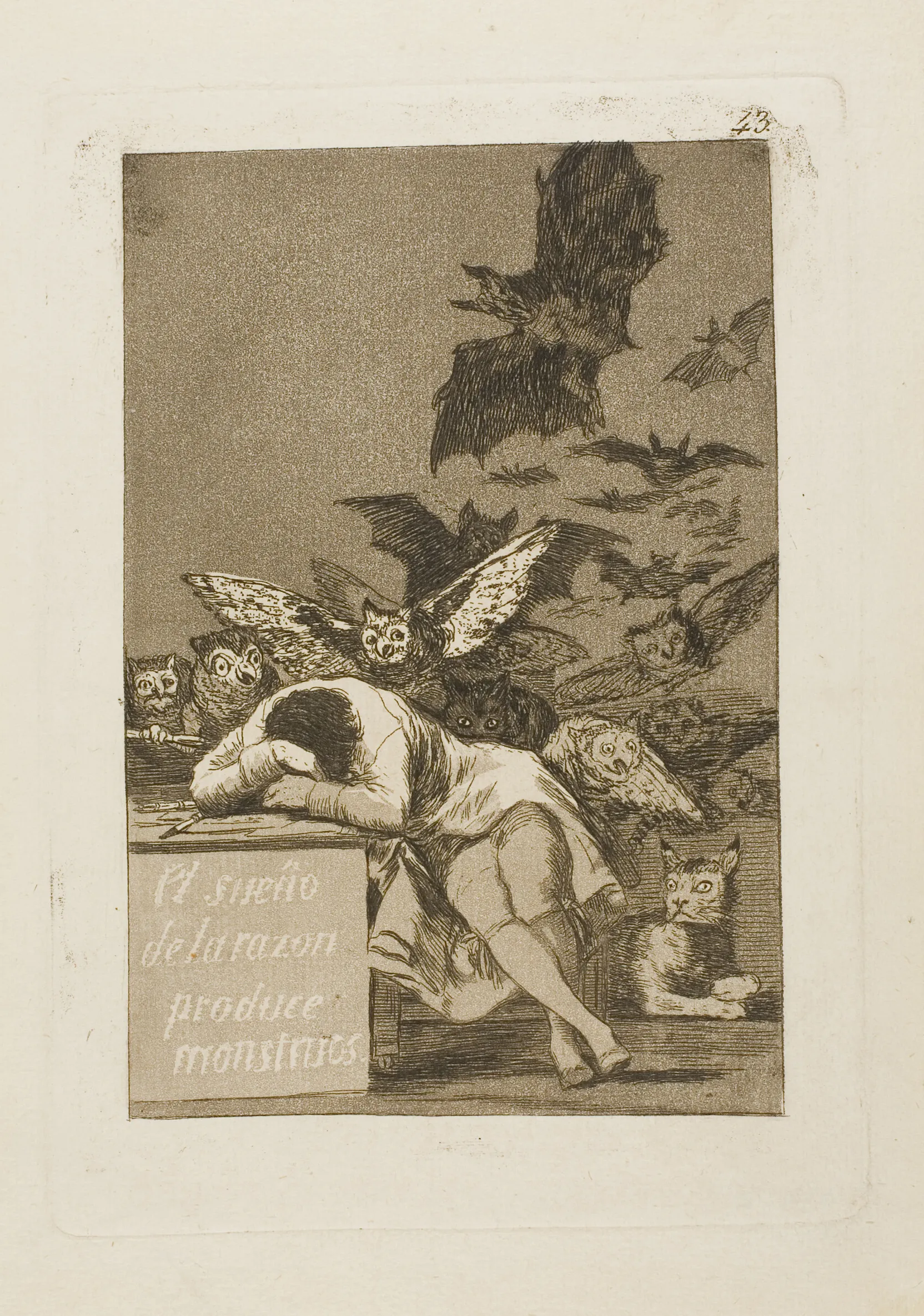
Even an artist publishing his own work did not yet number it. When Goya issued Los Caprichos in 1799 — eighty etchings he had made, proofed and put on sale himself in a Madrid shop, in a run of roughly three hundred sets — he sold them bound as a book, unsigned and unnumbered. The idea of inscribing each sheet with its place in a fixed, closed edition simply had not arrived.
It arrived over the following century, as painter-etchers began to make and sign prints as original works rather than reproductions of something else; the convention of signing and numbering in pencil belongs to that moment. But an original artwork that exists in multiples is an awkward thing for a market to trust, and the conventions only held once institutions stood behind them. In 1961 the Print Council of America, a body of museum curators founded five years earlier under the collector Lessing J. Rosenwald, published What Is an Original Print? — a set of principles written in response to a decade of loosely defined and outright fraudulent “prints.” It drew the distinction the trade still uses: an original print is one the artist conceived as a print, not a reproduction of a work that exists in some other form. The dealers followed, founding the International Fine Print Dealers Association (IFPDA) in 1987 to hold their members to comparable standards. The marks on a print today — signed, numbered, the edition declared and closed — are the working residue of that long effort to make a multiple trustworthy.
What the marks on an editioned print record
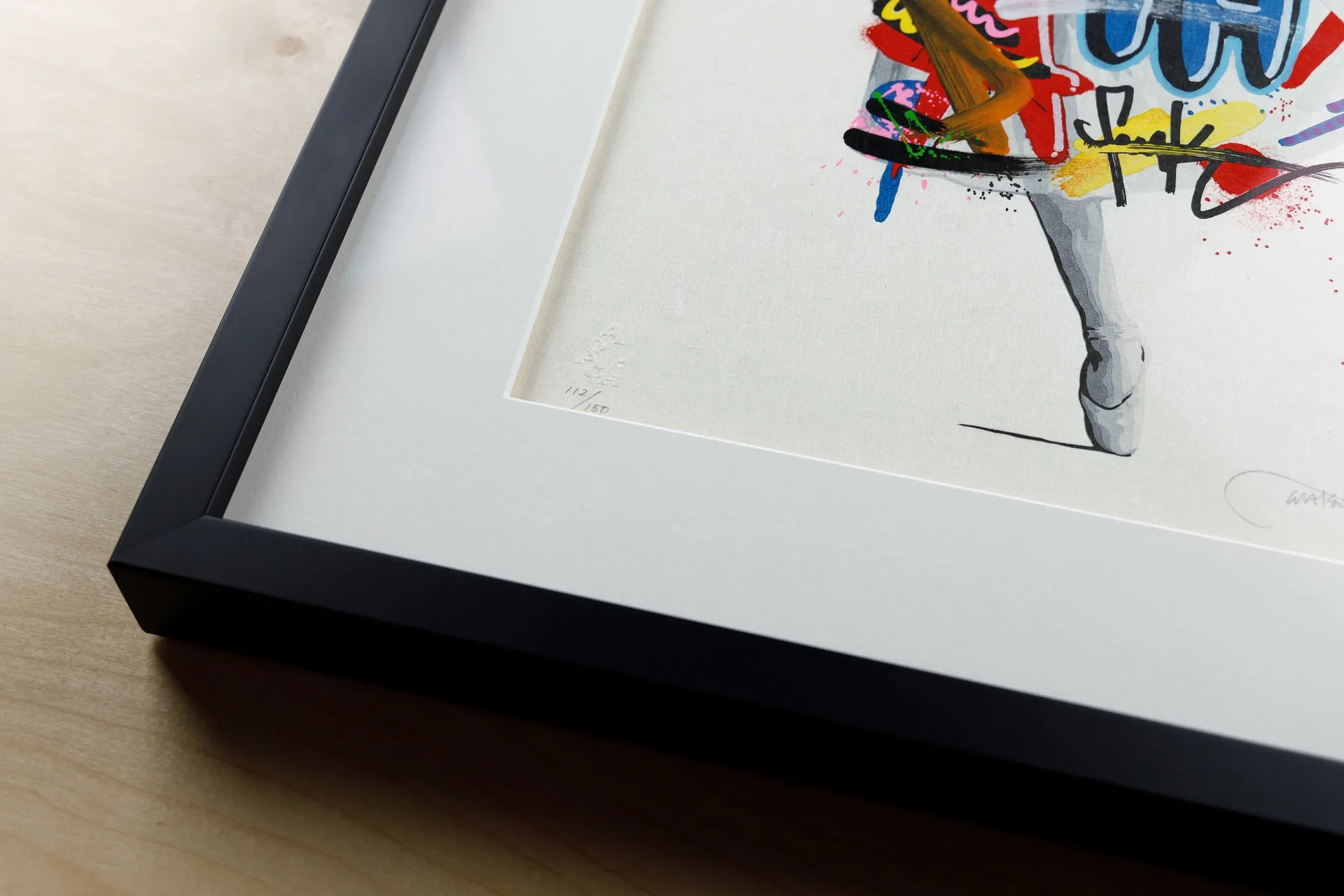
Look along the lower margin of an editioned print and you are reading a small dossier. Each inscription is a separate piece of information, and once you know what each one is for, the margin stops being mere decoration and becomes a record of how the print was made and the edition it belongs to.
The fraction is the edition number: the total number of impressions in the edition, and the individual number given to this one. It is the mark most people notice first, and the one most often misread; how to take it apart, along with the proof letters that sometimes appear in its place, is the work of the reading guide, so we will not repeat it here.
The signature is really two different marks wearing the same name. A signature drawn into the matrix itself prints with the image on every sheet, identical from one impression to the next — common on older prints and on reproductions. A signature added in pencil, by hand, after the sheet is printed is something else: the artist’s mark on that one impression, made individually. The shift toward hand-signing, which took hold in the later nineteenth century, is much of why a pencil signature counts for more today than one printed into the image itself.
Then there are the marks that have nothing to do with the artist. A chop, or blindstamp, is a small symbol pressed into the paper, often without ink and sometimes stamped on the back, that identifies the workshop or printer who pulled the edition rather than the artist who made it. The Tamarind Institute embosses an alchemist’s symbol for stone on its lithographs; Gemini G.E.L. places its chop beside the artist’s signature with a copyright mark. Not every print has one, since an artist printing alone may use none, but where a chop appears it tells you whose press the sheet came off — a small piece of provenance in itself. A publisher’s mark, where it appears, does the same for whoever financed and released the edition.
Taken together, these marks are a record of how a print was made and handled: the press it came off, the house that published it, the artist’s mark on this particular sheet. What they are not is a measure of what it is worth — and the gap between the two is where a lot of collectors go wrong, which is where we turn next.
Does edition size matter to a collector?
Yes — though not always in the way collectors hope. Of all the numbers on a print, the size of the edition is the one that genuinely speaks to scarcity: an edition of twenty is, simply, rarer than an edition of five hundred, and rarity is part of what makes an editioned print worth seeking out rather than a poster.
But scarcity and value are not the same thing, and edition size is only one input among several. A small edition by an artist few people are seeking is still just that — small, not sought-after. As Sotheby’s puts it, smaller editions are generally more scarce, but what a print is worth depends on a broader set of factors — the artist’s standing, demand, condition, the importance of the image within their work. The relationship is not even linear: an edition of ten is not worth five times an edition of fifty.
There is also a quieter complication. The number on the sheet is rarely the full count. Alongside the numbered edition, a printer and artist usually set aside a handful of impressions as proofs, which sit outside the run; an edition marked as fifty might, counting everything, run to sixty or more. So the denominator tells you the size of the numbered edition, not the exact number of impressions in existence.
For a collector, then, edition size is useful context — a sense of how rare a thing is — and nothing more final than that. It will not tell you what a print is worth, and it certainly will not tell you whether to buy it; those are questions for your own eye and, where money is at stake, for a qualified appraiser. We explain the marks. We don’t price them.
Edition numbering in our collection
It is one thing to describe these marks and another to stand over a sheet and read them. One print in our collection makes a tidy example: Cast Shadow, a hand-finished etching by the French duo Murmure (Paul Ressencourt and Simon Roché), published by Graffiti Prints in 2026 in an edition of fifty and printed from a zinc plate on heavy Fabriano Rosaspina paper. The image is characteristic of the pair: a small boy and a dog facing each other across an empty suburban street, worked in their charcoal-grey register.
Look along the lower margin and the vocabulary of the last two sections is all there, in pencil and in the paper itself. At the lower left is the fraction, 27/50, numbering this sheet within an edition of fifty — with the embossed Graffiti Prints stamp pressed into the paper directly over it, inkless, the publisher’s blindstamp we described earlier sitting on top of the number the artists had already written. At the lower right, in graphite, is the artists’ signature, added by hand to this particular impression after it came off the press. An etching is an original print in the most literal sense: the image exists because it was drawn and bitten into the plate, conceived as a print and not taken from anything that came before it.
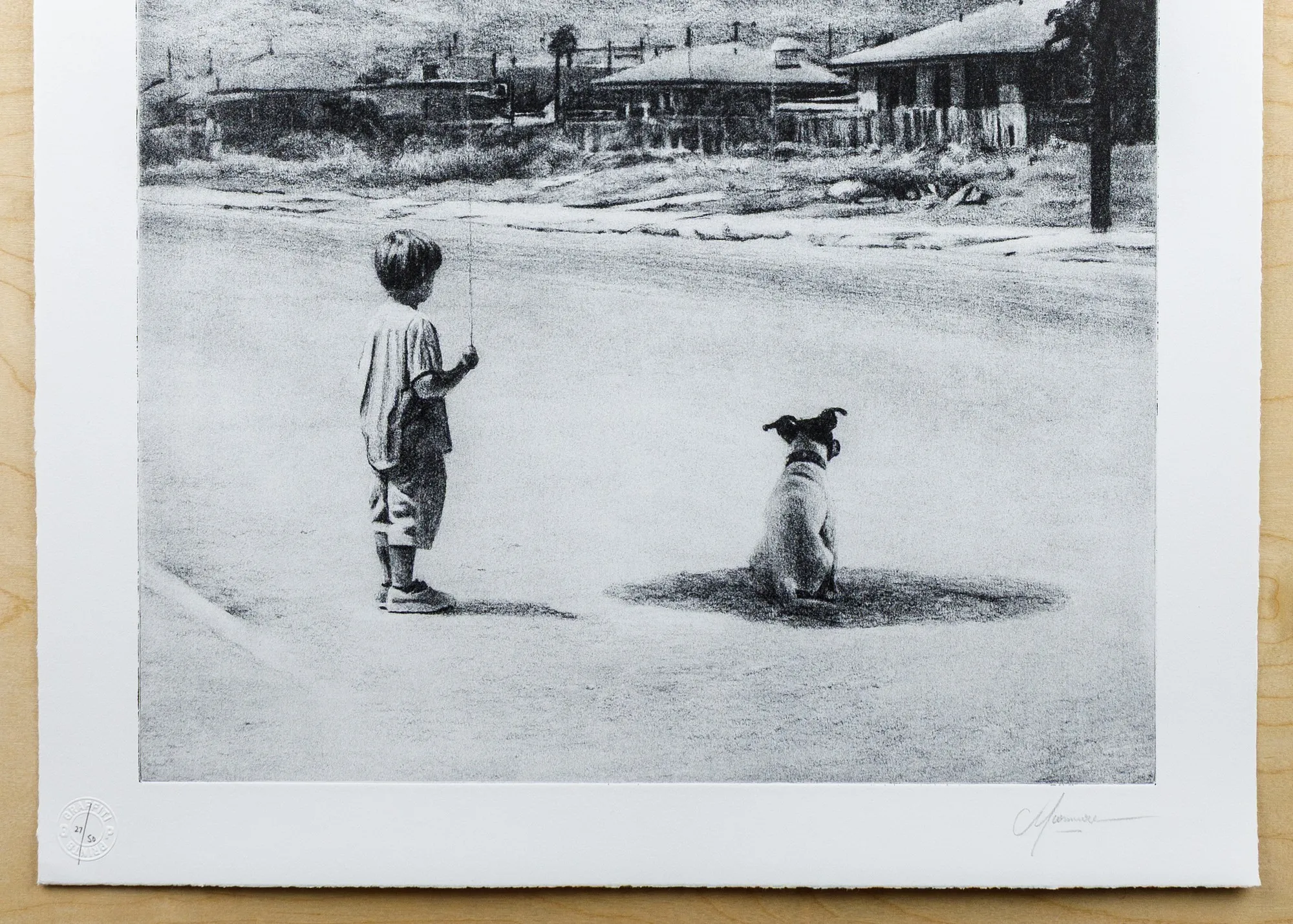
None of these marks is decorative. Between them they record an edition of fifty, and every hand that brought this sheet into being: the two artists who made and signed it, and the publisher who pressed its stamp over the number.
Where to go from here
By now the edition number should read as what it is: not a grade or a guarantee of worth, but a record — of how many impressions were made, that the matrix is closed, and that the artist stood behind this particular sheet. That is most of what the marks in a margin are doing.
The next step is to read one for yourself. Our companion guide to reading an edition number does the close work this overview has pointed toward throughout, taking the fraction, the pencil signature and the proof letters apart, mark by mark, on real prints.
In time this guide will sit alongside others on the neighbouring questions an edition raises: the fuller hierarchy of proof states, what a certificate of authenticity is worth, how an editioned sheet is best framed and kept. None of them will tell you which print to love. That part is yours.
FAQs
What is a limited edition print?
A limited edition print is an artwork printed in a deliberately fixed number of impressions from a single matrix — a plate, stone, block or screen — usually signed and numbered by the artist, with no further impressions made once the edition is complete.
Why are prints made in limited editions?
Because a matrix can yield many near-identical impressions, so limiting the number is a deliberate choice rather than a technical necessity. Fixing the edition, and usually cancelling the matrix once it is printed, assures a collector that only so many exist — which is what makes an editioned print a collectable object rather than an open-ended one.
What is the difference between an original print and a reproduction?
An original print is one the artist conceived as a print and made, or authorised, in a printmaking medium such as etching, lithography or screenprint, where the image is created in the matrix itself. A reproduction is a copy — often photographic — of an artwork that already exists in another form, such as a painting. The distinction was formalised by the Print Council of America in 1961.
Who decides how large an edition is?
The artist, usually with the publisher or print workshop, sets the edition size before printing begins, and once declared it cannot honestly be increased. Sizes range widely, from a handful of impressions to several hundred, and the choice balances the limits of the technique, the artist's intentions and the market the edition is made for.