TECHNIQUE · GUIDE
Line engraving
How a burin cuts a line into copper, how to recognize an engraving, and why engravers like Reinis Gailītis still choose the technique.
What is an engraving?
An engraving is a print made from a metal plate, usually copper, into which the image has been cut with a burin. Line engraving, the intaglio printmaking technique behind it, cuts the image with a burin: a steel bar with a lozenge-shaped tip, pushed through the metal by hand. Intaglio means the ink sits below the surface. The plate is inked, wiped so ink stays only in the cut grooves, and run through a press against damp paper, which is forced down into the lines to pull the ink out.
What separates engraving from the other intaglio techniques is how the line is made: the burin removes metal from the plate. As it moves, it lifts a thin curl of copper clean out of the groove. In etching, the artist’s needle only scratches through a protective coating, and acid makes the line. In drypoint, the needle shoves metal aside into a burr, a rough ridge along the line that holds ink and flattens a little with every pass through the press. In engraving, a groove grows wider as it goes deeper, so the line swells where the burin is pressed down and narrows as it eases up. The RISD Museum describes the result, the technique’s signature mark, as a swelling line that “tapers at both ends and becomes wider in the middle.”
Because its width can change within a single stroke, that line can model light and shadow, not just outline a shape. Early engravers used it for their own compositions. Albrecht Dürer was cutting his own inventions into copper in the early 1500s. From the sixteenth century into the nineteenth, the same ability also made engraving one of the ways to reproduce paintings, carrying them to viewers far from the originals. Old impressions of both kinds still change hands, and a collector needs to know which one they are holding, so we come back to that history below.
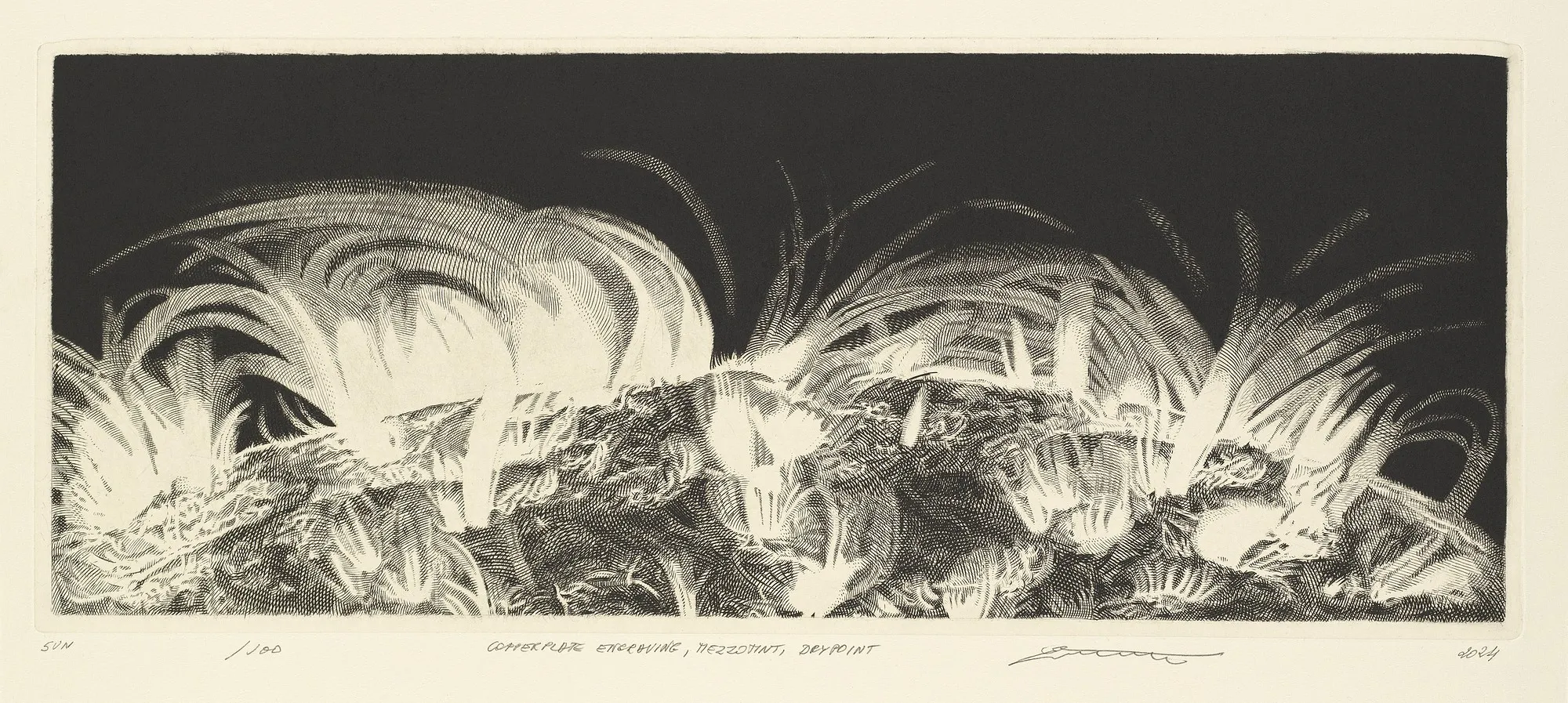
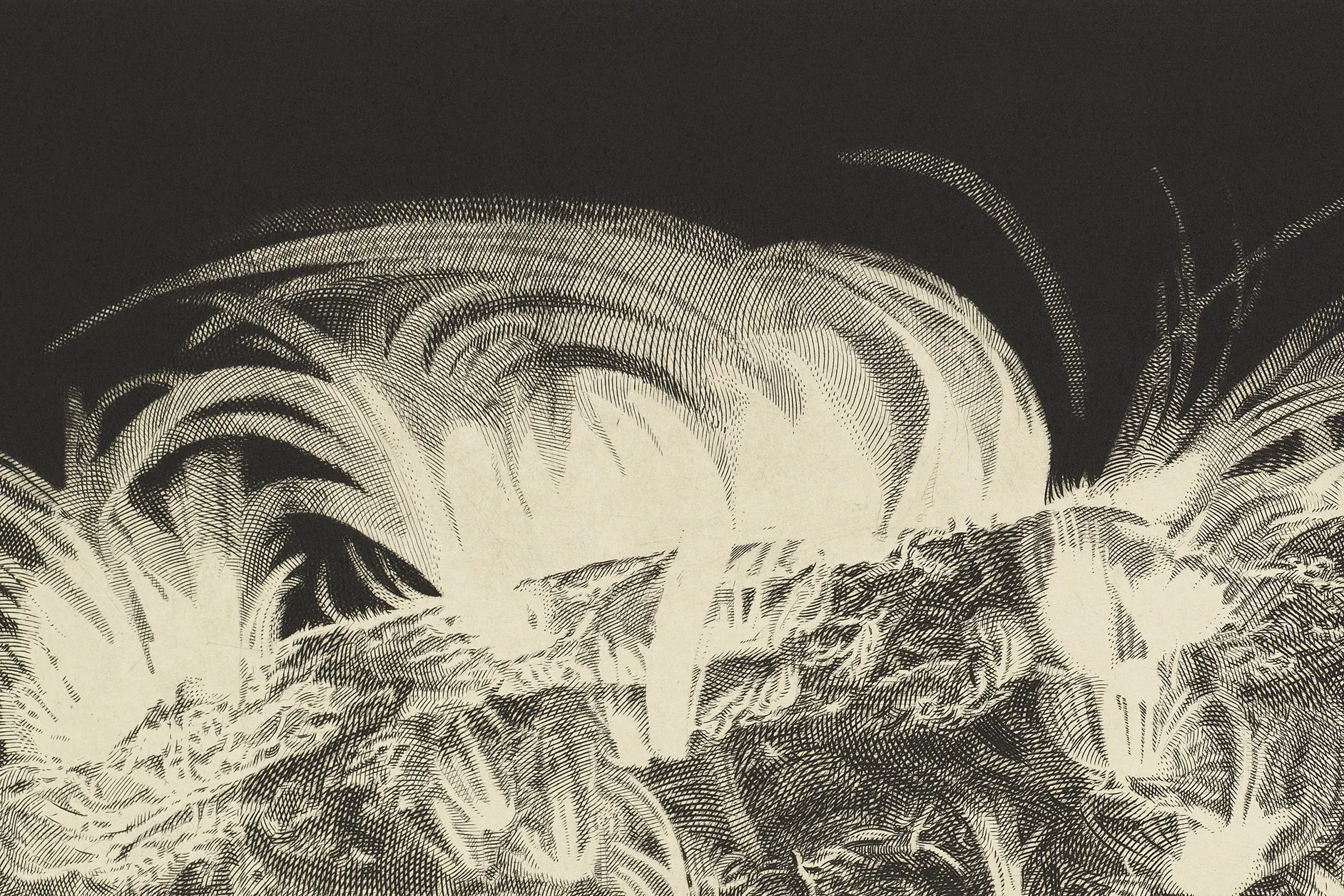
Throughout, we draw on the work of Reinis Gailītis, an engraver in Riga who cuts copper plates and end-grain boxwood blocks with the burin. His Sun (2024) combines engraving with mezzotint and drypoint on one copper plate. Through his plates we follow the line from the tool to the finished sheet: how it is cut, how to recognize it, and what the technique gives an artist who chooses it.
How is an engraving made?
An engraving starts with a copper plate polished to a mirror finish. The plate rests on a leather cushion filled with sand, so it can be turned freely while the hand holding the burin stays steady. The burin’s mushroom-shaped wooden handle sits in the palm, the fingers lie along the steel to guide and slow it, and the push comes from the forearm and shoulder as much as the wrist.
The burin goes in a little at a time and is never forced. As it moves, a continuous strip of copper curls up ahead of the tip. A properly sharpened burin leaves the sides of the groove clean, but the curl stays attached where the line ends. Reinis Gailītis snips it off with a scraper, a three-edged blade, which lets him stop the line at a precise point. He can also ease the burin out and snap the curl free, though the tool then travels a little farther. The main lines of the image are usually cut first. Grays are then built up gradually across the whole plate, and the darkest passages come last, from deeper lines and from lines crossed over one another. He crosses them at a variety of angles, “traditionally 45 degrees,” as he puts it.
A polished copper plate works like a mirror, which makes it hard to see what has already been cut. The aid Reinis values most is one of the cheapest: a light diffuser. It softens the glare that strains the eyes, and its white surface reflects onto the copper so the engraved lines stand out. He also rubs a darkening paste of beeswax, lamb fat or lard, and black pigment into the plate, and it settles into the grooves so the image reads as dark lines on bright copper. Some engravers use charcoal powder for the same purpose.
For the faintest grays, he doesn’t start with the burin at all. He scratches the line with a drypoint needle, then sands off the burr it raises, which leaves what he calls “an extremely fine, shallow, crisp line.” He uses it in backgrounds to give a sense of distance and volume. Where the line needs to grow stronger, the burin is set into the scratch and driven along it. “The shallow line almost works as a rail and guides the burin,” he writes.
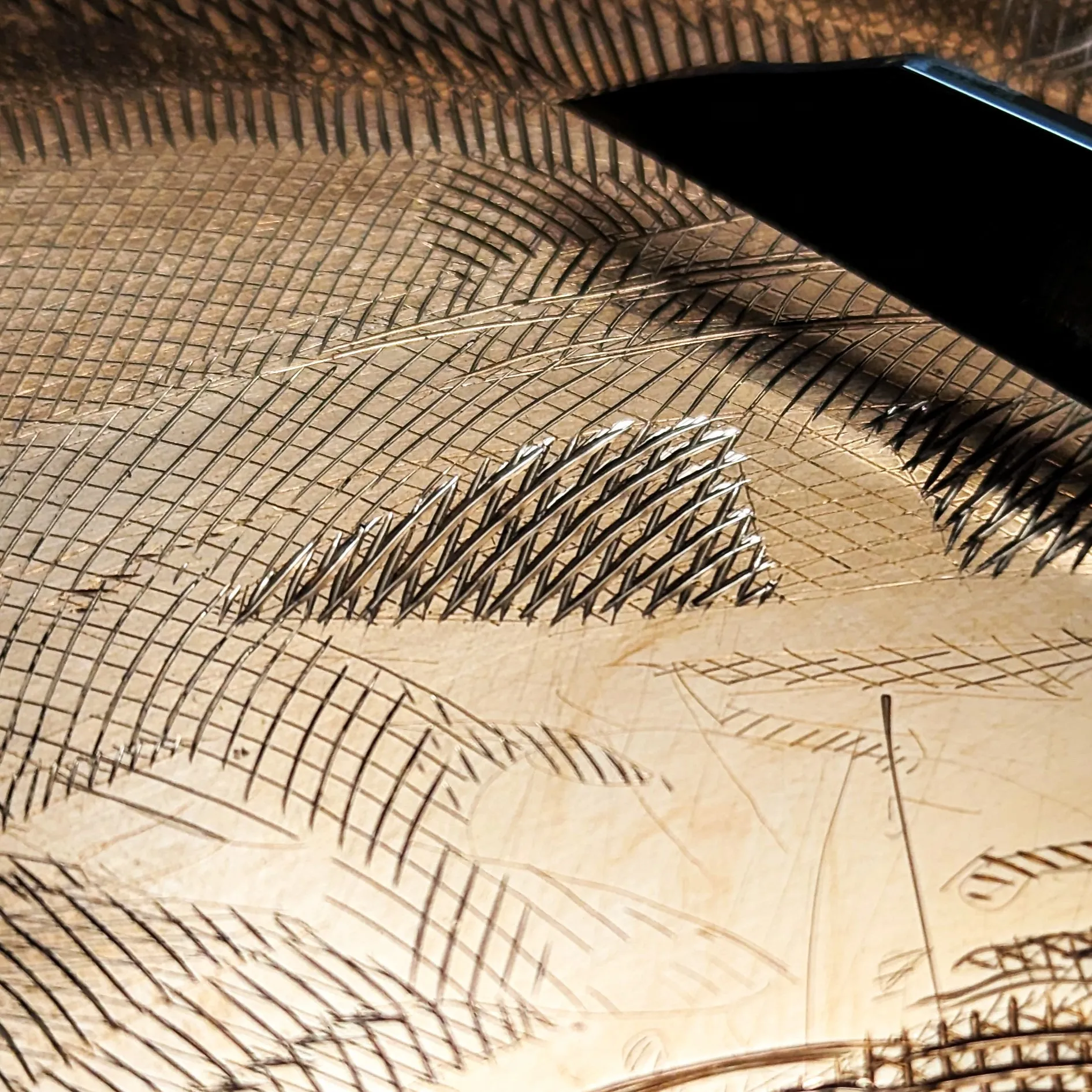
A mistake can be corrected, within limits. Reinis scrapes out a scratch or a slip, then burnishes the spot with a polished steel tool until the line is too wide and shallow to hold ink. Deeply engraved areas are much harder to fix. Every repair costs time and leaves marks that must themselves be polished out, which is why engravers plan their lines before the burin touches the copper.
How can you tell an engraved line from an etched or drypoint one?
At arm’s length, the three intaglio line techniques can look much alike. The differences show up close, ideally under a magnifying glass. We asked Reinis Gailītis what tells him a line was cut with a burin, and he answered by setting the three side by side:
Drypoint is the fuzziest, softest. Can have deep, dark, velvety blacks. The line is torn open, ink is caught both in the line and the burrs on the side of it.
Etching is very fine, usually quite uniform due to the etching process. … As acid also bites slightly sideways, not only straight down, it has a slightly fuzzy, soft look.
The engraved line is incredibly crisp. Almost unnaturally so. … It is also dynamic, it changes along its length. It can start very narrow and fine, then swell, becoming deeper and wider, then again fine and narrow. Like drawing with a nib of a quill or fountain pen.
Reinis Gailītis, in correspondence with Paper Matters
That gives a collector a practical test. Follow a single line from one end to the other. An etched line keeps roughly the same width and has slightly soft edges. A drypoint line looks furred, with ink caught beside it as well as in it. An engraved line starts as a hairline, swells, and tapers back to a point, and its edges stay sharp the whole way.
Reinis is careful to add that real prints rarely sort themselves so neatly. Artists combined techniques on one plate, a deeply bitten etched line can pass for drypoint, and a dull burin can leave a line that looks etched.
Reinis has found the same mixing in prints more than four centuries old. In a 2020 essay for his supporters on Patreon, he looks closely at Jacob Matham’s Landscape with the Parable of the Sower (1605), engraved after a drawing by Abraham Bloemaert and now in the Rijksmuseum. He argues that its faint gray clouds could only have been scratched with a drypoint needle and then cleaned of burr. In Hendrick Goltzius’s Publius Horatius (1586), he traces scratched lines that turn into engraved ones partway along, and in Claude Mellan’s Sudarium of Saint Veronica (1649), he finds signs that a compass guided the famous spiral. He reads these prints through his own experience at the plate, testing each idea on copper, and presents his conclusions as informed speculation rather than documented history. Much of his own cross-hatching, he notes, is cut freehand, by eye and muscle memory. He scratches in guidelines only when a piece needs more planning. Engravers had every reason to keep their shortcuts quiet, he suggests, and to let buyers believe every line was cut freehand.
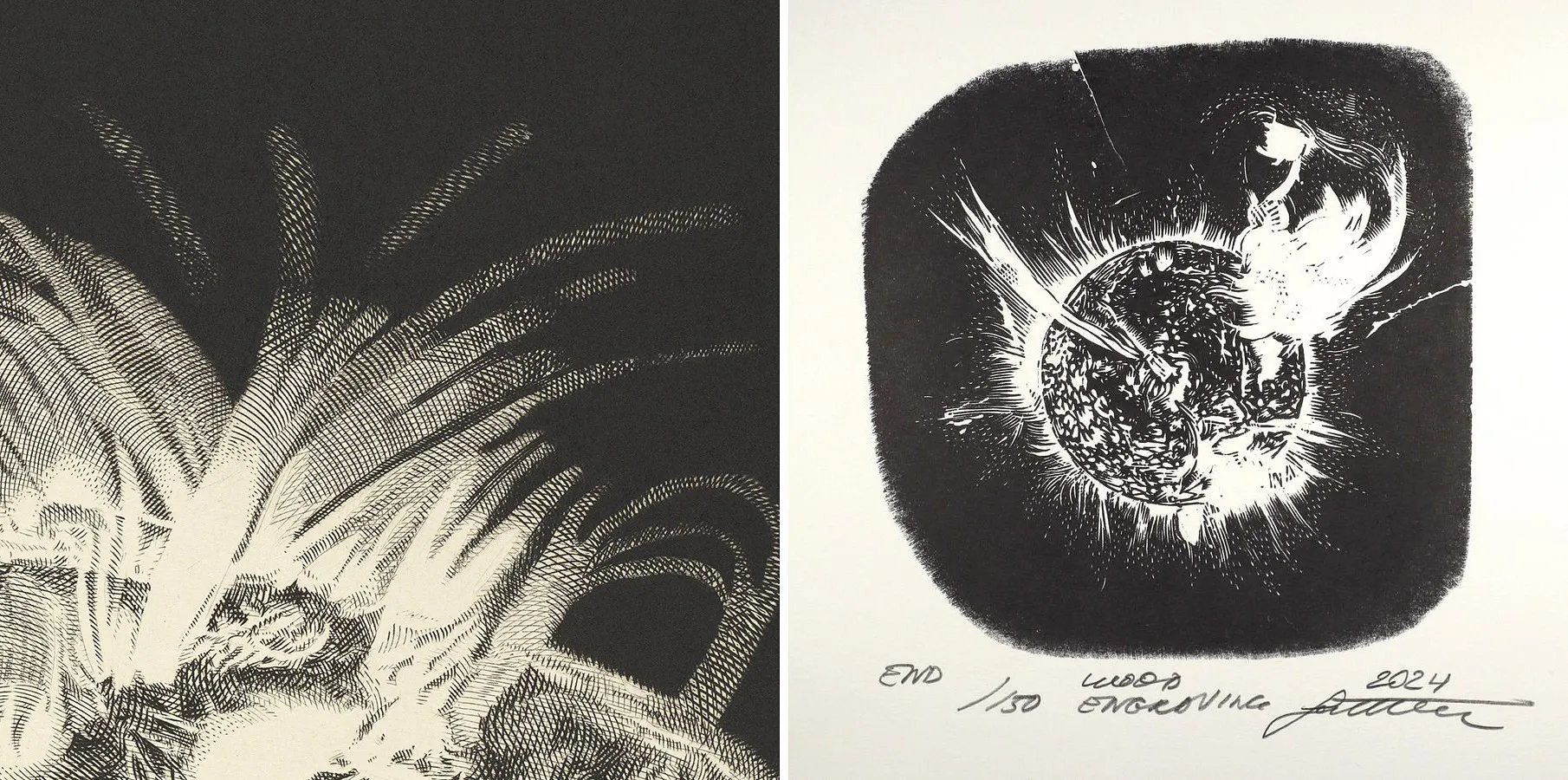
Wood engraving is the relief counterpart to copper engraving. The tool is the same burin, but it cuts into the end grain of a boxwood block instead of a copper plate. In copper engraving, the ink sits in the cut lines, so they print black. In wood engraving, the ink sits on the uncut surface, so every cut prints white. Reinis works in both, and his End (2024) shows what the burin does when the cut line becomes light rather than dark.
Why do so many old engravings carry two names?
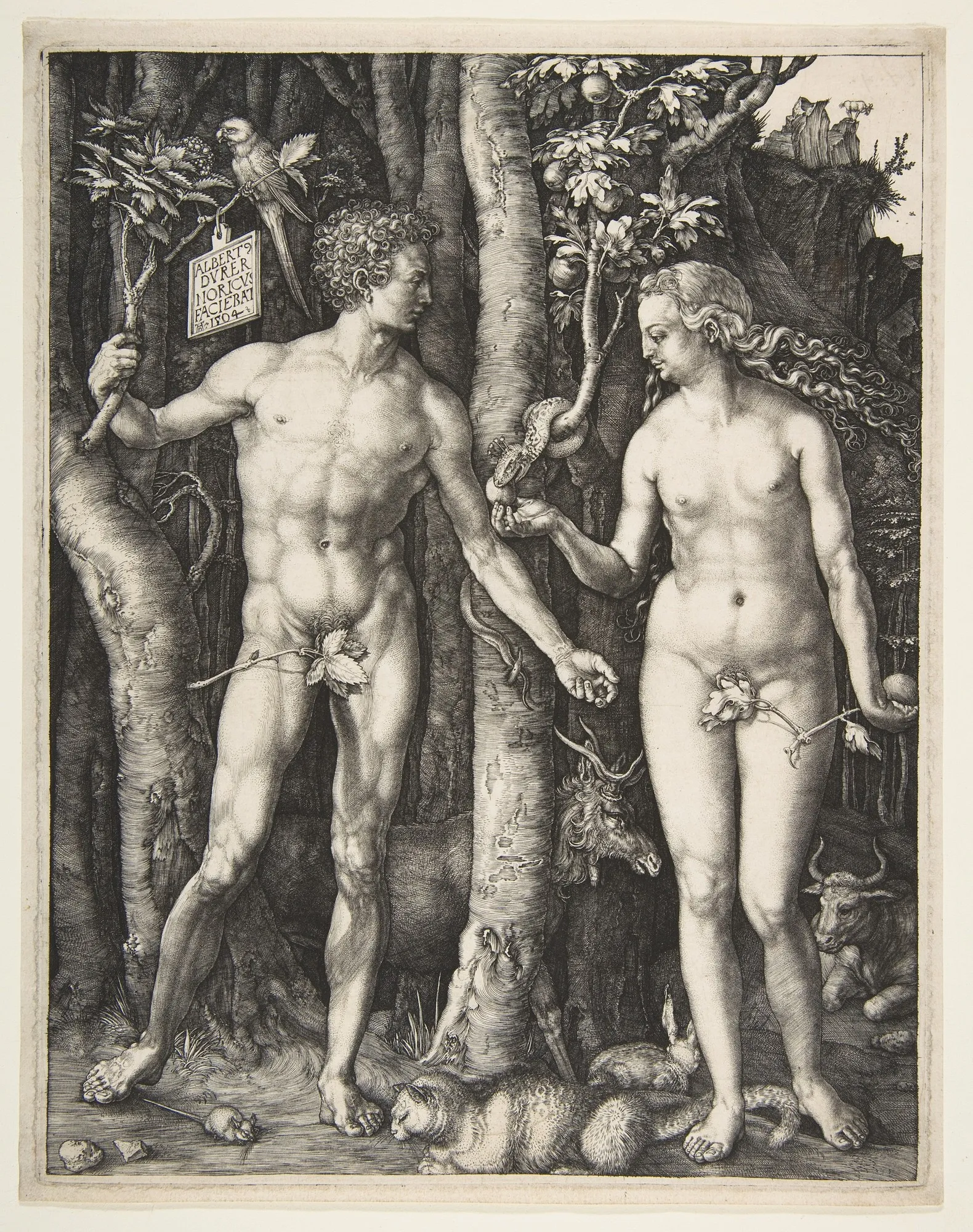
Albrecht Dürer designed his engravings and cut them himself. His Adam and Eve (1504), now in the Metropolitan Museum of Art, hangs a small tablet from a branch near Adam’s hand, inscribed in Latin: Albrecht Dürer of Nuremberg made this. The Victoria and Albert Museum calls it the longest and most emphatic inscription he added to any print. The museum suggests he made it part of the design as a safeguard, since other printmakers were free to copy his image but not to put his name and monogram on it.
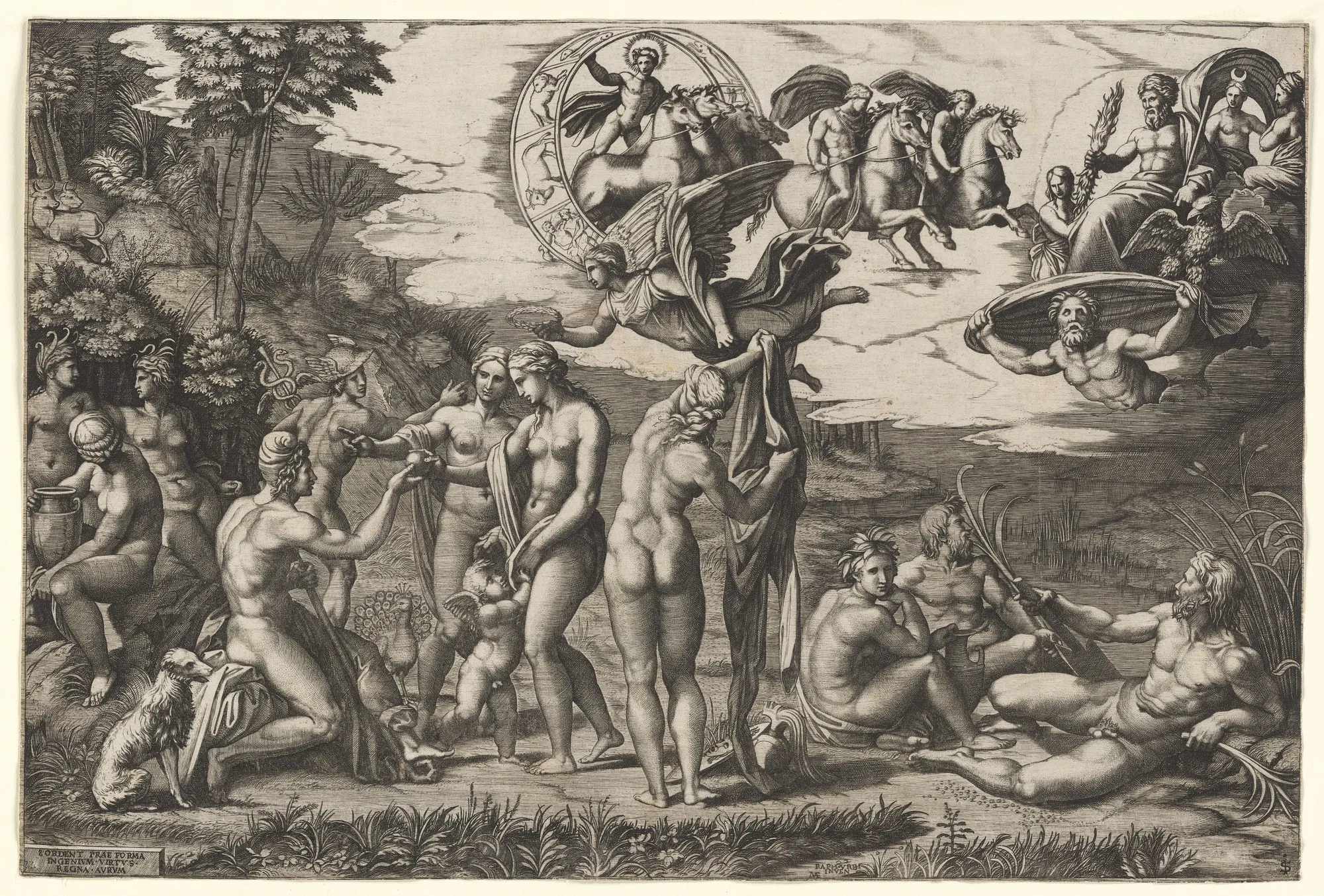
A few years later in Rome, Marcantonio Raimondi built a different kind of career. He engraved the designs of other artists, Raphael above all, and the National Gallery of Victoria credits him with opening “the so-called ‘reproductive’ print.” His Judgment of Paris (about 1510–20) belongs to a group of compositions that, according to the Met, Raphael made specifically for Marcantonio to engrave. The plate names both men. Marcantonio’s monogram sits near the inscription “RAPH. VRBI INVEN,” Latin shorthand naming Raphael of Urbino as the designer.
Engraving suited this partnership because it could turn a design’s light and shadow into lines. By varying how wide each line was, how closely the lines were spaced, and how they crossed one another, an engraver could build shading and volume with nothing but black ink on white paper. Marcantonio built tone with systematic hatching, and the Met notes that his method shaped the engravers who followed him. Later in the sixteenth century, Cornelis Cort in Antwerp and Hendrick Goltzius in Haarlem pushed the swelling line further. The RISD Museum calls it “the most crucial weapon” of the reproductive engraver, because it could carry the light and shadow of a painting into black and white.
The same division of labor lasted well into the nineteenth century, in wood engraving as well as copper. Gustave Doré is often called an engraver, Reinis points out, but for most of his illustrated books he was the illustrator, and professional wood engravers cut his drawings into the block. The prints carry both names: the Baltimore Museum of Art credits God Creates Light (1866) to Doré and to the engraver Héliodore Pisan.
For a collector, the lettering in the margin of an old engraving names each person behind the print and the part they played. Julie Mellby, curator of graphic arts at Princeton University Library, glosses the common abbreviations: inv. or invenit means designed by, pinx. means painted by, del. means drawn by, sculp. means engraved by, and exc. means published by. A sheet marked Raphael inv. and Marcantonio sculp. is still entirely handmade, with every line cut by the engraver, but the image began with someone else. Neither kind is lesser than the other. They are different objects, and the inscription tells you which one is in front of you.
How long does an engraved plate last?
An engraved plate lasts longer than a drypoint plate, but not forever. Because the burin removes metal rather than raising a burr, very little stands above the surface of the plate once the engraver has scraped it. In Reinis’s experience, wear comes slowly and mostly from inking and wiping: the pigment in the ink is slightly abrasive, and every wipe polishes the lines down a little. The finest lines go first. Conservator Angela Campbell and engraver Andrew Raftery measured this on a replica of Dürer’s Saint Paul (1514), which Raftery engraved by hand from a high-resolution scan of the original. A newly engraved plate still holds a little burr along its lines. On Raftery’s plate, it was enough to make the first 20 or so impressions especially rich. By the 50th, the plate had settled. The 100th was still “fine, but significantly lighter than the 10th.” Lightly engraved lines, they observed, wear faster than deep ones.
How many impressions a plate can give depends on how deeply it was cut and whether anyone recut it. The special collections at King’s College London note that fine lines on copper showed deterioration after only a few hundred impressions. Steel, which replaced copper for commercial work from the 1820s, could give thousands without visible wear. Reinis’s own reading of the history points the same way: hundreds of impressions from seventeenth- and eighteenth-century copper, thousands from twentieth-century steel. At the far end, historians Karen Bowen and Dirk Imhof traced one engraved title page, for Cesare Baronio’s Annales ecclesiastici, through surviving account books. Between 1601 and 1658 it printed 18,257 impressions, with four rounds of reworking along the way.
That slow wear is why the order of printing matters with old master engravings. Over decades, an early impression keeps detail that a late one loses. Campbell has used this to put surviving Dürer impressions in order. Tiny scratches on his copper plates print clearly in early impressions and fade in later ones, so whether a scratch still shows tells her where a sheet falls in the sequence.
Engravers today print far smaller editions. Sun was printed in an edition of 100, a fraction of what an engraved plate can give. Its plate also carries two other techniques. One is mezzotint, in which the copper is roughened all over so it prints a velvety black. The other is drypoint. Both wear faster than engraving. Reinis uses mezzotint and tightly cross-hatched drypoint only for solid black backgrounds. Where a drypoint line has to print as a fine gray, he removes its burr first, so nothing is left to flatten.
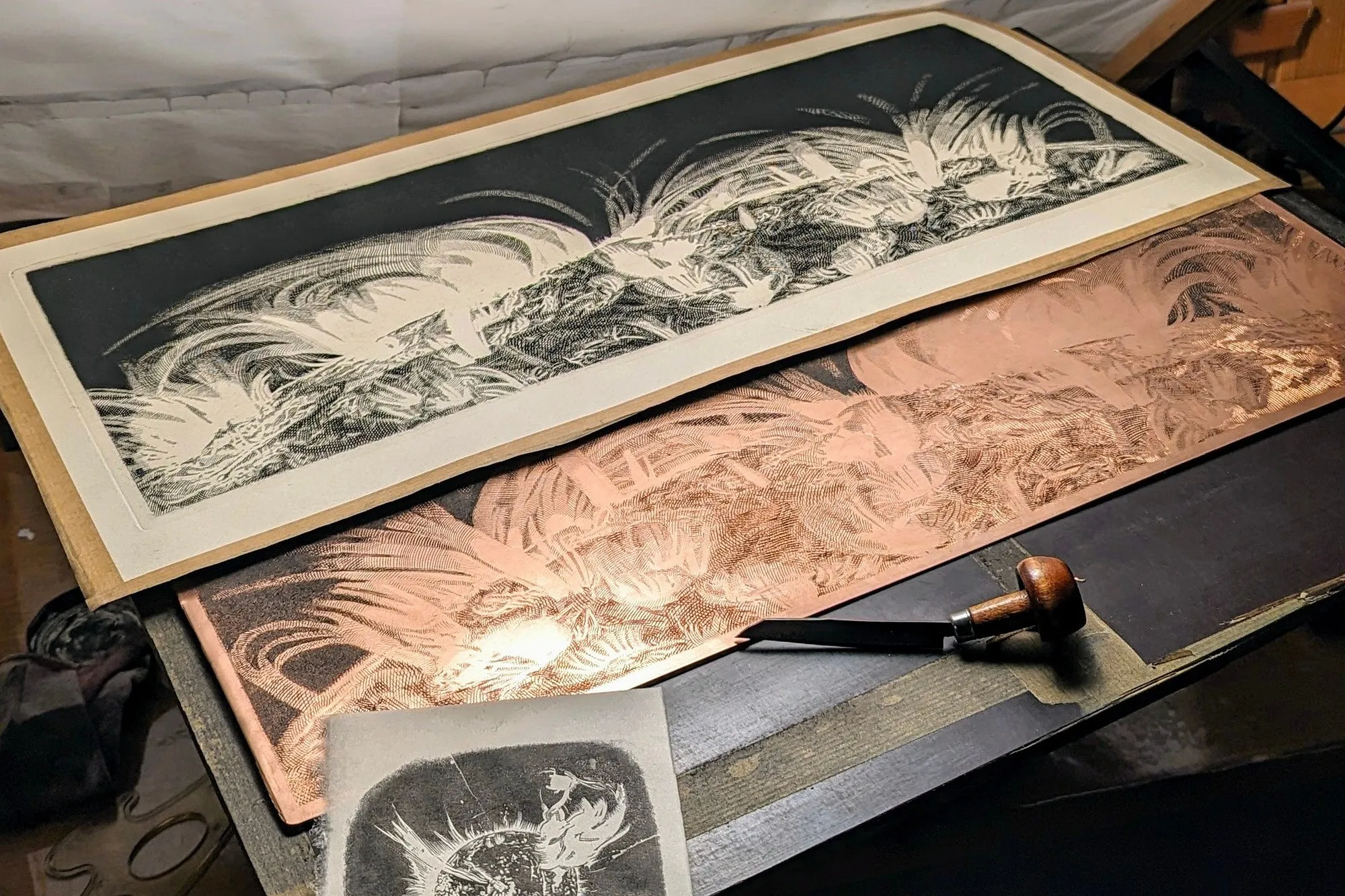
The result is a plate built around engraving’s durability. On a sheet like Sun, the edition number tells you how many impressions exist and where this one fell in the run. It says far less about the quality of the impression than it would on a plate with a burr, where an early impression and a late one can look like different prints.
What does engraving give an artist?
It gives a line no other printmaking technique produces. Everything in this guide comes back to the cut. A burin stroke records exactly how deep and how hard it was driven, so width, darkness and direction are all set in a single movement of the hand. The line swells and tapers, its edges stay sharp, and an engraver can lay it down as a hairline in one place and a full black stroke in the next.
It also asks the artist for sustained attention. Cutting is slow and repairs are costly, so every line is decided before it is made. NOBA calls copper and wood engraving “two of the most historically rich, technically demanding, and today increasingly rare methods” of printmaking. On the Platemark podcast in 2023, Reinis and host Ann Shafer took the point further, discussing engraving as both the most direct printmaking technique and one of the most difficult. Nothing stands between the hand and the plate, and that is exactly why each decision shows.
The plate’s durability gives the artist two practical advantages. The first is consistency across an edition: Reinis has not noticed real wear in his own editions, even on plates that combine engraving with mezzotint and drypoint. The second is a stable base for more fragile techniques. On Sun, the engraved lines carry the image, and mezzotint and drypoint fill in the solid black around them.
The same burin cut can print as a black line or a white one, depending on which technique is used to print it. Copper engraving is printed intaglio, with ink in the grooves, so the cuts print black. Wood engraving is printed in relief, with ink on the surface of an end-grain boxwood block, so the cuts stay white. Reinis cut Sun and End in the same year with the same tool, and the two prints show how much ground a single technique covers when an artist commits to it.
In an engraving, every mark is a cut made by the burin. Its line, its precision and the patience it demands belong to the technique itself, which is why artists like Reinis still choose it, and why collectors who learn to read that line find a print that rewards looking at closely, one cut at a time.
Where to go from here
Engraving is one of several ways to work an image into a copper plate. If the cut line is what drew you in, compare it with the bitten line of etching, where acid does the work that the burin does in engraving. For tone rather than line, aquatint builds its grays from a grain of rosin fused to the plate, and mezzotint works from a solid black toward the light. Each technique leaves its own evidence on the sheet, and once you can read an engraved line, the others become easier to tell apart.
There is much more of Reinis Gailītis’s work to discover, in copper and in boxwood, and we’d encourage you to spend time with it at gailitis.berta.me, on Instagram and on Linktree.
FAQs
What is the difference between engraving and etching?
In engraving, the artist cuts each line directly into a copper plate with a burin, which removes a sliver of metal. The result is a crisp line that swells and tapers along its length. In etching, the artist draws through an acid-resistant coating and acid bites the line into the plate. An etched line is usually more even in width, with slightly softer edges.
How can you tell if a print is an engraving?
Follow a single line under magnification. An engraved line starts as a hairline, swells, and tapers back to a point, and its edges stay sharp the whole way. Etched lines stay roughly even and look slightly soft, and drypoint lines look furred. Artists often combined techniques on one plate, so treat these as signs rather than proof.
How many prints can be made from an engraved plate?
It depends on how deeply the plate was cut and whether it was reworked. Fine lines on copper can show wear within a few hundred impressions, while steel plates gave thousands. One seventeenth-century title-page plate printed 18,257 impressions between 1601 and 1658, reworked four times along the way. Modern editions are far smaller.
What do inv. and sculp. mean on an old engraving?
They record who did what. Inv., short for invenit, means designed by. Pinx. means painted by, del. means drawn by, sculp. means engraved by, and exc. means published by. A sheet marked Raphael inv. and Marcantonio sculp. was designed by Raphael and engraved by Marcantonio Raimondi.