
TECHNIQUE · GUIDE
Mezzotint
Mezzotint begins with a plate that prints solid black; the image is scraped out of it. How a mezzotint is made, why editions are small, and how to read one.
Mezzotint begins with a plate capable of printing nothing but black. Other techniques also move from dark towards light, but in mezzotint the black belongs to the metal itself. The printmaker takes a copper plate and works it over with a rocker, a curved steel blade cut with fine teeth, until the whole surface carries burr — thousands of raised ridges of displaced metal, each one able to hold ink. Inked, wiped and run through a press in that state, the plate prints solid black. The image comes afterwards, and it is made by removing metal rather than adding a mark. Working the bare plate with a scraper and a burnisher, the printmaker flattens the burr wherever the print needs to be lighter, so that area holds less ink and prints paler. Nothing is drawn. Nothing is bitten. The image is what survives once the capacity to print black has been worn away.
That inversion explains almost everything a collector needs to know about mezzotints. The labour arrives before the image does: Devon Stackonis spent roughly six hours rocking the small copper plate for Record of Wear, spread over three days, before a single mark meant anything. The burr that gives the technique its velvet blacks is fragile, and it flattens under the pressure of the press, so a plate yields far fewer good impressions than an etching or an engraving made with the same effort. Editions are small because the plate’s working life is short. And impression order matters here more than in any other technique, because the difference between an early sheet and a late one is visible without a loupe.
What makes a mezzotint different from every other print?
Mezzotint belongs to the intaglio family, the techniques in which the ink sits below the surface of the plate rather than on top of it. The plate is inked, the surface wiped clean, and damp paper forced into the recesses under the pressure of a press. Etching, engraving, drypoint and aquatint all work this way, and all of them leave the plate-mark: the shallow embossed rectangle where the edge of the plate has pressed into the sheet.
Within that family, most techniques make lines. An engraver cuts them with a burin; an etcher draws through a waxy ground and lets acid bite the exposed metal; a drypoint needle scratches the plate directly. Different tools, but the same basic move: marks cut into a blank plate, with tone built up from how densely those marks are packed. Look closely at Dürer’s Melencolia I and the greys resolve into hatching, cross-hatching and stippled flicks, with white paper showing between the marks — three different systems, all doing the work that a mezzotint plate does with none of them.
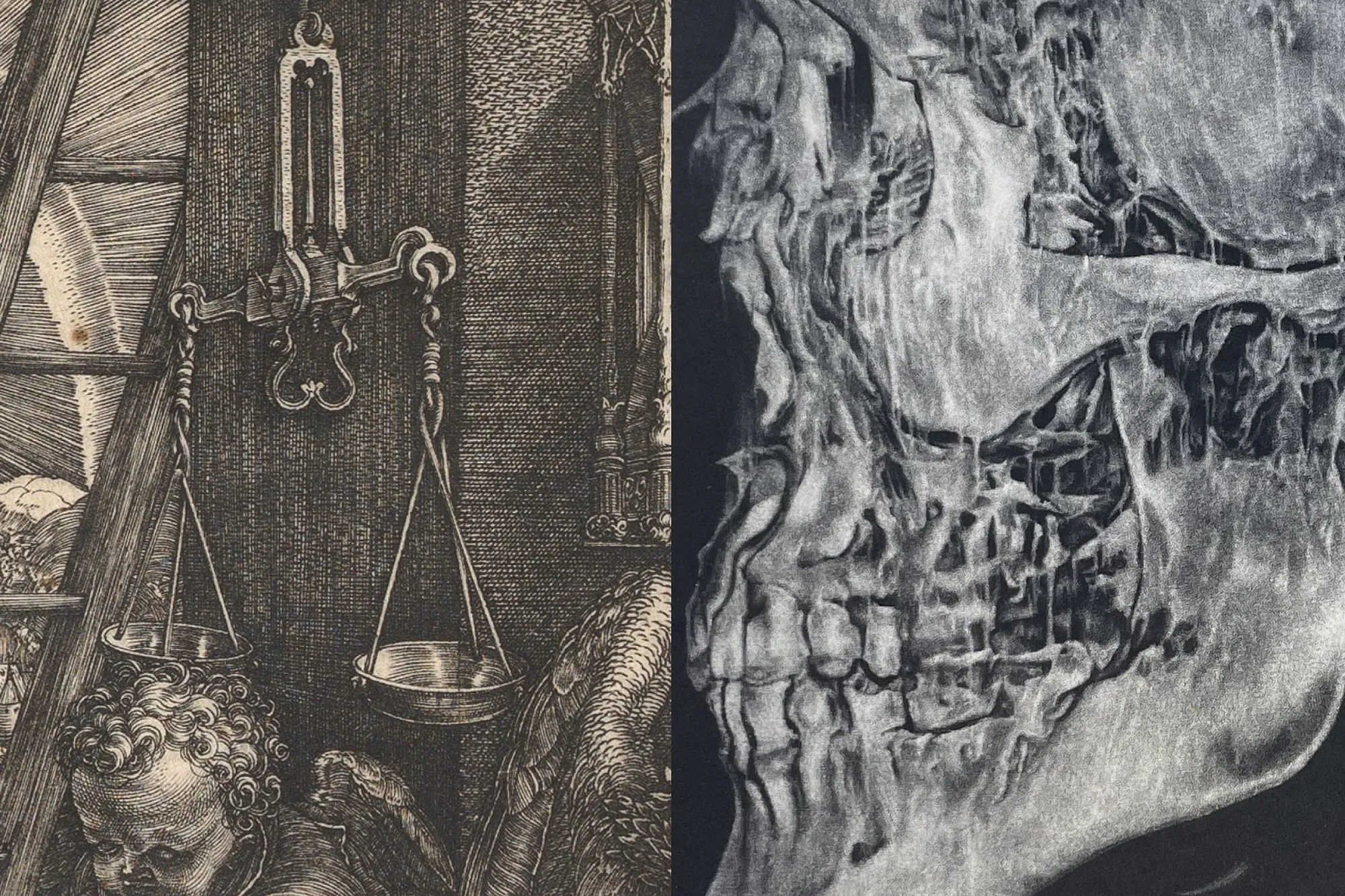
Mezzotint does not make lines. It makes fields. Nothing resolves into hatching under magnification, because the tone is not assembled from marks; it is the condition of the surface itself. That is why a mezzotint reads as continuous. There is no structure in the greys to find; one tone simply gives way to the next. The result looks closer to a photograph or a wash drawing than to anything made with a pen.
The technique it gets confused with is aquatint, the other tonal process in the family, and the distinction is worth holding onto. Mezzotint is mechanical; aquatint is chemical. A mezzotint printmaker roughens the plate with a rocker and then flattens the burr by hand. An aquatint printmaker dusts the plate with powdered rosin, fuses it with heat, and lets acid bite the copper in the channels between the grains. Mezzotint also came first (1642, against the 1760s for aquatint’s adoption), which makes it the first tonal process in printmaking. Before it, intaglio prints were made almost entirely of lines.
How is a mezzotint made?
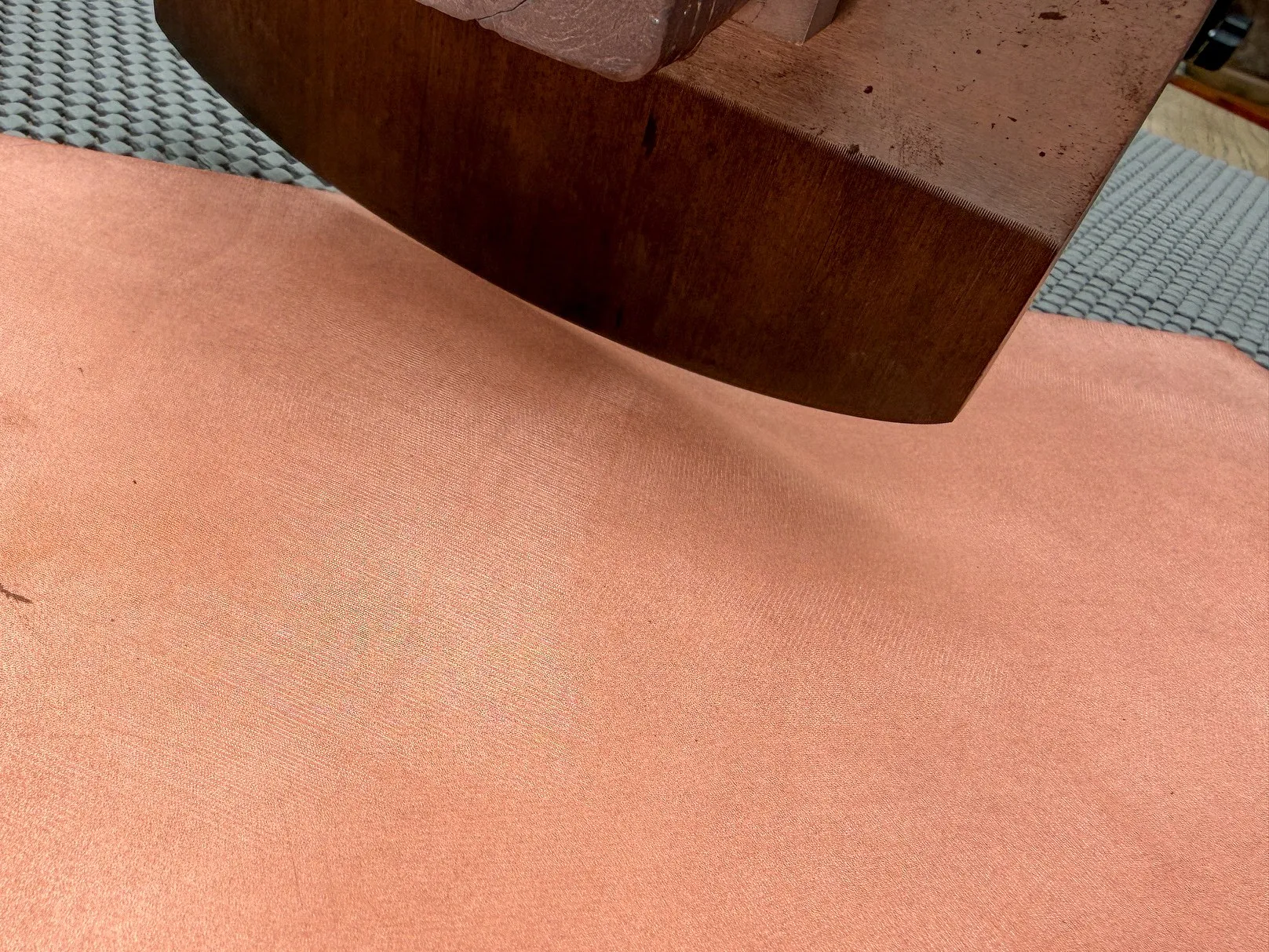
The tool that starts it is the rocker: a weighted steel blade with a curved, finely toothed edge, sized by gauge, which counts the teeth per inch. Stackonis uses an 85-gauge rocker with a five-inch edge, having moved up from a two-inch, which covers ground faster. The printmaker walks it across the copper in short strokes, the curve of the blade letting it pivot, each pass leaving a band of pitted metal with the displaced copper standing up alongside as burr.
One pass is not enough. The plate is turned and rocked again from another angle, and again, through a long series of directions until the pitting is dense and even across the whole surface. That evenly pitted surface is called the ground, and preparing it is the labour that defines the technique: hours of mechanical work, scaling with the size of the plate, before any image exists. The printmaker judges it by tilting the plate to the light rather than by looking at an image: an even ground scatters reflection uniformly, and a thin patch shows up as a shine. At that point the plate prints solid black and nothing else. The work is physical enough to be rationed. Stackonis rocks in two-hour sessions across three days rather than in one sitting, which she has done, to avoid the stiffness that follows. She notes it is cumulative: it comes from years at the technique rather than from a first plate.
The image is made by removing the burr. A scraper shaves it away where the print needs to be lighter, and a burnisher, smooth and polished, flattens what remains and softens the transition. Scrape more and the area holds less ink and prints paler; scrape back to bare copper and it prints as white paper. Where too much has come off, a small toothed wheel called a roulette can re-roughen the passage. Carol Wax’s The Mezzotint: History and Technique, in its second edition from Schiffer Books, remains the standard account of these methods.
Because the work subtracts and cannot easily be undone, mezzotint printmakers proof constantly: ink the plate, pull an impression, read what the tones are doing, return to the plate. But each proof costs plate life, so they are rationed rather than taken freely. Each impression is a state: the plate recorded at one moment in its making. Most never leave the studio. Occasionally an artist keeps them, and the states become the work itself.
Why are mezzotint editions so small?
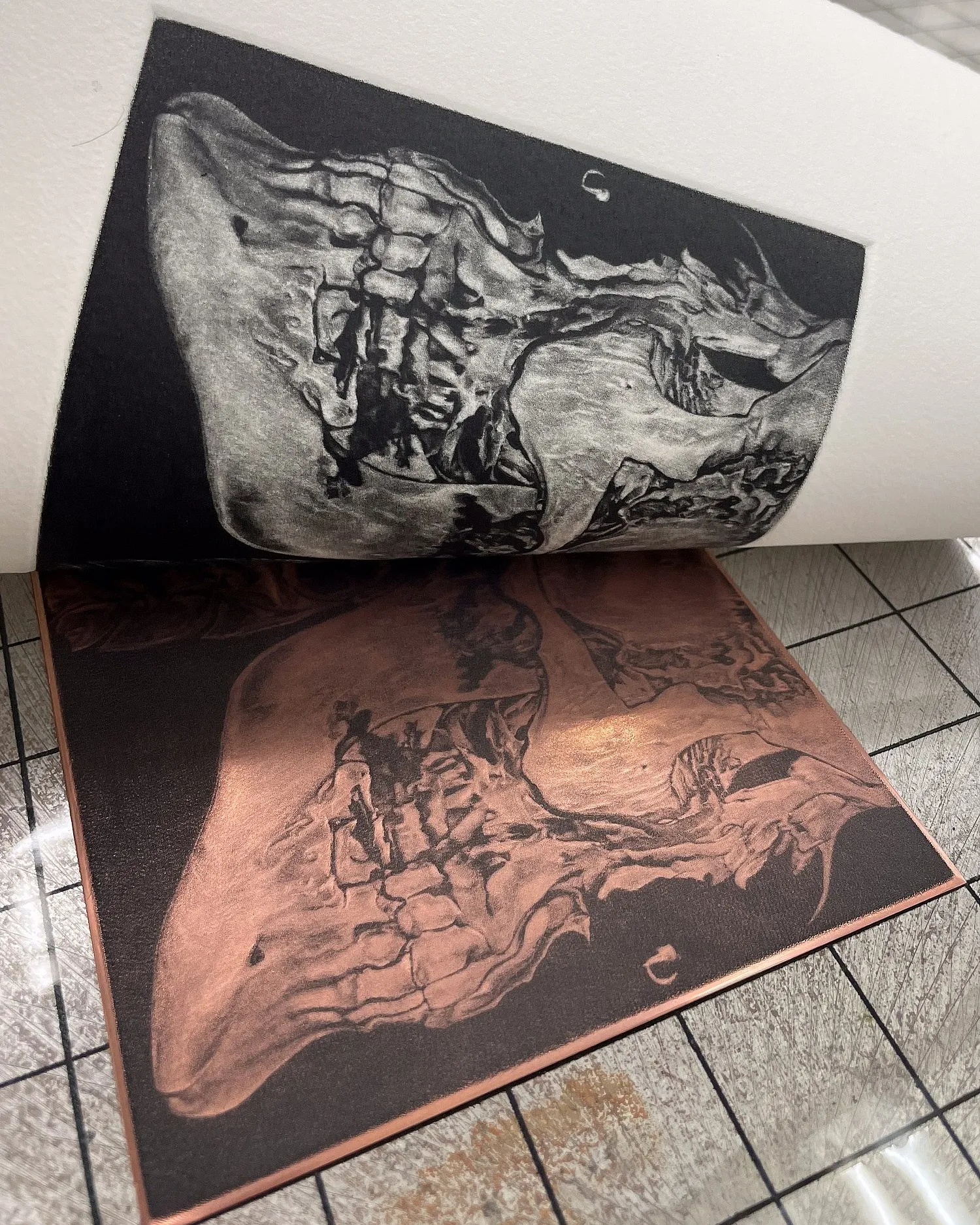
The burr that holds the ink is fragile. Every pass through the press compresses it a little, and mezzotint needs more pressure than an etching of the same size to force the paper into that shallow, densely pitted surface. Wiping the plate between impressions abrades it further. The darks are the first to go: as the burr flattens, the deepest areas hold less ink and begin to read as grey rather than black, the tonal transitions coarsen, and the image loses the depth that made the technique worth the labour.
How many good impressions a plate yields depends on the gauge of the rocker, how deeply the ground was laid, the ink, the wiping, the press pressure and the paper, which is why the literature declines to give a number. What can be said plainly is that mezzotint editions are among the smallest in printmaking.
Stackonis will say what her own press gives: a fairly steady edition of about thirty on bare copper, sometimes forty. Steel-faced plates hold consistency into the upper fifties and beyond. She adds that a skilled printer counteracts the wear rather than simply accepting it, adapting the wipe to leave more ink in the areas that an unworn plate held black without help.
The decline is not the whole curve, though. Printmakers know that a plate takes a few impressions to settle: the first proof tends to come out very dark, with contrast more intense than the plate will give once it has been printed a few times, and the image evens out by the third to fifth impression. Stackonis cites the studio saying that you cannot trust a plate until after the fifth proof, or the tenth. So the best impression is not always the first one.
Printmakers fought this for two centuries, and the fight changed how mezzotints look. Steel plates replaced soft copper in 1823, but steel is harder, so the rocker raised less burr and the darks weakened. Steel-facing solved it better: a copper plate electroplated with a renewable film of steel keeps copper’s richer burr and survives a longer run.
For a collector, this is the practical consequence of everything above. Impression order in mezzotint is not a matter of record-keeping but of what the sheet actually looks like. An early impression and a late one from the same plate are different objects, and the difference is legible across a room. Which raises a question most printmakers try to avoid: what does that decline actually look like, laid out in order?
What does plate wear actually look like?
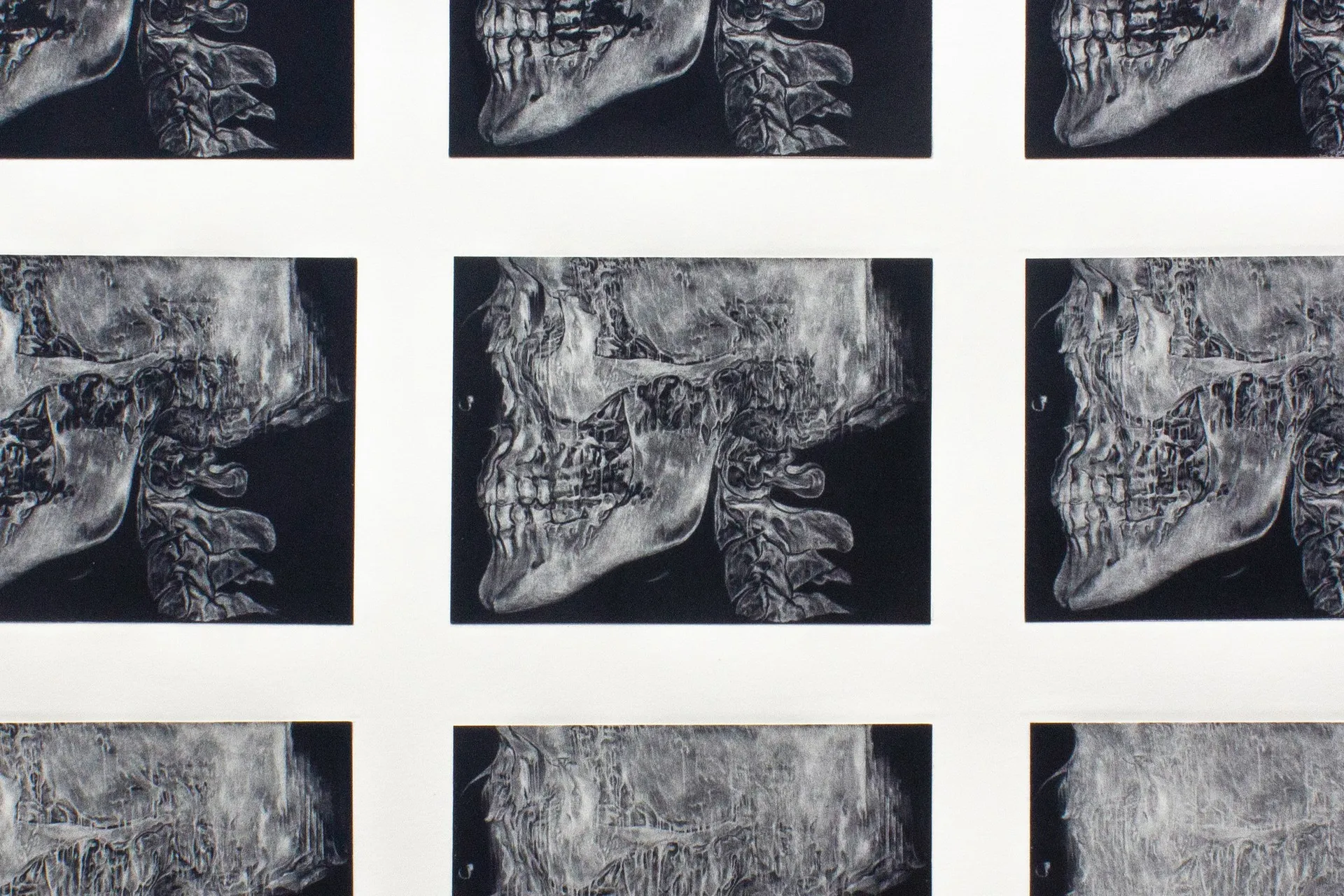
In 2022 the printmaker Devon Stackonis made a work called Record of Wear: nine impressions of a single copper mezzotint plate, rendered after her own skull, printed and then scraped and then printed again, nine times over. The nine are shown together in a three-by-three grid, read left to right and top to bottom, with the title, edition and signature in pencil beneath. The first impression is dense, with deep blacks. The last is pale, flattened and nearly gone.
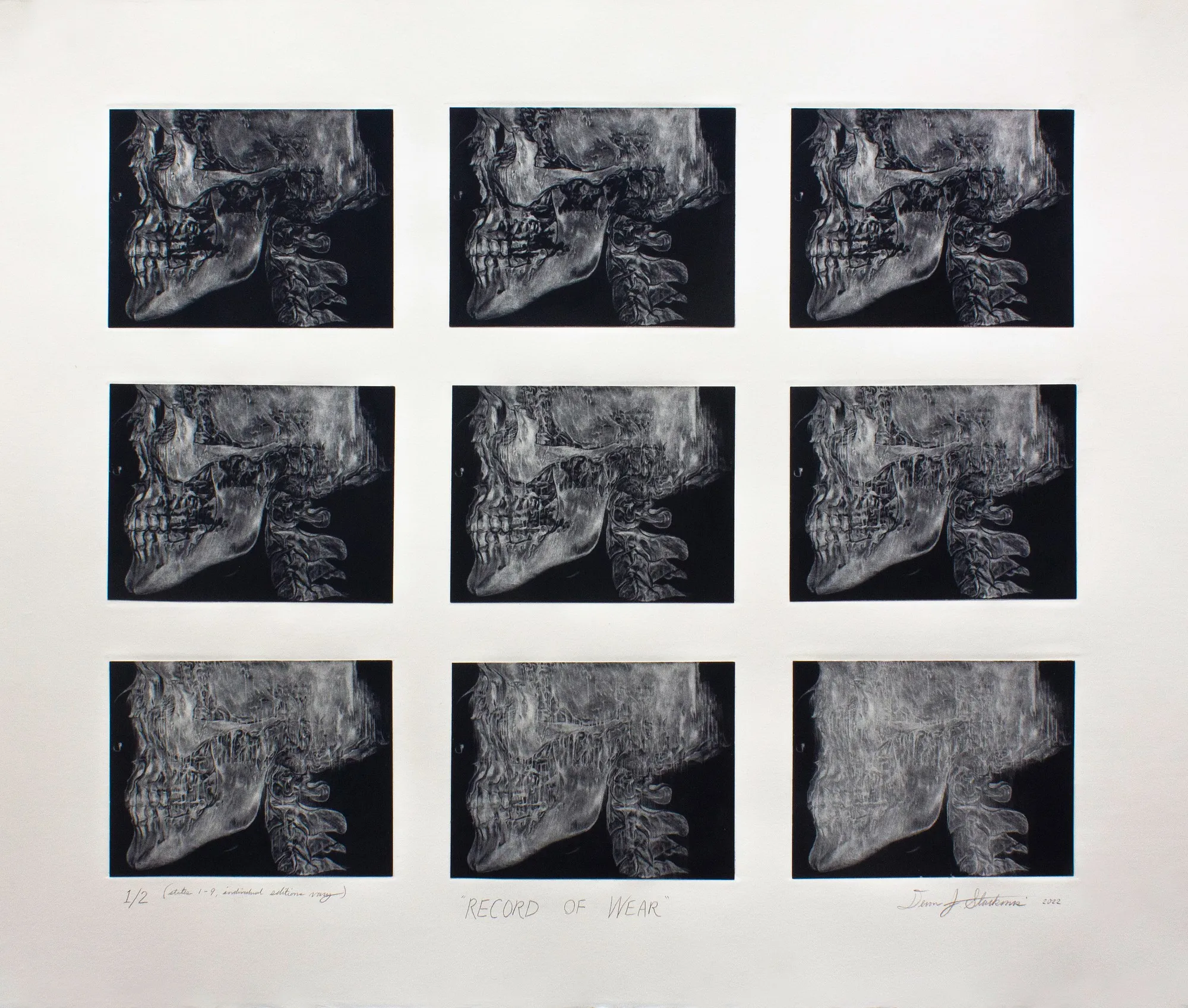
Between impressions she scraped the plate. Scraping is normally corrective: you lift a highlight, or bring back a passage that has gone too dark. She scraped across the whole image instead, reducing it each time. In her own account of the work she describes leaning into the plate’s limited lifespan. What interests her is the rapid deterioration of the matrix, and the thinning and softening of tone that follows from it.
Two things were happening to the plate at once, and Stackonis intended both. She scraped between states, and the plate was also wearing from being printed. After each state she pulled seven impressions: two went into the grid compositions, of which two exist, and she printed the additional five deliberately so that the press’s own wear would work alongside her hand. Sixty-three impressions came off that plate in total. The nine states are therefore not a record of scraping alone, nor of press wear alone. They are the two acting together, which is what happens to every plate that prints an edition, run at speed and made visible.
This inverts the usual purpose of a state. A printmaker pulls state proofs while building an image, and each one moves closer to the finished thing. The sequence documents construction, and it stops when the plate is right. Stackonis kept going. Her states continue past the finished image, so the sequence documents removal instead. It stops only when there is almost nothing left to take.
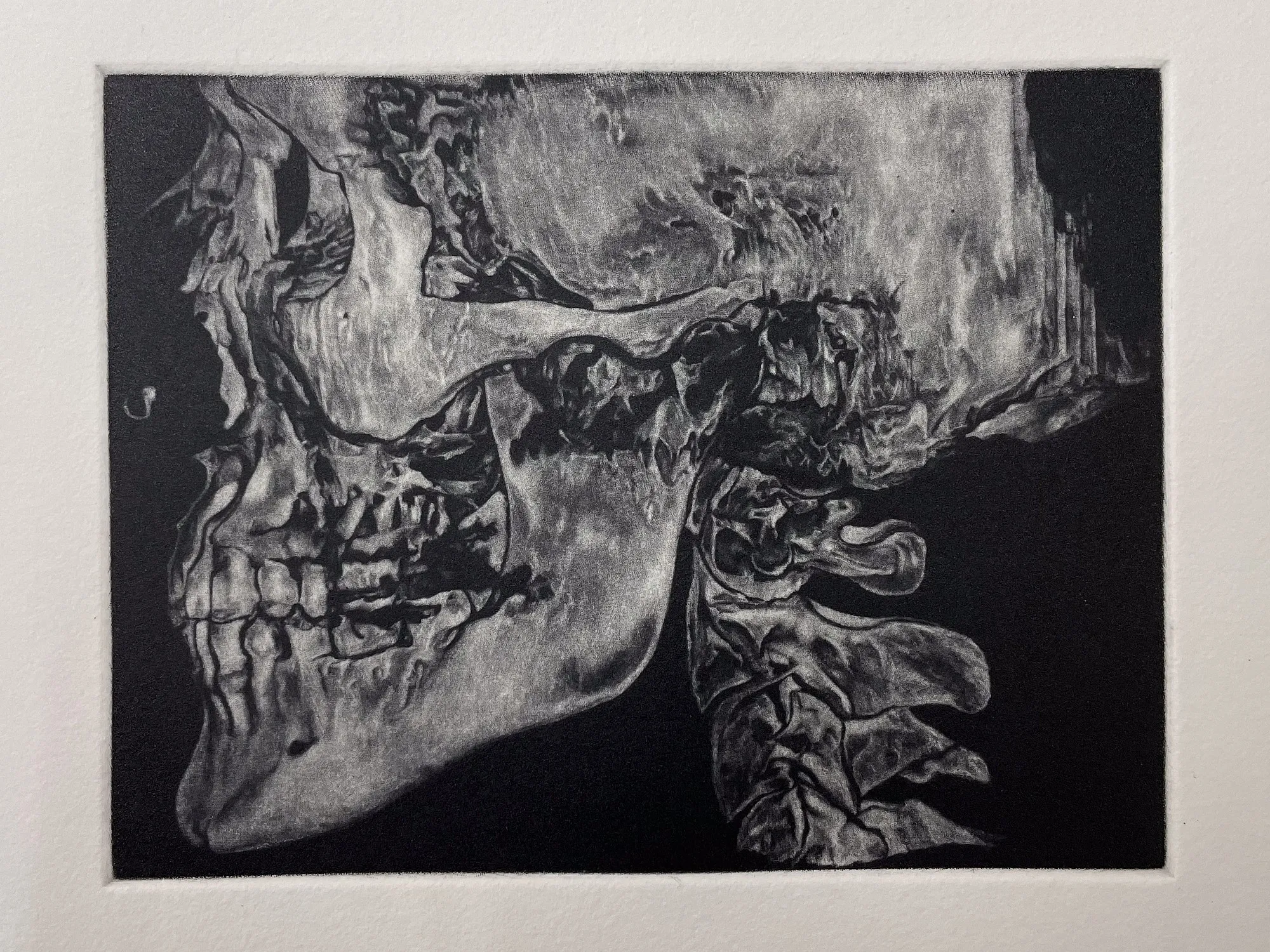
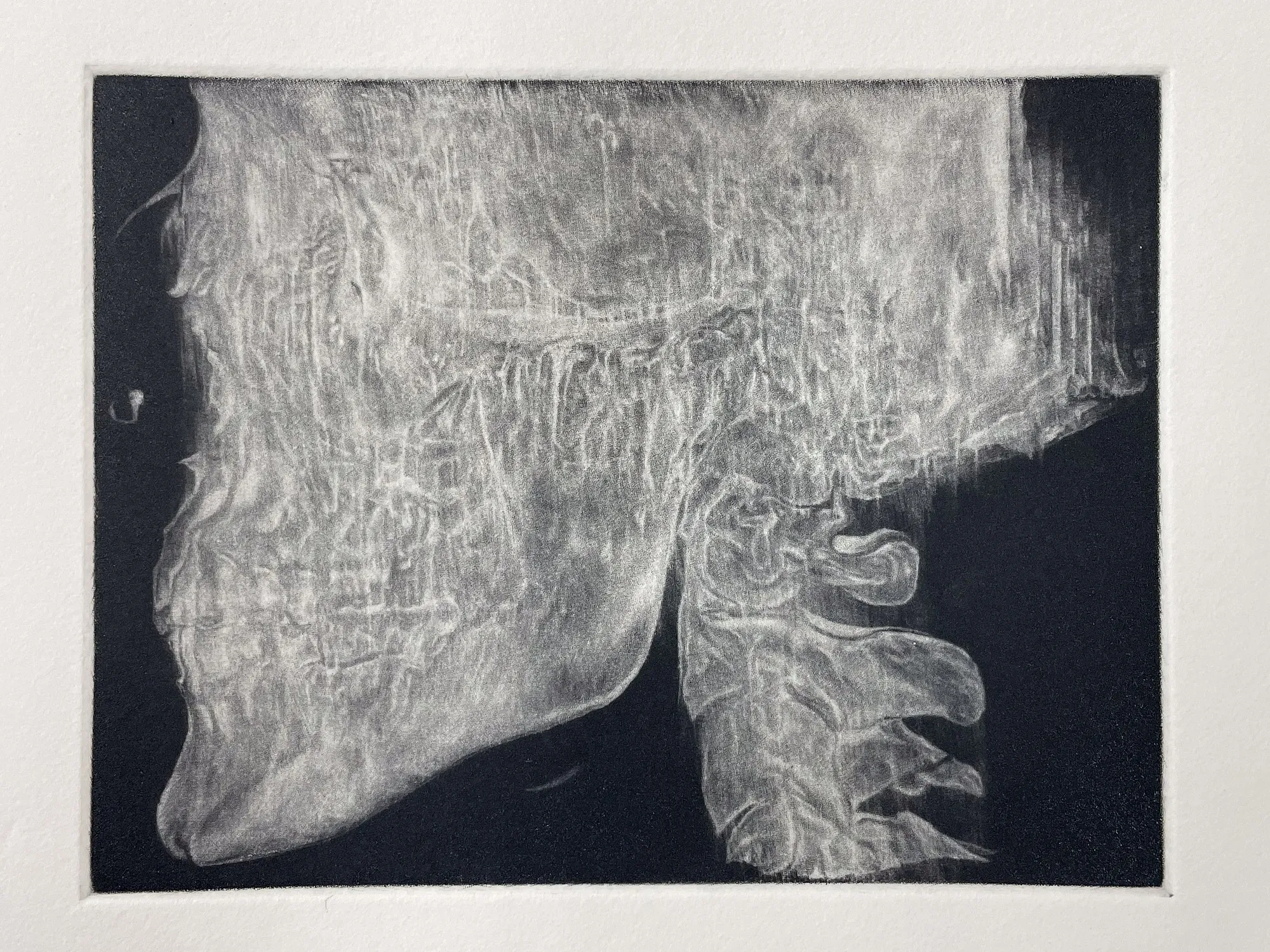
The sequence is worth reading closely, because it shows the order in which a mezzotint fails. The blacks go first. The ground behind the skull is dense and light-absorbing in the first state; by the ninth it has lifted, still dark but no longer the true black it was. Fine detail survives longer than depth does, and then it too coarsens. By the final state no true black remains anywhere on the sheet, and the skull itself has paled and lost its internal modelling, so it no longer separates from what sits behind it. The image is legible only as a ghost of itself.
Where did mezzotint come from?
The first mezzotint dates to 1642. Ludwig von Siegen, a soldier in the service of the Landgrave of Hesse-Kassel, made a portrait of the Landgravine Amalia Elisabeth and sent it to her son with a letter claiming the method as his own invention. It was not quite the technique as it is practised now. The National Portrait Gallery’s research on the early mezzotint notes that von Siegen worked light to dark, roughening only the areas he wanted tonal, and used roulettes rather than a rocker. The rocker, and the dark-to-light method that defines mezzotint today, came with Prince Rupert of the Rhine, who learned of the process around 1654 and carried it to England.
There it became an industry. Before photography, the only way to circulate a painting was to have someone cut it by hand, and mezzotint was faster than line engraving at the broad tonal passages of flesh and fabric. It was used above all for portraits: more than four hundred mezzotints after paintings by Joshua Reynolds are known, by various hands. The association with Britain became so complete that on the Continent the technique was called la manière anglaise, the English manner.
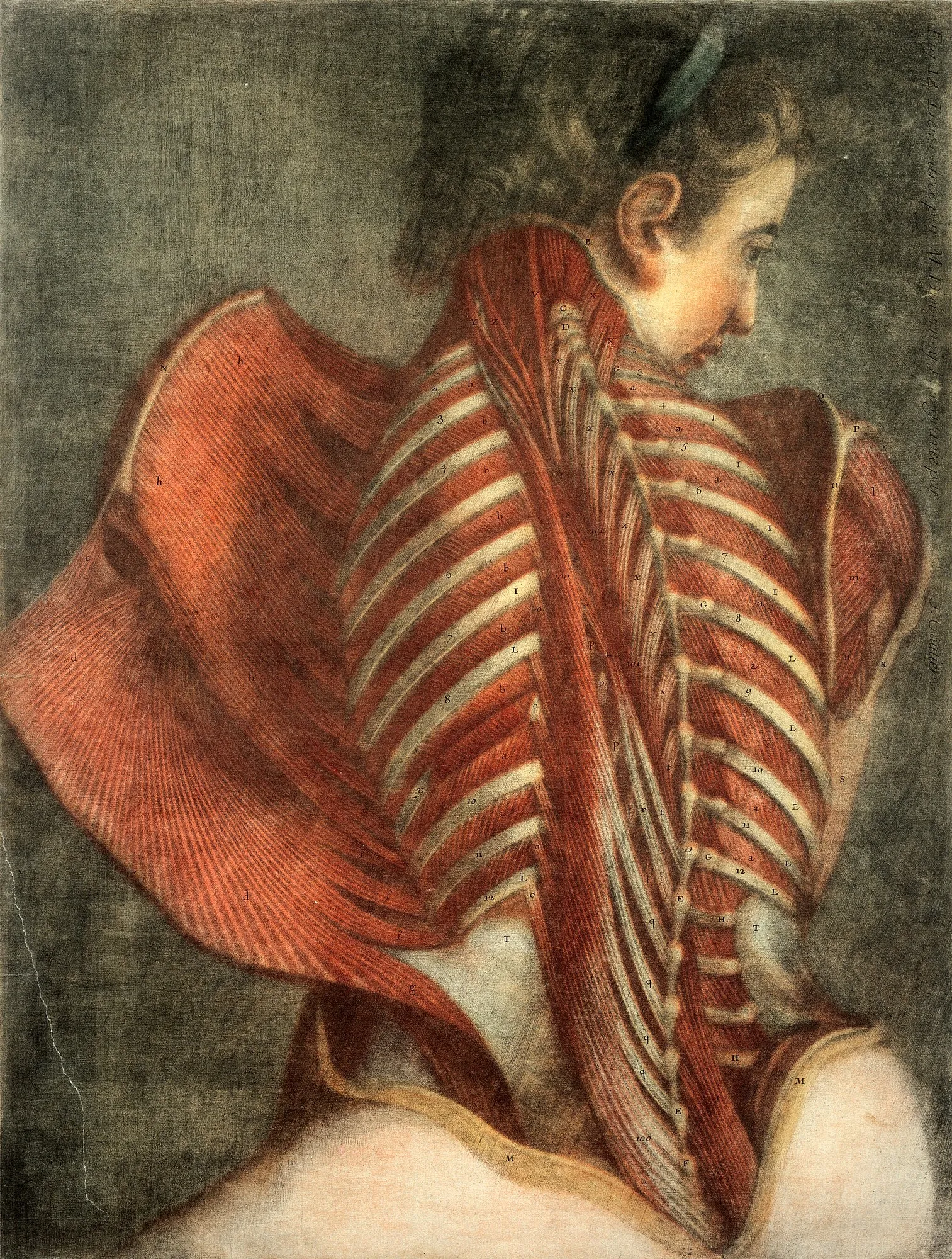
It went into colour, and into science. Working from separate plates, Jacques-Fabien Gautier d’Agoty printed anatomical mezzotints in the 1740s: flayed bodies rendered at life size, in colour, after dissections by the anatomist Duverney.
What ended the industry was the thing it existed to do. Once photography and then photomechanical reproduction could carry a painting to a page, there was no commercial reason to rock a plate by hand. Mezzotint did not fail as a technique. Its job was taken. What survived was a smaller practice: artists using the process to make original prints rather than reproductions of paintings.
How to read a mezzotint
Start by confirming it is one. Look at a mid-grey passage under magnification. An engraving or etching resolves into lines with paper between them; an aquatint shows a granular field with a roughly even pattern left by the rosin; a photomechanical reproduction shows a regular grid of dots. A mezzotint shows none of those patterns. It has a texture of its own from the rocked pits, but it is irregular, not a grid. The sheet should also carry a plate mark, which tells you it was printed as an intaglio rather than laid on the surface.
A caution on that, and this page’s own opening image is the reason for it. Record of Wear is not nine impressions printed onto one sheet. Each was printed separately, then cut to the image edge and adhered to a backing sheet with rice paste, in the manner of chine-collé. Stackonis cut and bevelled a piece of plexiglass to match each one and ran the assembly through the press, so that every panel carries a plate mark made by acrylic rather than by the copper that printed it. A plate mark tells you a sheet went through an intaglio press. It does not always tell you what was in the press.
Then judge the impression, which matters more here than in any other technique. Look first at the deepest darks. In a strong impression they are genuinely black; in a late one they have lifted towards grey and the transitions between tones have coarsened. If two impressions can be compared side by side, the difference is unmistakable. If not, ask the dealer where in the edition the sheet falls.
The inscriptions carry mezzotint’s history. Collectors of eighteenth-century work meet a vocabulary that predates signing and numbering: a proof before letters is an impression pulled before the title and publication line were added beneath the image. That vocabulary exists because of mezzotint. A proof is, properly, a working impression: the printer pulls one to check that the plate is doing what the artist intended before committing to the run. Mezzotinters began selling those impressions to collectors, because their plates wore quickly and an early sheet was visibly better than a late one. Publishers then found the premium profitable and began pulling proofs to satisfy the market rather than to check the plate.
Paper can tell you roughly how old a sheet is. Earlier mezzotints are generally on handmade laid paper, which shows fine parallel lines and more widely spaced chain lines against the light. Later impressions tend to be on smoother wove. A contemporary mezzotint follows current convention, signed in pencil in the lower right margin and numbered in the lower left.
Where to go from here
Mezzotint rewards the kind of attention this site is built on. The inversion is the thing to hold onto: a plate that begins black, and an image made by taking that black away. Everything else follows from it. The labour comes before the image does. The burr that carries the image is fragile, which is why the editions are small. And the position of a sheet within its edition is something you can see, not merely something recorded on paper.
The fuller history is worth its own telling, and we are writing it: how a soldier’s private invention became an English industry, what happened when steel replaced copper, and how the technique survived the arrival of photography. For the vocabulary in the margins, see our guide to how to read an edition number.
Devon Stackonis’s work can be seen at devonstackonis.com and on Instagram. Ilaria Rosselli Del Turco’s work is at ilardt.com.
FAQs
What is the difference between a mezzotint and an aquatint?
Both are intaglio techniques that produce tone rather than line, but they achieve it differently. Mezzotint is mechanical: the printmaker roughens the whole plate with a toothed rocker, then scrapes and burnishes areas smooth to make them print lighter. Aquatint is chemical: the plate is dusted with powdered rosin, heated so the grains stick, and acid bites the metal between them. Under magnification an aquatint shows a granular pattern left by the rosin, while a mezzotint shows continuous tone with no structure in it.
How can you tell if a print is a mezzotint?
Look at a mid-grey passage under magnification. An engraving or etching resolves into lines with paper visible between them, and a photomechanical reproduction shows a regular grid of dots. A mezzotint shows neither. Its own texture is irregular rather than repeating. The sheet should also carry a plate mark, the shallow embossed rectangle left where the edge of the plate pressed into damp paper. Mezzotint is often combined with etching or engraving, so a sheet may show line work alongside the tonal passages.
Are mezzotints valuable?
It depends on the artist, the edition and, unusually for printmaking, where the sheet falls within its edition. Because the burr that holds the ink flattens under the press, early impressions carry deeper blacks and finer transitions than late ones, and the market prices that difference. Eighteenth-century reproductive mezzotints after popular portraits survive in quantity and are mostly modest in value, while a strong early impression of a scarce plate, or a contemporary mezzotint by a collected artist, is a different proposition.
Is mezzotint still practised today?
Yes, though by a small number of people. After photography removed the commercial reason to make reproductive mezzotints, the technique was taken up as an original medium. Frank Short in Britain and Peter Ilsted in Denmark were among the figures who carried it into the twentieth century. It remains a minority practice because the labour is considerable and the editions it yields are small, which is much the same reason it nearly disappeared.