
TECHNIQUE · GUIDE
Linocut
The technique of linocut: how linoleum cuts, why it has no old masters, and what to look at when you are reading a hand-pulled linocut.
A linocut is a relief print pulled from a sheet of linoleum. The artist cuts into the lino with gouges, ink is rolled across whatever survives the cutting, and the paper takes its image from that raised surface alone. Everything cut away prints as bare paper, which means every white line in a linocut is a line the artist removed.
No Dürer stands behind the technique, no Rembrandt, no Hokusai. Linoleum turned up in the 1860s as a floor covering, and artists left it alone for another forty years. By the time they did take it up, at the turn of the century, the material had already been in use in craft classrooms, and that association stuck for most of the century that followed. Other techniques can reach for a canonical name when they need to establish their seriousness. This one has only ever had the work.
What is a linocut made from?
Linoleum was invented to be walked on. Frederick Walton patented the process behind it in 1860 and the material itself three years later. The date moves around in the literature because of that gap. Accounts giving a single year are collapsing a film of oxidised linseed oil and the floor covering eventually made from it. He built the name out of the Latin linum and oleum, flax and oil.
The recipe has hardly moved since. Linseed oil is oxidised until it solidifies, cut with cork dust or finely milled wood flour, and pressed onto a jute backing. What printmakers buy is the same material in thicker sheets, sold loose or already mounted on a wooden block, and usually in the grey-brown that anyone who sat through a school art lesson will recognise on sight. Worth knowing before you buy: much of what sells today as easy-cut or soft-cut lino is not linoleum but vinyl, which takes the tool differently and holds a different line.
The useful thing about linoleum, though, is something it does not have. Wood has grain, and grain steers the tool. A cut running with it opens cleanly, a cut running across it can tear, and much of a woodcut’s character comes out of that argument between the hand and the plank. Linoleum has no grain at all. It is the same substance in every direction, so the line goes where the hand sends it and stops where the hand stops. A curve costs nothing a straight line does not. That is why the technique draws the imagery it does, dense and turning and organic. It is also why it takes so readily to scale: no plank to join, no direction to fight.
The sheet itself is the matrix, the surface every impression comes from, and cutting it runs one way only. Ink sits on what survives, which puts linocut in the relief family alongside woodcut and at the opposite pole from intaglio, where ink lies in lines bitten or scratched below the surface. Nothing taken out can be put back, so a cut has to be right when it is made.
One point of usage, since it goes wrong constantly. Linocut is the process. A linocut is one sheet of paper with an impression on it. The gallery offering an original linocut is offering a sheet; the studio teaching linocut is teaching the process. The indefinite article is where it slips.
Why does linocut have no old masters?
Because for forty years nobody thought to cut it. Linoleum spread through British and American homes from the 1860s as flooring, and it stayed under the furniture rather than under a gouge.
The first people to take a blade to it were teachers. Linoleum entered arts and crafts education in the late nineteenth century for the obvious reasons: cheap, soft enough for a child’s hand, no press required. Escher in Het Paleis, the Escher museum in The Hague, puts the classroom first and the studio second in its account of the technique. It says plainly that this order is what kept the linocut from being taken seriously as a graphic medium for decades. The reputation arrived ahead of the work.
Artists came to it late, and casually. The earliest examples anyone can point to sit at the turn of the century. The V&A holds three of them: a triptych by the Prague-born printmaker Emil Orlik, catalogued as linocut and dated to about 1901. Orlik had just spent ten months in Japan learning colour woodblock, partly under the painter Kanō Tomonobu. The triptych lays out the division of labour he had watched there. One plate shows the painter, one the carver, one the printer kneeling to press the sheet by hand. The oldest relief tradition in the world, cut into a floor covering.
Erich Heckel’s first print followed in 1903, also a linocut. Two years later he founded Die Brücke in Dresden with Kirchner, Bleyl and Schmidt-Rottluff, a group already drawn to relief printing for its bluntness. Linoleum offered the same bluntness without the plank.
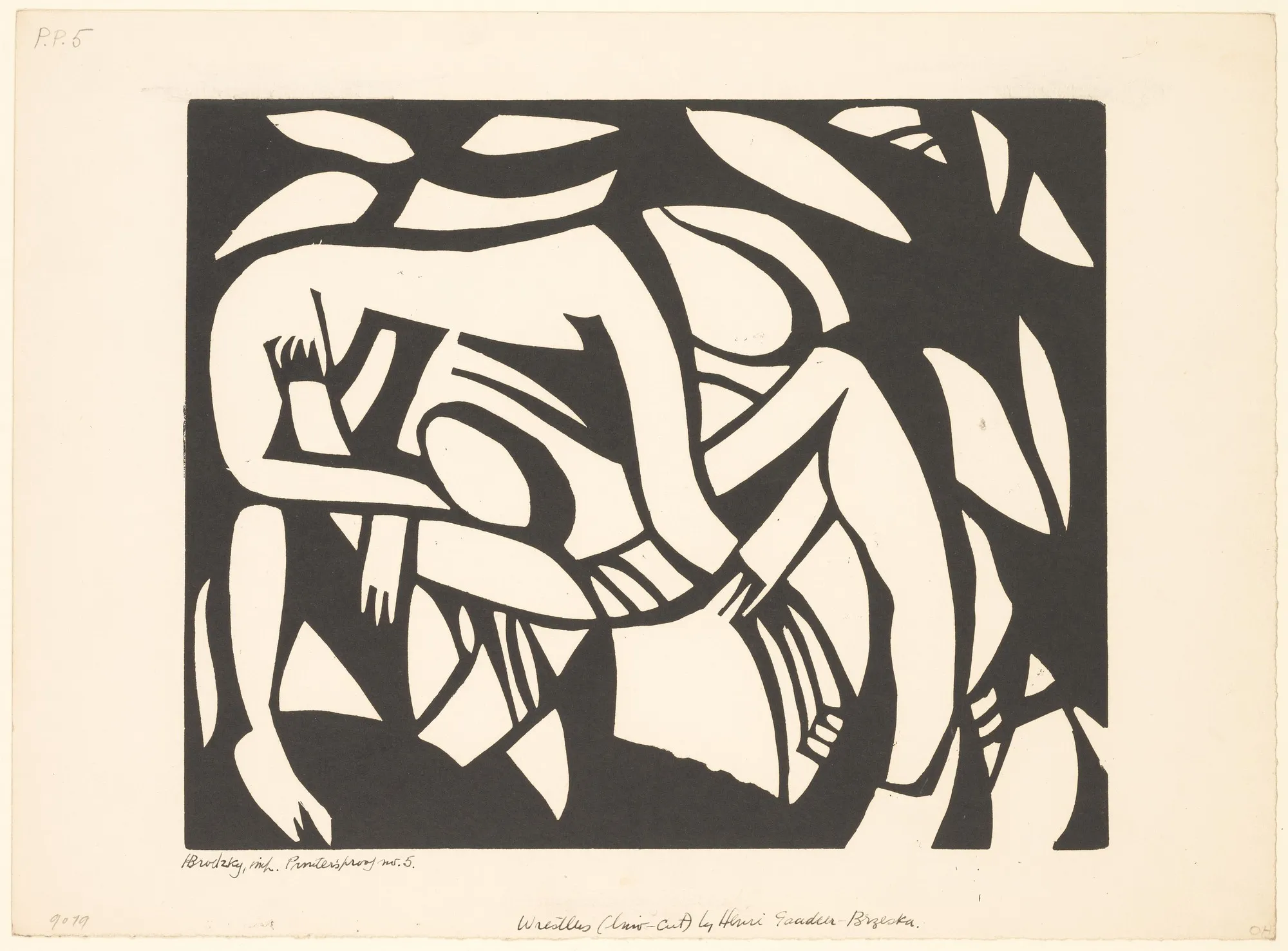
In London around 1914 the sculptor Henri Gaudier-Brzeska watched his friend Horace Brodzky cutting designs at home and decided to give it a go. Brodzky, writing in 1933, remembered that Christmas was close, so Gaudier cut a version of his Wrestlers to serve as a card. He took the design from a plaster relief he had worked up out of drawings made at a wrestling club off Fleet Street. The V&A, which holds an impression, records it as the only linocut he ever made and describes him as among the first to try linoleum in place of wood. Carey and Griffiths catalogue it in Avant-Garde British Printmaking 1914–1960. He was killed in France the following year at twenty-three. The projected edition of fifty was never completed, and Brodzky pulled the proofs himself, inscribing one of them printer’s proof no. 5.
Two years later a seventeen-year-old in the Netherlands cut a portrait of his father into lino, which was the first print he ever made, and went on to become far better known for what he did with woodcut, lithography and mezzotint.
Not one of these is a founding statement. A greeting card, a classroom exercise, a boy’s first attempt, a quicker way to get what wood gave slowly. The technique had arrived, and nobody had yet made a case for it.
How did linocut become serious?
Someone had to argue for it, and the argument was made in Pimlico.
The Grosvenor School of Modern Art opened at 33 Warwick Square in October 1925, founded by the Scottish wood engraver Iain Macnab. Claude Flight joined the following year. He taught colour linocutting one afternoon a week until 1930. Four years, one afternoon a week, and almost everything the technique is now known for in Britain came out of it.
The people who were in the room mattered. Cyril Power was a founding lecturer, teaching architectural drawing and history. Sybil Andrews was the school secretary. Flight taught them both, and neither had arrived as a printmaker.
His instructions were pointedly cheap. Ordinary household linoleum. Gouges ground from the ribs of old umbrellas. No press at all: printing was done by hand, using a wooden disc wrapped in bamboo leaves, or the back of a dessert spoon, or a toothbrush handle for the tight passages.
He wanted the prints cheap as well. They should cost a wage-earner no more than his daily beer or a seat at the pictures, he argued. What they sold for was two to three guineas, a guinea being twenty-one shillings, the unit British dealers used for art and professional fees. That landed well below what a painting fetched and well above a cinema ticket.
His first handbook, Lino-Cuts: A Hand-Book of Linoleum-Cut Colour Printing, came in 1927 from John Lane The Bodley Head, with his linocut Speed as the frontispiece. The Redfern Gallery mounted the first British lino-cut exhibition in 1929, and annual shows followed for most of the next decade.
Then came a second manual, The Art and Craft of Lino Cutting and Printing, published by Batsford in 1934. In it Flight wrote the sentence this essay rests on. The medium, he said, has “no tradition of technique behind it.” He meant it as the advantage. A student could work without measuring himself against Bewick or Rembrandt, and make his own tradition instead.
The verdict he was arguing against arrived in the same years. In 1930 F. J. Glass, headmaster of the Doncaster School of Art and Crafts, published a classroom manual: The Lino Cut in Elementary, Secondary, Art and Technical Schools. Flight’s own 1934 book is illustrated with work by Lill Tschudi, Dorrit Black, Ethel Spowers, Edith Lawrence and, alongside them, children. The case for the medium and the case against it were being made at the same time, and once inside the same covers.
What did Picasso actually change?
Not the technique. His only linocut before the 1950s dates from 1939, the year German troops entered Prague. He titled it Pour la Tchécoslovaquie. Hommage à un pays martyr (for Czechoslovakia, homage to a martyred country). Then he left the material alone. He came back to it in Vallauris in the mid-1950s, where a commercial printer named Hidalgo Arnéra had a shop and Picasso wanted posters for local exhibitions.
Colour came first, in the conventional way, one block per colour printed one over another. On July 3, 1958 he cut a portrait after Cranach the Younger in two colours, was not satisfied, and went back the next day to do it properly. The finished print took five blocks. He found the whole business laborious.
So he stopped using more than one. The method is called reduction: print the block, cut more away, print again in a second colour, and keep going until almost nothing is left standing. Older writing calls it elimination. Every pass destroys the state before it, so when the last colour goes down the block can no longer make the print.
Between 1958 and the early 1960s he produced over a hundred of them. Exact counts vary from source to source, depending on which years each one covers.
Here the trade record goes wrong. Galleries and auction houses still describe reduction as his invention, in exactly those words. It was not. Alisa Bunbury’s 2001 conference paper, held on the National Gallery of Australia’s research site, traces the claim to Donald Karshan’s 1968 book Picasso Linocuts 1958–1963. Rigby Graham and Pat Gilmour both testify that reduction was already common knowledge among British art students at the time. The catalogue raisonné of Blair Hughes-Stanton’s prints records eight- and nine-colour elimination linocuts made in 1959, to illustrate Conrad’s Youth. Bunbury adds the plainest objection of all: it is an easy thing to stumble on while experimenting.
Picasso changed the standing of the material rather than the method. In 1930 linocut was still being written up for use in schools. Thirty years later it was the medium of the most famous artist alive. A commercial printer in a pottery town pulled the sheets, and Kahnweiler’s gallery in Paris sold them.
Reduction also settled something for collectors. A reduction print cannot be restruck, because the block that made it no longer exists. The edition is closed by the process rather than by a promise, which is worth holding on to when you read any edition number.
How is a linocut printed?
Relief printing needs pressure, not a press. Ink sits on the surface that survived the cutting. Lay a sheet over it, press evenly, and the image transfers in reverse. What supplies the pressure is left to whoever is printing.
Three routes are in ordinary use. The printmaker can burnish by hand, rubbing the back of the sheet until the ink lifts off the block. A relief or etching press does the same under a roller. A commercial press does it quickly, which is how Arnéra worked in Vallauris.
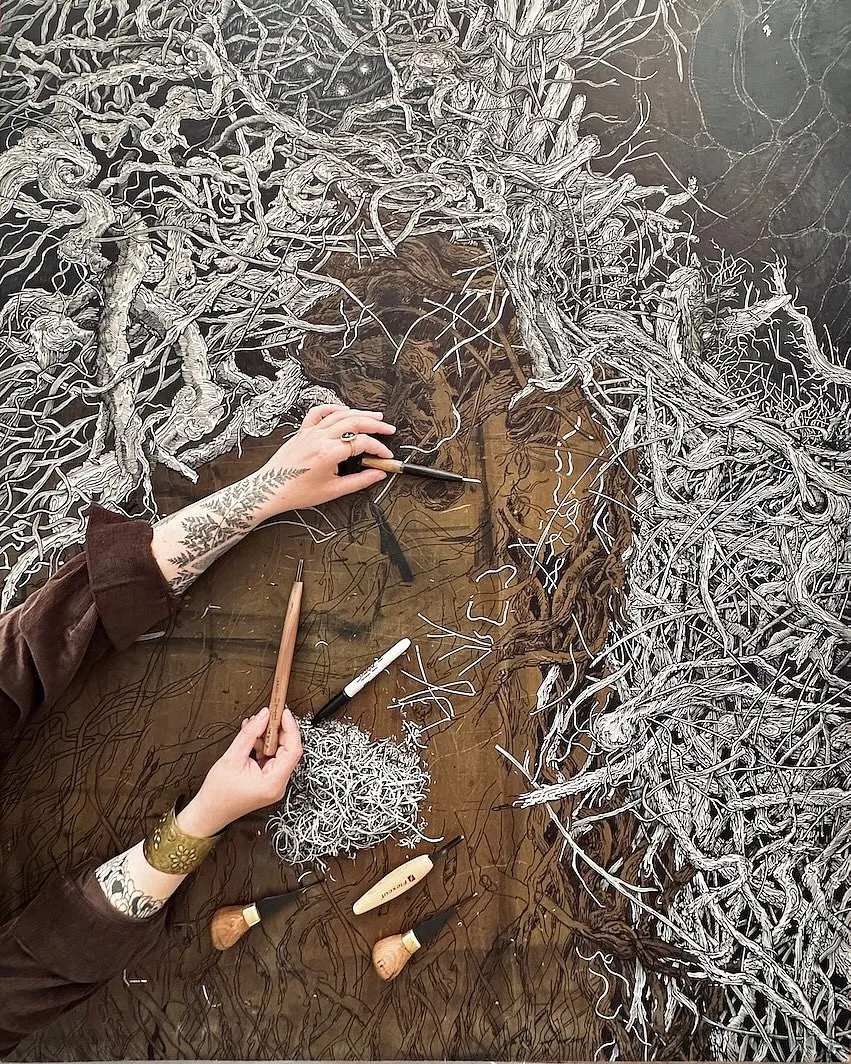
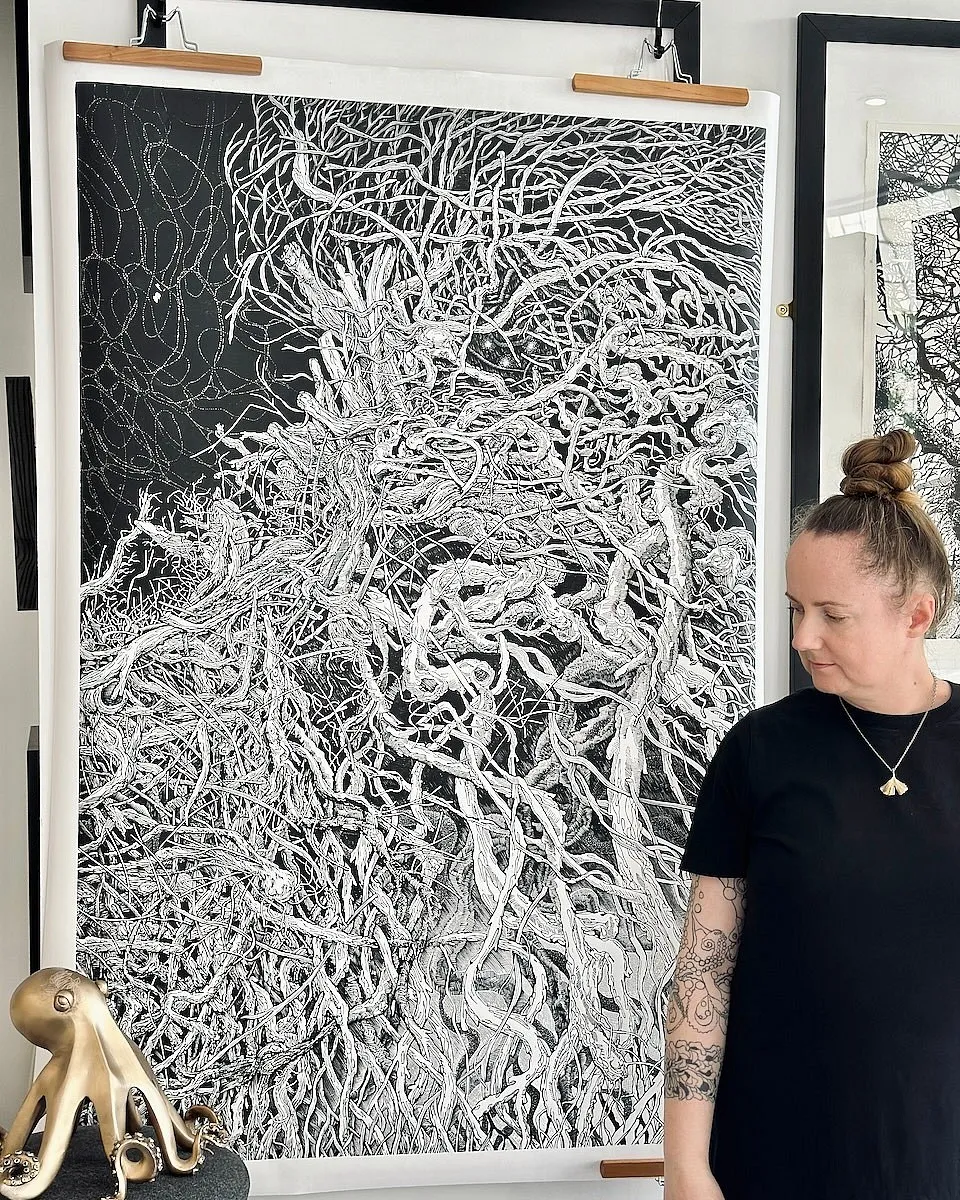
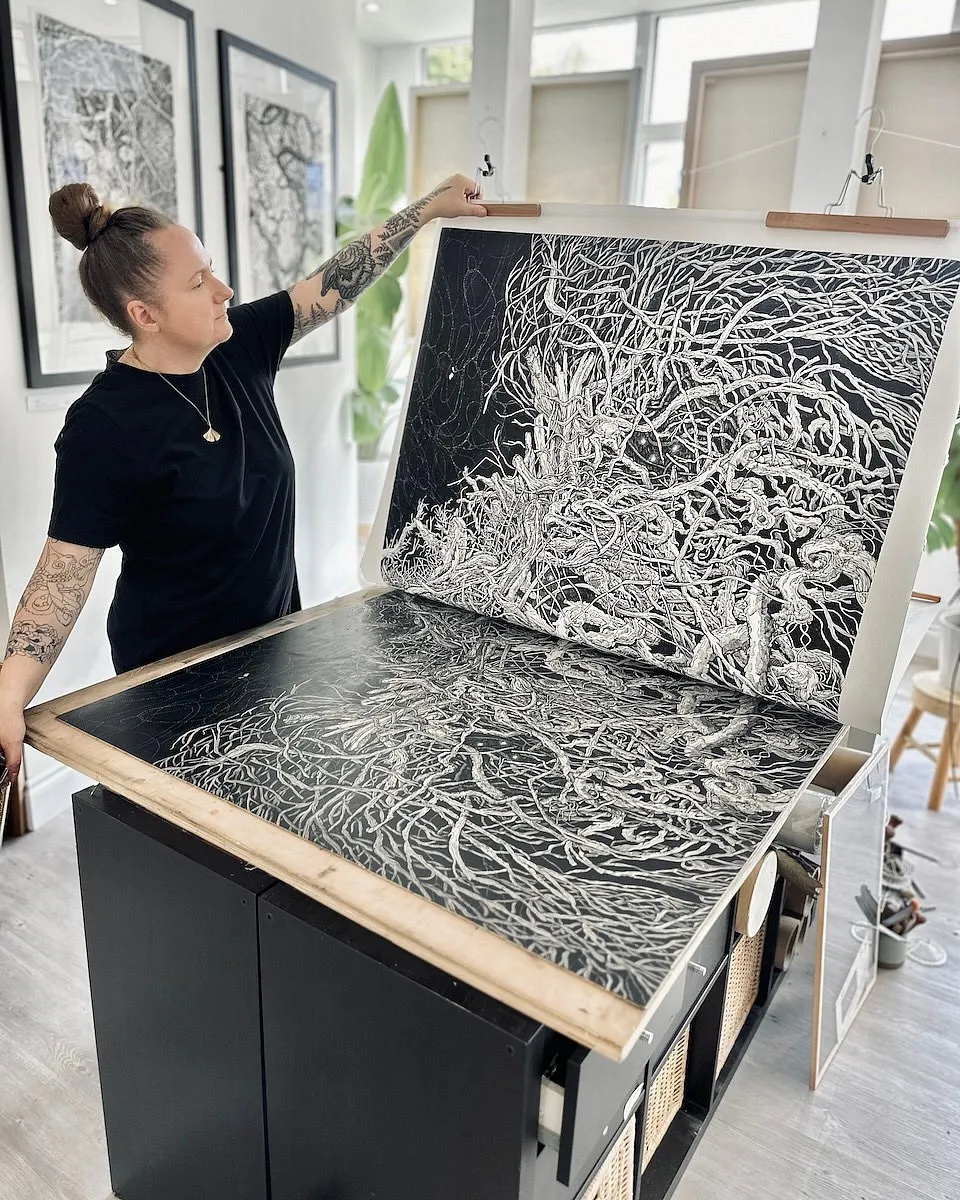
Aga Kubish took the first route for Habitat, at a size that makes the choice worth examining. The block is 140 × 93 cm. She inks it by hand with Speedball relief ink, lays the paper down, and works pressure across the whole image with a glass jar. The first impression took two hours, counting the trimming and a second pass of ink. The edition is thirty.
Her reason is practical rather than romantic. Printing by hand lets her work considerably larger than her press allows. It is not a rejection of machinery. It is what happens when the machinery stops at a size smaller than the idea.
Hand printing does set a problem that a press solves by itself. Every impression has to match the others closely enough to belong to the same edition, and the only instrument enforcing that is the printer’s arm. Across thirty sheets at that size, it is a great deal of consistent pressure.
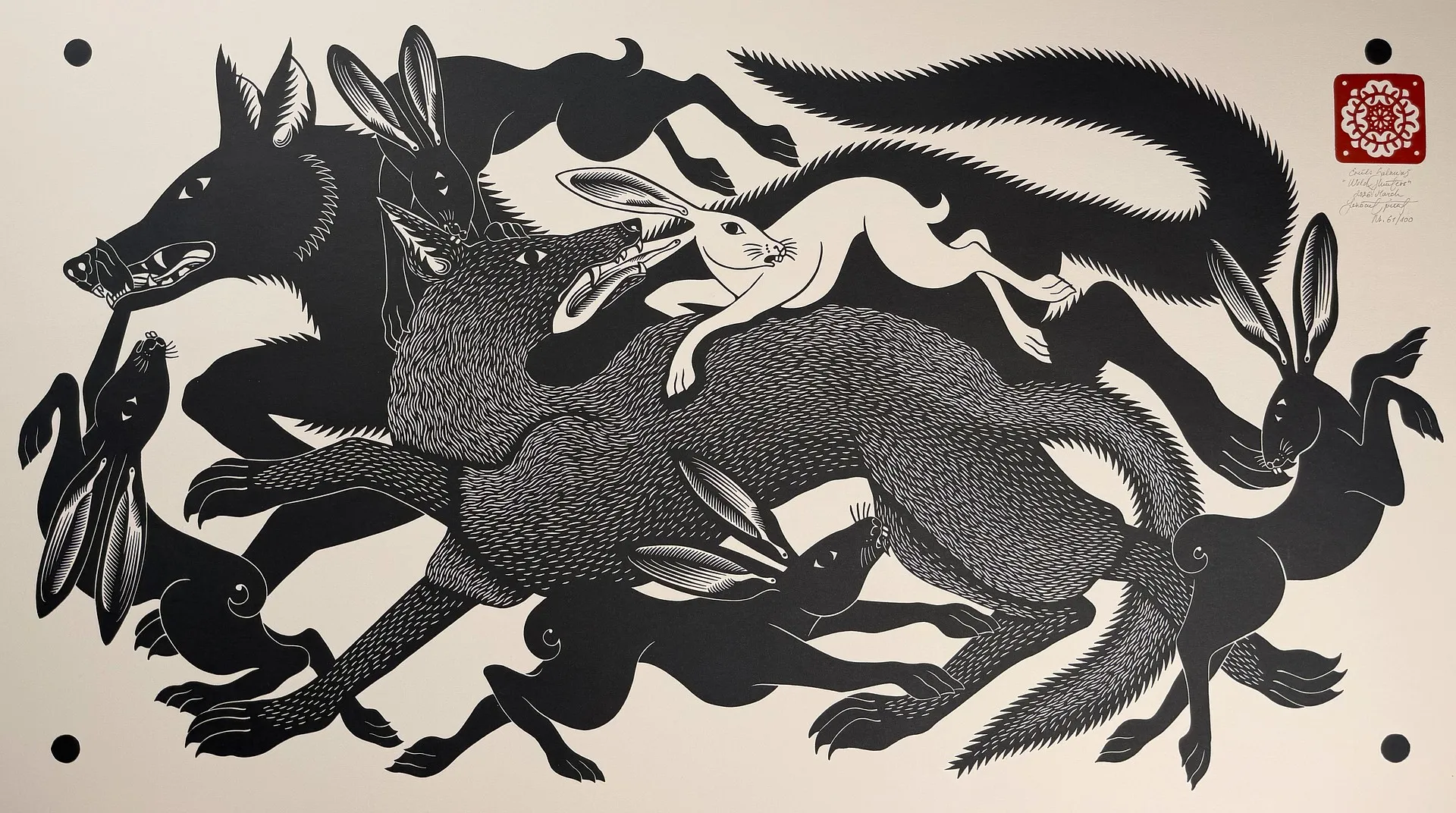
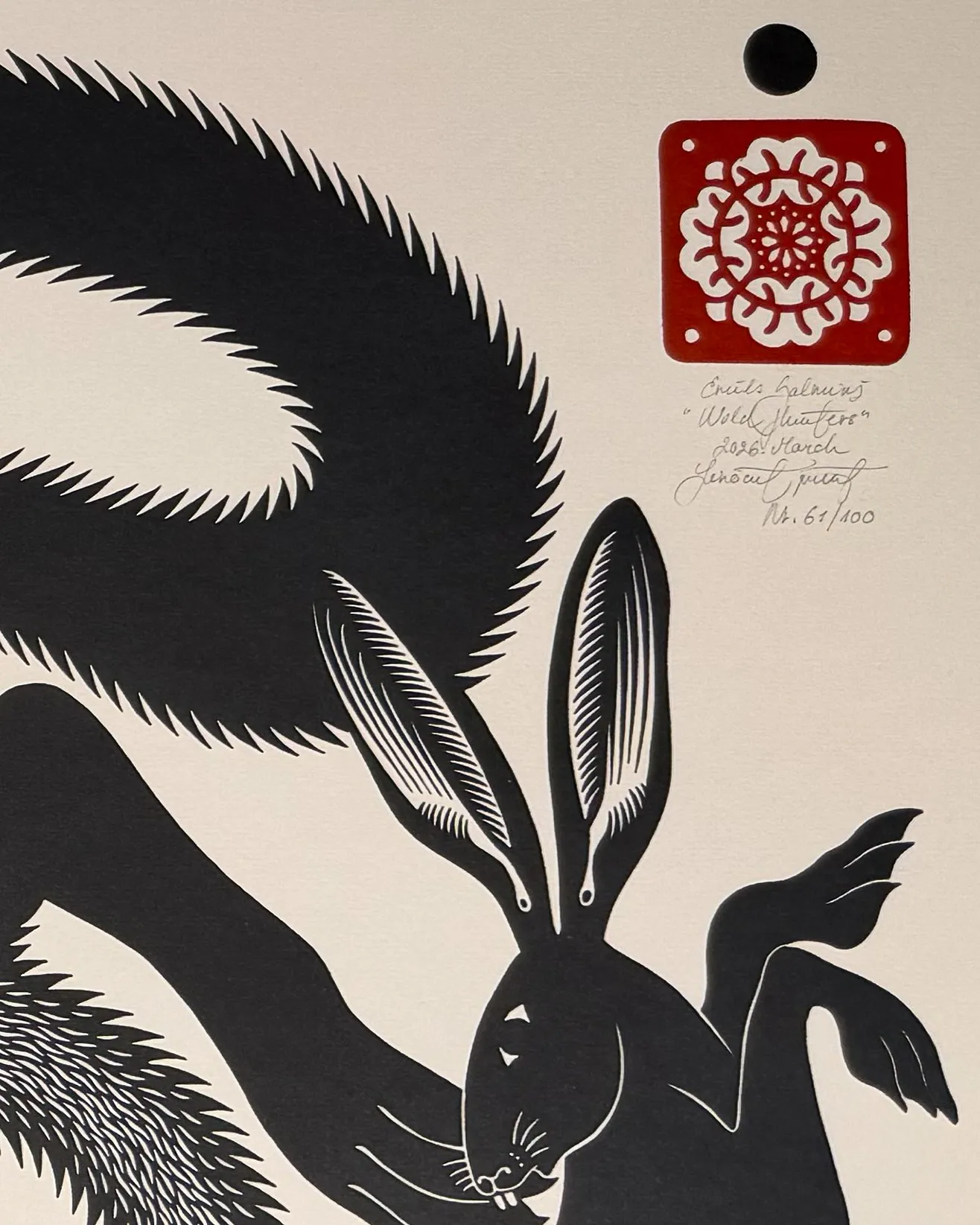
Emīls Salmiņš answers the same question the other way. He designed, carved and printed Wild Hunters himself, on an etching press, on Fabriano Rosaspina Avorio. The sheet is 58 × 100 cm. The black version runs to an edition of one hundred.
Neither sheet is the more legitimate for it. Flight’s students were printing with the back of a spoon in 1930. Almost a century later the technique still has no standard apparatus, and that is not a gap in it.
What does a collector actually look at?
Start with what a linocut does not have. Intaglio printing presses the paper into lines bitten or scratched below the plate’s surface, and the plate’s edge leaves a visible impressed border called a plate mark. Relief printing works the other way, so no plate mark appears. A “linocut” offered with one is worth a question.
What you do get is the ink sitting on the paper rather than in it, and, where pressure was firm, a slight embossing on the reverse where the raised surface pushed through. Hold the sheet to raking light. The relief is usually easier to feel than to see.
The white areas are the cut areas. That sounds obvious until you use it, because it lets you read the cutting directly. A wide clean white passage was cleared with a broad gouge. A hairline was left standing between two cuts, which is harder than removing it. Fine parallel hatching in the dark passages is not tone, it is a series of individual cuts.
Inscriptions usually sit in the lower margin in pencil: title at the left, edition position in the centre or left, signature at the right. Grosvenor School prints often put them somewhere else. Flight and his circle tended to inscribe the title, signature and edition number inside the image area, and Flight would mark the area intended to show through a mount. A sheet following that convention is behaving normally for its period. The habit did not die with them. Emīls Salmiņš signs Wild Hunters in the upper right of the printed field, beneath his own stamp, with the title, the month, the technique and the edition position stacked under his name in pencil.
How long an edition can run is a property of the block. Linoleum is durable and will yield a long run, which is why editions of a hundred are unremarkable here while a drypoint plate is exhausted in a few dozen impressions. Reduction is the exception, and it runs the other way. The block is consumed as the colours go down, so the final state is the only state that can ever be printed. Whatever was pulled through those passes is the whole edition, and no further impression is possible from that block.
None of this settles whether a sheet is what it claims to be. It tells you what to look at, which is the part that transfers between prints. The rest is documentation: what an edition number means, and where the line falls between a hand-pulled sheet and a photographic reproduction of one.
Where linocut stands
Linocut had no old masters to inherit and no tradition of technique to work against. For most of its first century that counted against it, and the classroom manuals kept pace with the exhibition catalogues the whole way. What changed the verdict was not an argument. It was Orlik’s triptych, Gaudier-Brzeska’s card, the Grosvenor School’s four years, Picasso’s hundred sheets, and a large block carved over six weeks in 2024 and printed by hand with a glass jar. The case was made by the work, which is the only way it could have been made.
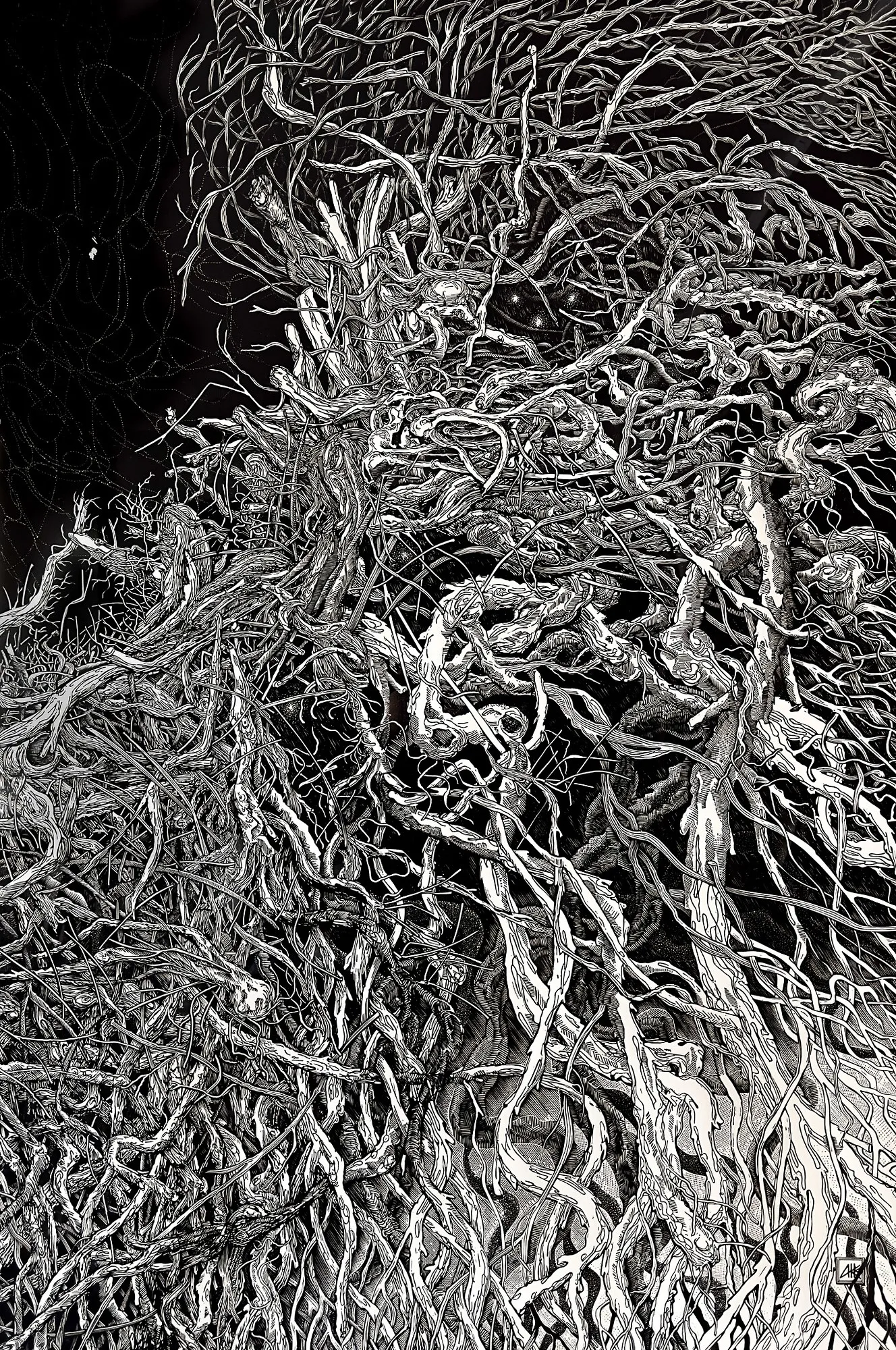
Aga Kubish shows Habitat at the Imprint Art Fair, RHS Lawrence Hall, London, from 29 October to 1 November 2026. Her site and her Instagram carry the rest of the work.
FAQs
Is a linocut an original print?
Yes, where the artist cut the block and the impression was pulled from it. The sheet is not a copy of an artwork that exists elsewhere; the block cannot produce an image without being printed. What disqualifies a sheet is photographic reproduction of an existing linocut, which is a different object and should be described as one.
How can you tell a linocut from a woodcut?
Chiefly by the line. Wood has grain that resists the tool in one direction, so woodcut lines tend to carry angular breaks and splintering, particularly in long curves. Linoleum has no grain, so curves run smooth and uniform in any direction. The evidence is not conclusive on its own, since a skilled woodcutter can suppress grain and some woods barely show it.
Why are linocut editions often larger than etching editions?
Because linoleum does not wear the way a metal plate does. A drypoint burr collapses within a few dozen impressions and an etched plate degrades steadily, so editions are set low to protect the later sheets. A lino block prints consistently for far longer, which makes an edition of a hundred ordinary rather than suspect.
Does a linocut need a press?
No. Relief printing requires even pressure, not a machine. Claude Flight's students at the Grosvenor School printed with the back of a dessert spoon; Aga Kubish prints a sheet of 150 by 105 cm by hand with a glass jar. A press is faster and more repeatable, and neither method makes the resulting sheet more or less original.