ARTIST
Conor Harrington
Contemporary Irish artist working in screen printing, with a wider practice in large-scale painting and murals.
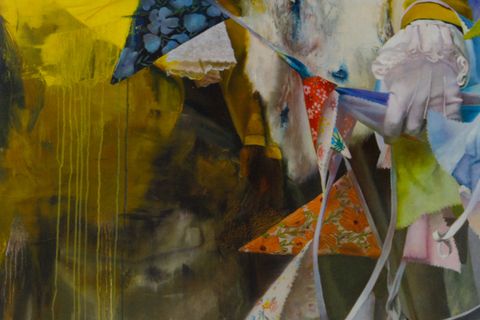
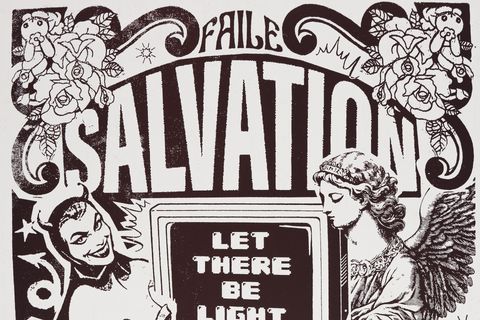
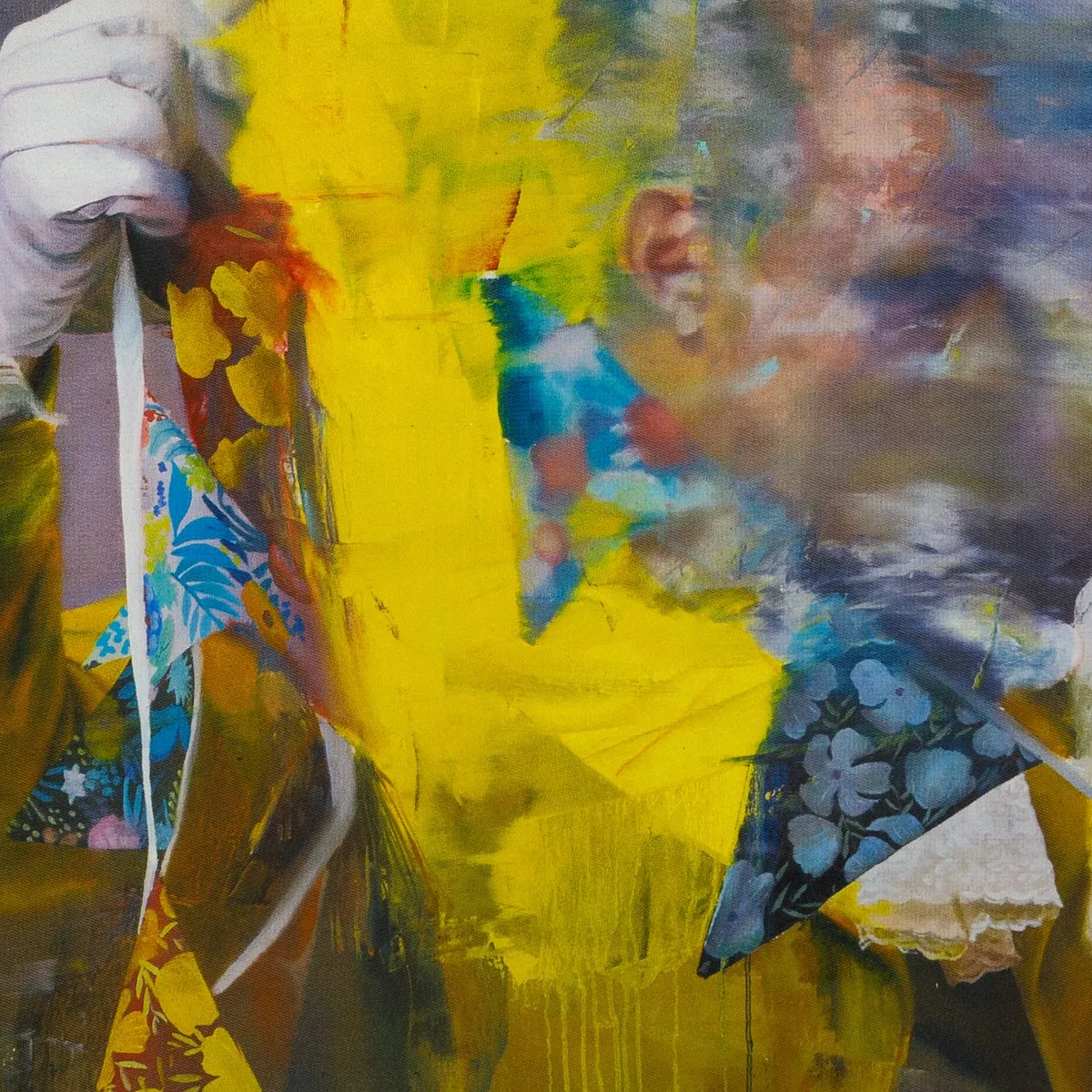
Conor Harrington calls himself a painter, and it’s the right word even though the work spills well past the canvas. Cork-born and London-based, he builds large figurative paintings that set the discipline of the Old Masters against the energy of street art — men in eighteenth-century military dress, rendered with Baroque seriousness and then half-dissolved in sprayed and dragged paint, caught somewhere between ceremony and collapse. He paints them at mural scale on walls from Paris to São Paulo and on linen in the gallery, and the same images travel into print. Two of those prints are in the collection — Welcome to the Cabaret and Elvis is Back in the Building — both screen prints, both drawn from paintings in his most recent London show, both carrying that collision of the classical and the street onto a single sheet.
The two screen prints
Both prints come out of the same body of work: paintings shown in Pallium, Harrington’s 2025 solo exhibition at Ben Brown Fine Arts in London and his first with the gallery. Each is signed and numbered, printed by the southeast-London print studio Atelier JI and published by Hungryboy Books, on Somerset Satin — a 410gsm mould-made cotton paper from St Cuthberts Mill in Somerset — and finished with a gloss-varnish overprint that gives the surface something of the depth of paint. What sets them apart is method.
Welcome to the Cabaret (2026, edition of 100, roughly 110 by 130 centimetres) is the more unusual of the two, and the more revealing. It begins from the painting of the same name — at three metres across, the largest canvas in Pallium — and strips it of colour and saturation down to black and white. To print it, Harrington uses his own studio oil paint — the same he paints his canvases with — which is not the conventional way to make a screen print. Pushed through the screen in a single layer, the paint lays the whole image down in one pass — a one-colour screen print that, as he describes it, arrives finished and complete.
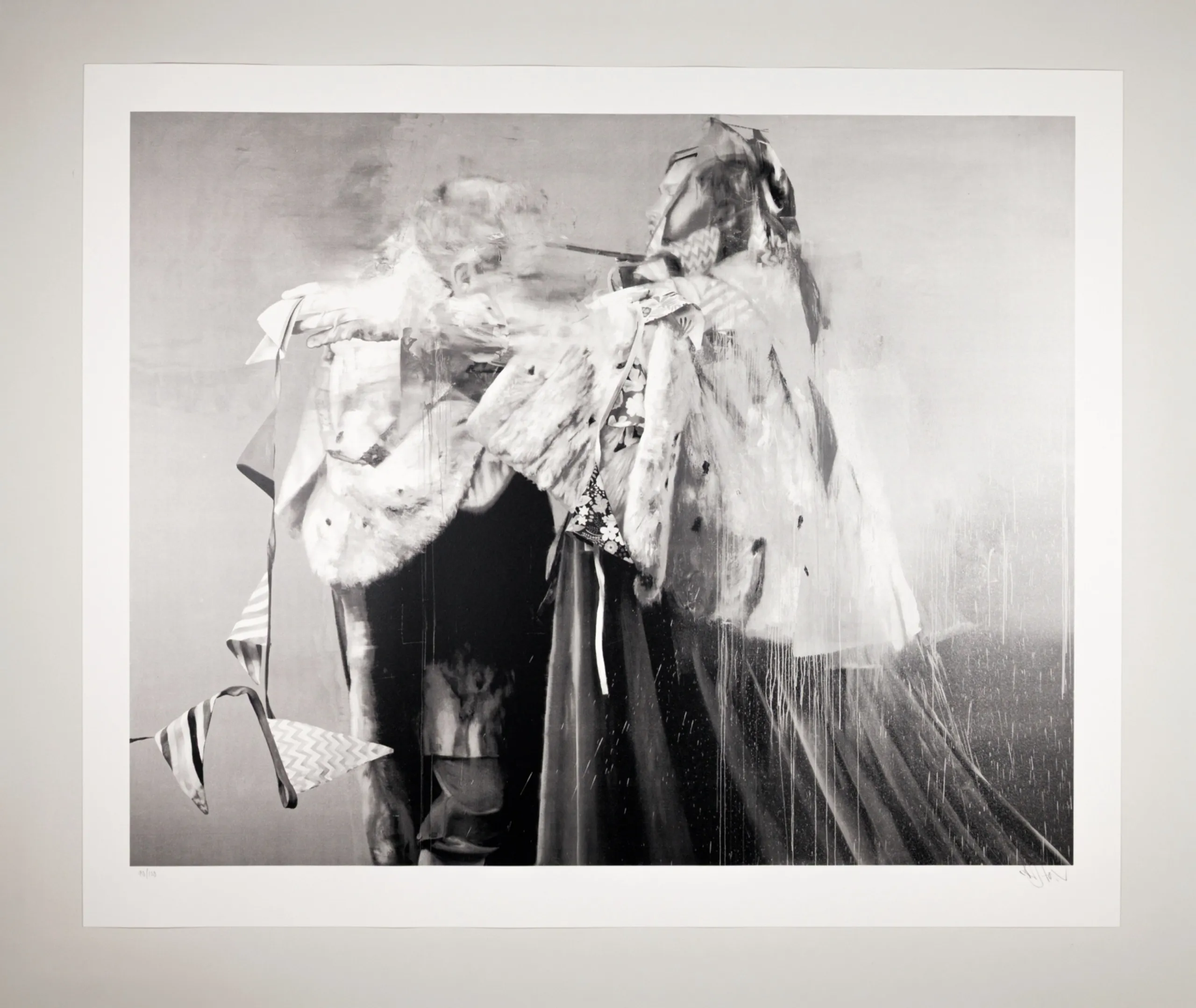
Alongside the edition, Harrington made a series of monotypes from the same image, each one worked by hand into a unique state. He works each freshly pulled impression with brushes, squeegees, rags and sprayed solvent, dissolving and dragging the oil paint so that no two resolve the same way. The impulse is one he traces to a story from art college in Limerick: a tutor who, in 1960s New York, would carry newspaper pages straight from the printing plant to Robert Rauschenberg’s studio while the ink was still wet, so it could be transferred onto canvas. Harrington wanted that same urgency in his own hands. He is careful, though, to distinguish these from hand-finished prints, where the printing and the painting are separate steps with time in between; here the two happen at once, the image worked the moment it comes off the press.
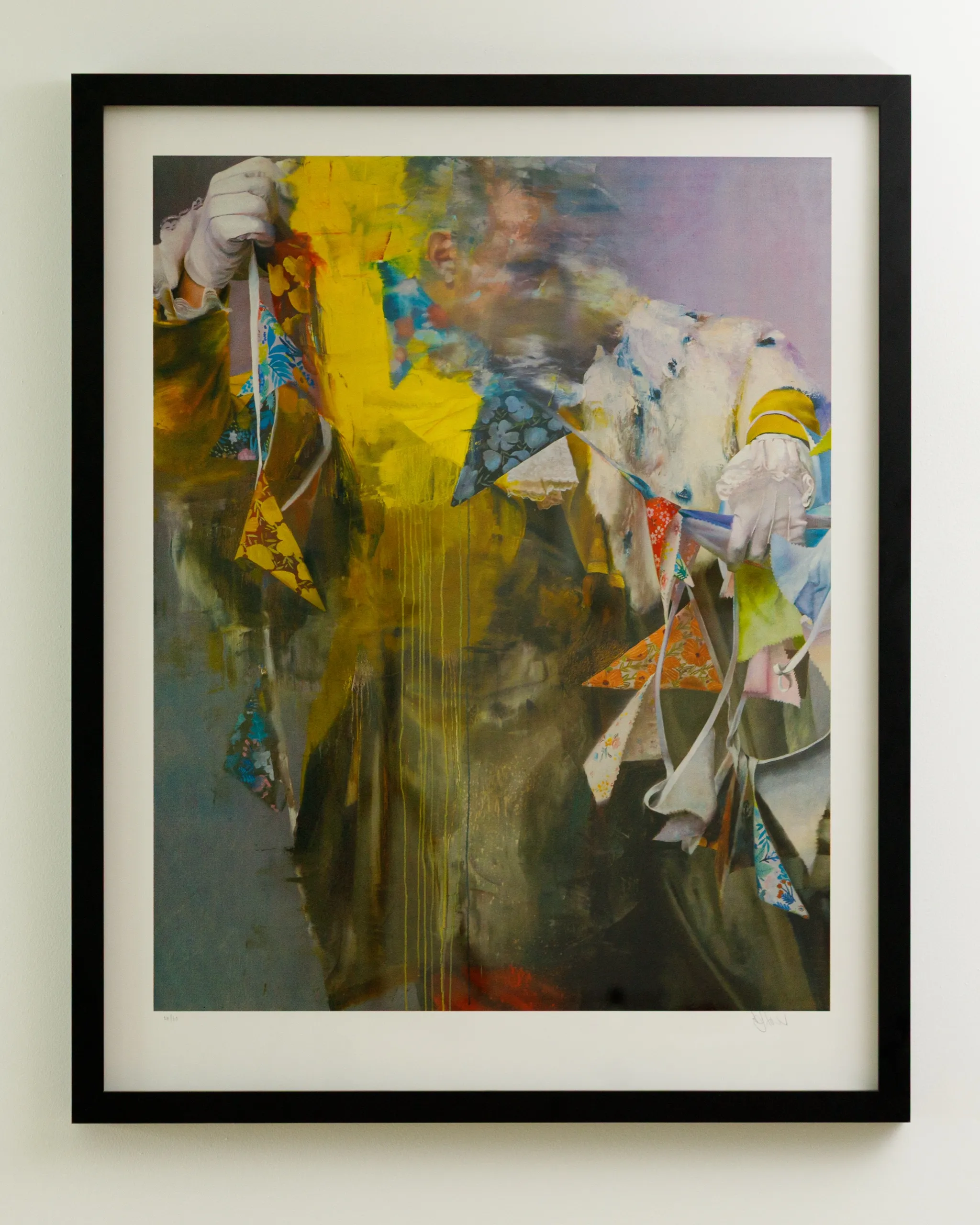
Elvis is Back in the Building (2025, edition of 60, around 94 by 71 centimetres) is the tighter counterpart, smaller and based on another of the Pallium paintings. It runs in the opposite direction: where Welcome to the Cabaret reduces a painting to a single black-and-white layer, Elvis is built up in five colours on the same Somerset Satin — the one stripping an image to its barest structure, the other reassembling one in the flatter, layered register that screen printing does most naturally.
Why these works are in the collection
The collection’s relationship with Harrington began with a reproduction. The first piece was a giclée — or, in the more exact term, an archival pigment print: an image printed in pigment inks on heavy Somerset paper, finished with a silkscreen gloss varnish. It is a serious object, not a poster. But it is a reproduction, and the move from it to the two screen prints is the distinction Paper Matters exists to draw.
Harrington works a single image across several mediums, and each is an original in its own right. Welcome to the Cabaret exists as the three-metre painting, as the screen print in the collection, and as the unique monotypes — separate realisations of one image, not copies of one another. A giclée does something else: it photographs an image and reprints it. The screen print is the image remade; the giclée is the image reproduced.
A screen print is also an edition — sixty impressions, or a hundred — so it costs a fraction of what a painting does. That is how a collector comes to own one at all.
There is also what these images are about. The figures — soldiers and aristocrats in the dress of empire, dissolving mid-gesture — are not decorative. Harrington’s subject has always been power: who holds it, how it is staged, the violence underneath the ceremony.
Harrington’s wider practice
The prints are a small part of what Harrington does. His main work is painting at scale — large oil canvases and murals on city walls around the world — and one subject runs through nearly all of it: power, and the costumes it wears. His figures appear in military dress and the regalia of empire and church, painted with an Old Master’s gravity and then taken apart — dragged with solvent, sprayed over, sometimes hit with a fire extinguisher until the realism slides into abstraction. What he keeps circling is the performance underneath authority, and behind it the long reach of colonialism and the Catholic Church, and a masculinity that looks, up close, brittle and absurd. The empire he paints once ruled his own country, and that is the side he comes at it from.
Born in Cork in 1980, Harrington started out as a graffiti writer, took a BFA at the Limerick School of Art and Design in 2002, and has spent the two decades since in London. The graffiti is long behind him, but its energy isn’t: the speed and attack of the spray can are still there in how he handles paint. His murals have gone up across Europe and the Americas, and his work has shown at the Saatchi Gallery and entered the public collection of the Museum of Urban and Contemporary Art in Munich.
His paintings are handled by Ben Brown Fine Arts in London, where Pallium was his first show. The prints are one way in; the painting and the murals are the larger story, and Harrington’s own site is the place to follow it.
More about the artist...
Conor Harrington also mentioned in…