ARTIST
Ethan Murrow
Contemporary American artist working in stone lithography, with a wider practice in graphite drawing, painting, and site-specific installation.
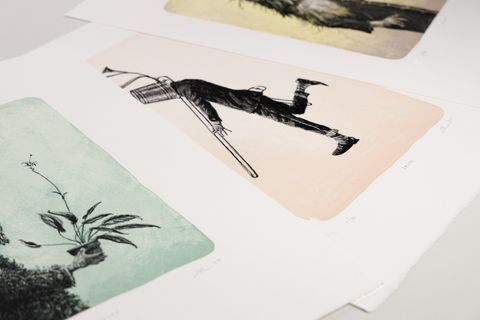
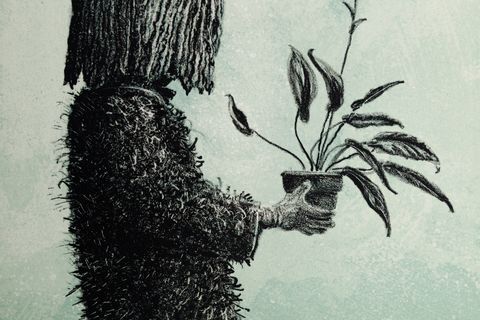
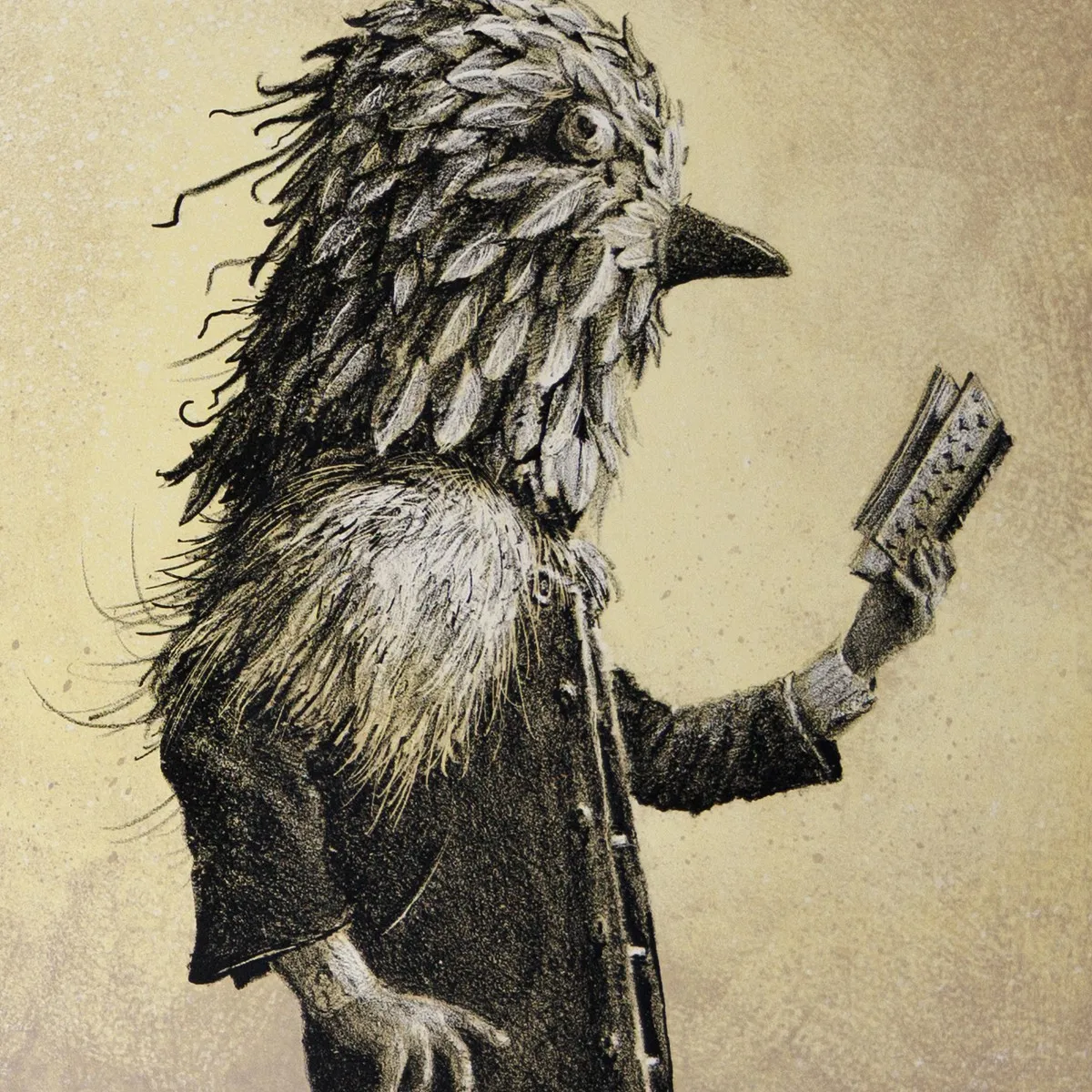
Ethan Murrow is better known for his large-scale graphite drawings and site-specific wall pieces — meticulously rendered, theatrically narrative — but it was a set of three quiet editioned prints from 2025 that brought him into the collection. Hunch, Sense, and Belief: three solitary figures, three soft fields of colour, drawn directly on stone and printed in Paris on a Voirin flatbed press. They are small, deliberate, and the most distilled version of Murrow’s practice you can hold in your hands.
The three lithographs
Each is a colour stone lithograph from 2025, in an edition of eighty. Hunch and Belief are pulled in four colours each; Sense in three. The paper is Rives BFK — a French mould-made cotton sheet at 20.75 × 15.5 inches — and the images themselves are smaller still, centred on the sheet with room to breathe.
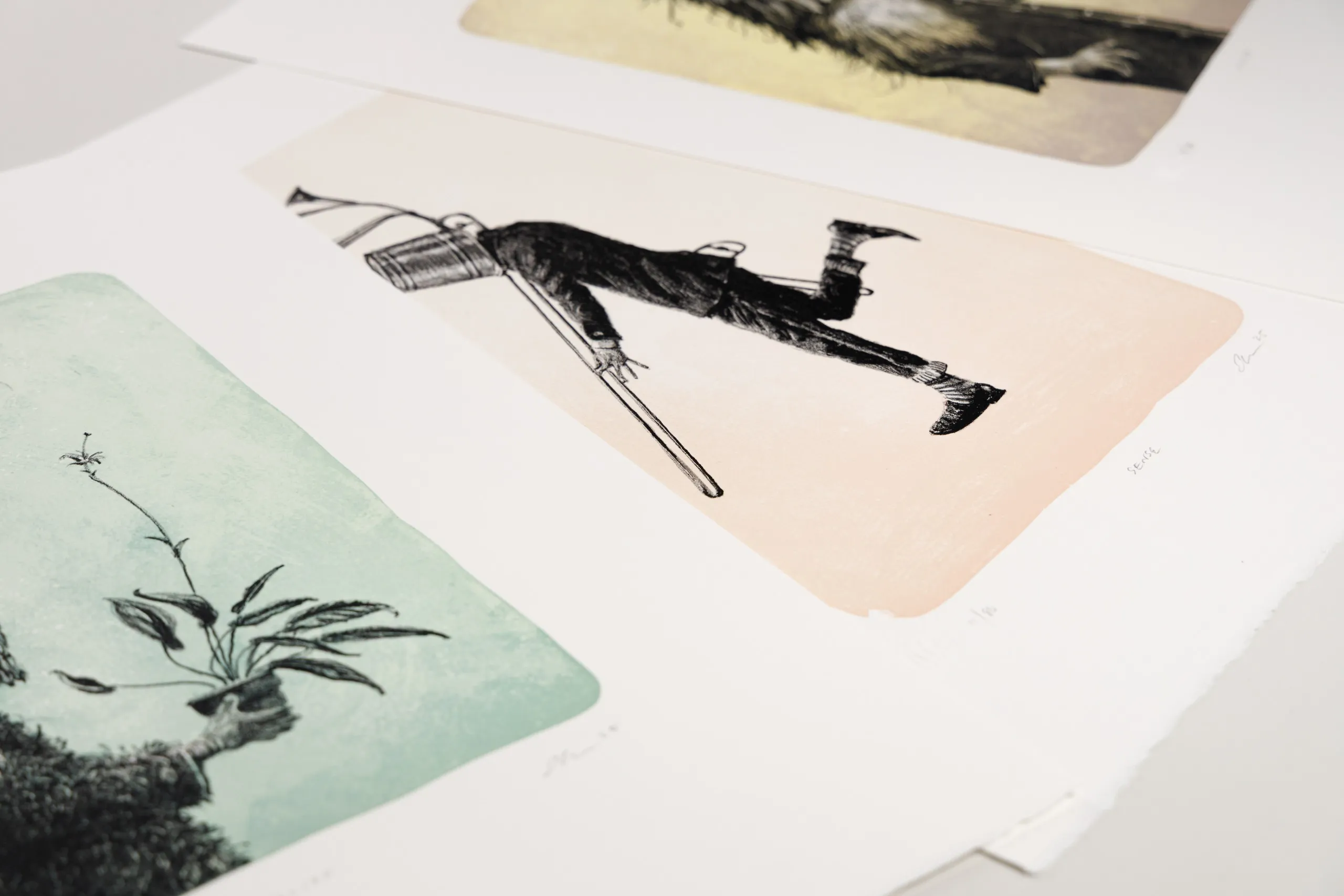
They were published and printed by D+S Fine Art Editions — the print shop co-founded by Deb Chaney, a Tamarind Master Printer trained in Albuquerque, and Stéphane Guilbaud, a Paris lithographer who began his career in 1979 at Atelier Desjobert. D+S works out of two studios: one in Paris, at the Viaduc des Arts in the 12th arrondissement, and a second in La Force in southwest France, where a historic 1880 Marinoni Voirin handles the larger editions. Hunch, Sense, and Belief were pulled on the Paris press, and for all three Murrow worked the stones directly — drawing the image, building the colour separations with the printers, deciding what each layer would carry.
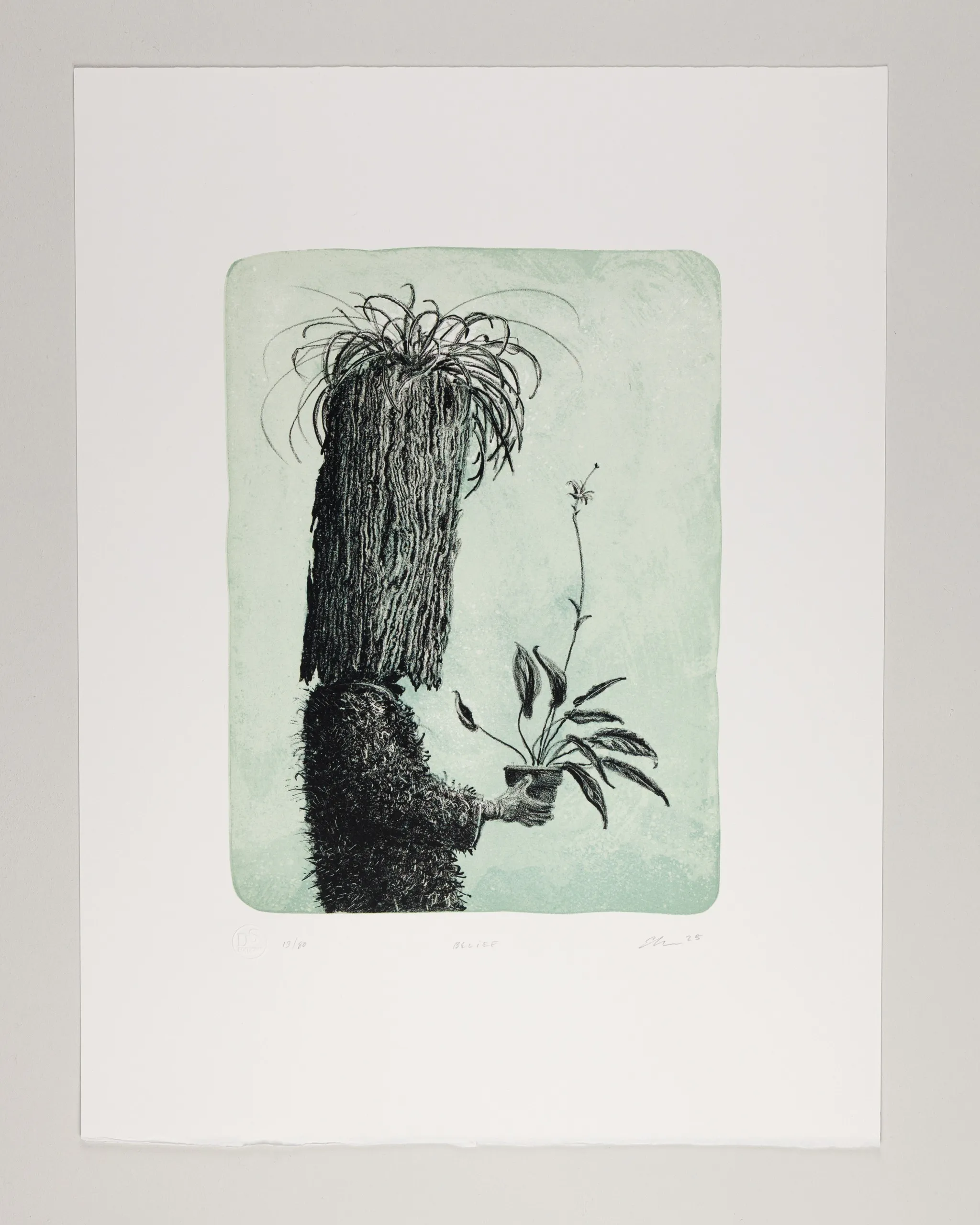
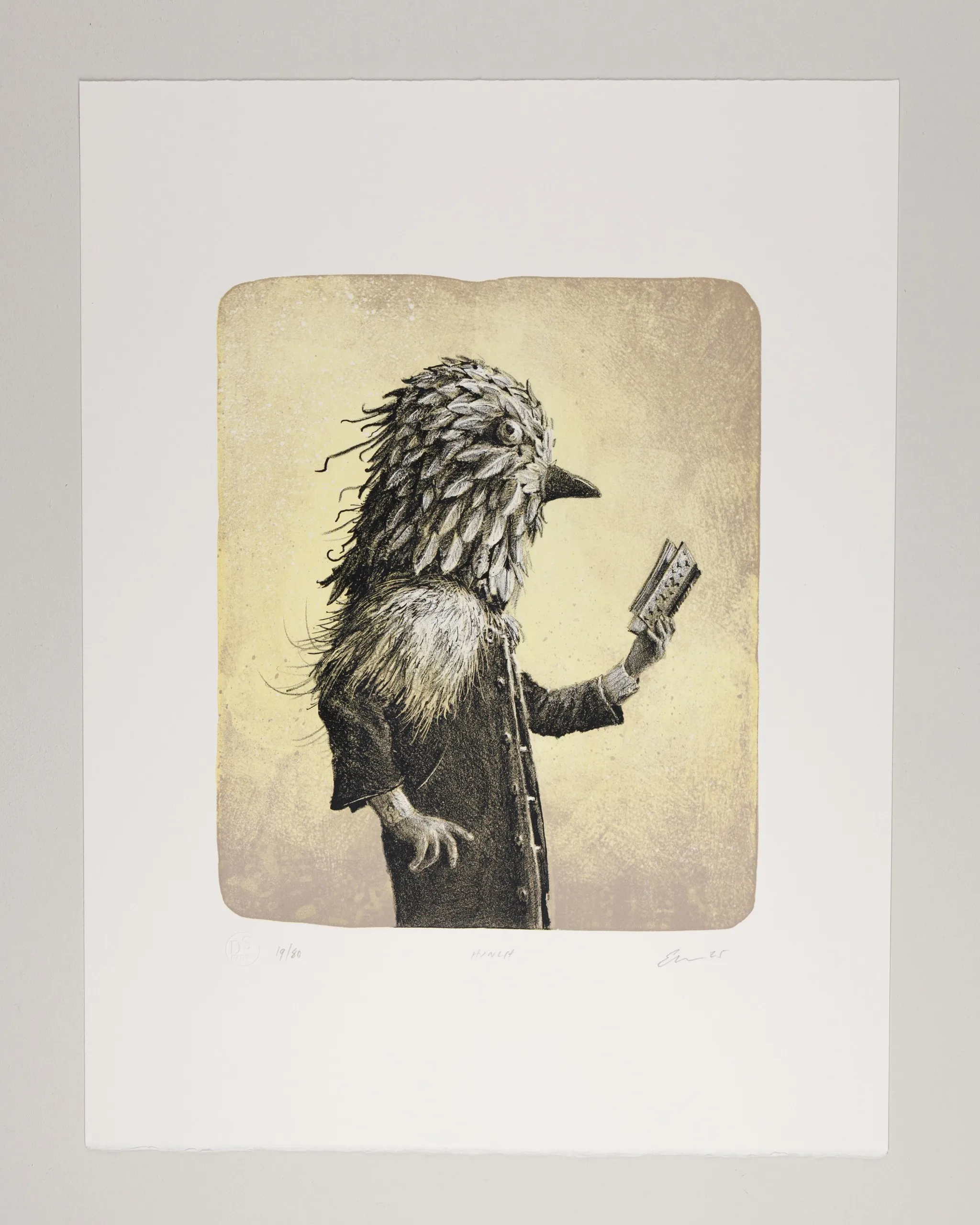
The set reads as a sequence — three character studies in Murrow’s familiar mode of solo figures absorbed in some quiet, slightly absurd undertaking. Where his graphite drawings tend toward elaborate narrative scenes built up with props, weather, and theatrical staging, here Murrow has stripped almost everything away. What remains is the figure, the gesture, and the coloured field around them. The same straight-faced precision he brings to a five-foot mural runs across these small editions, scaled down and held still.
Why these works are in the collection
For Paper Matters, the lithographs sit at the intersection of two things that matter: a serious editioning lineage and a contemporary artist whose primary practice isn’t printmaking. Both conditions are unusual together. Murrow works in both drawing and painting, but it’s the drawing discipline that travels directly onto the stone. The mark holds whether he’s using a graphite pencil or a lithographic crayon. The decisions about light, surface, and weight are the same decisions, made in a different medium.
The second thing is the publisher. D+S Fine Art Editions is one of a small number of contemporary shops working seriously with stone — slow, hand-pulled editions, no offset, no photographic reproduction. Deb Chaney’s Tamarind training is part of the lineage that kept this practice alive in America after the mid-century revival. The fuller history of that revival — and why it matters that a small handful of shops still pull stone editions today — is in our longer look at lithography. To collect a Murrow stone lithograph from D+S is to collect a contemporary work made through a printing tradition that almost disappeared and now persists in a handful of studios on two continents.
And one more thing, smaller but real: the visual world of these prints feels close to the body of work Murrow showed in The Parliament, his September 2025 solo at Winston Wächter in Seattle. The characters, the quietness, the way a single figure inhabits an open field — those preoccupations have run through his recent work, and you can see them at concentrated scale in the lithographs.
Murrow’s wider practice
Murrow works across graphite drawing, acrylic painting on panel, and site-specific wall drawings. The graphite work is what he’s best known for — large, slow, photographic-source images that read as historical document but slip into the absurd at the corners. He starts with staged photographs (props, costumes, performance) and translates them by hand into drawings that can take weeks to complete. The paintings run parallel to the drawings: bright and saturated, same characters, on panel rather than paper. And the wall drawings — made for institutions including the Institute of Contemporary Art Boston and the Museum of Contemporary Art Jacksonville — extend the same hand-drawn discipline at architectural scale.
Outside the studio, he teaches at the School of the Museum of Fine Arts at Tufts University in Boston, where he holds the title Professor of the Practice in Drawing and Painting.
He’s represented by Galerie Les Filles du Calvaire in Paris and by Winston Wächter Fine Art in New York and Seattle. If you want to spend more time with the wider practice, Murrow’s own site is worth wandering — the full drawing archive, the wall-drawing commissions, and his upcoming exhibitions all live there.
More about the artist...
Ethan Murrow also mentioned in…