
ARTIST
André Schulze
Painter and painting conservator from Dresden, known for the pixelated bouquets he paints into restored old canvases.
André Schulze is a Dresden painter and painting conservator, born in 1982, who studied painting at the Dresden Academy of Fine Arts and completed its master-student programme under Christian Macketanz. His paintings are held in public collections in Saxony, among them the Kunstfonds of the Staatliche Kunstsammlungen Dresden. The work he is best known for begins with someone else’s painting: old canvases, often badly damaged and unwanted, which he restores himself before painting into them. In his bouquet series he overpaints parts of a traditional still life in blocks of flat colour that read like pixels on a screen, while much of the original stays visible. Kern Bouquet (2026), the one work by him in the collection, is a 24-colour screen print made from one of those paintings. It carries two signatures: his own, and that of the painter whose still life he restored and reworked.
Kern Bouquet
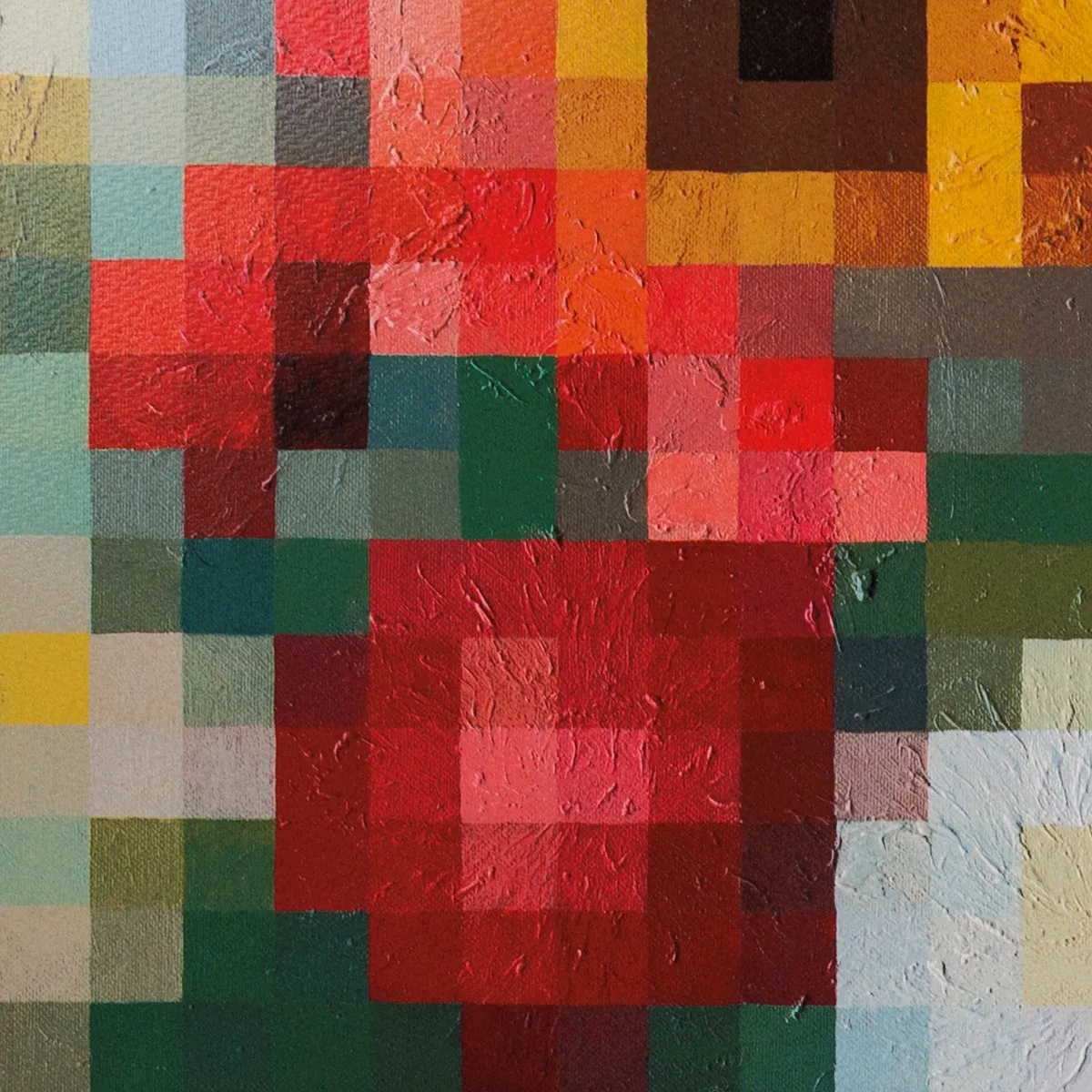
A bouquet in a dark vase stands on a table against a pale wall, painted in the loose, warm manner of an older still life. Above the vase, the flowers dissolve into a grid of square blocks in reds, oranges, yellows and greens, each one still carrying the brushed texture of paint. A single flower at the left edge escapes the grid and droops, untouched. Three loose squares, yellow, orange and white, lie on the table beside the vase.
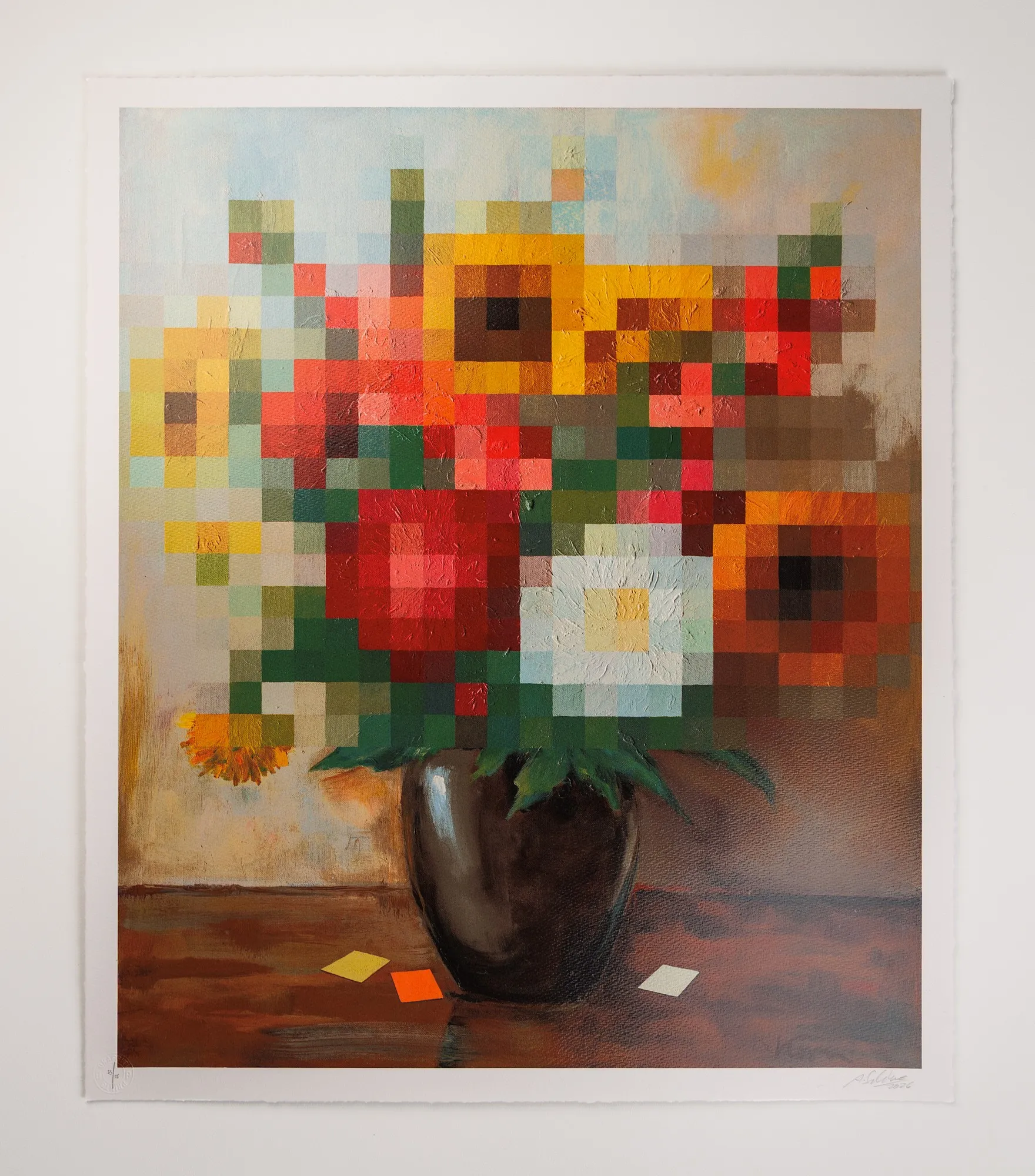
The print is a 24-colour screen print on 300 gsm Somerset Velvet, 60 × 50.5 cm, in an edition of 75, published by GraffitiPrints in March 2026. Somerset Velvet is a sister surface to the Satin GraffitiPrints used for FLOG’s Sunrise and Martin Whatson’s Poise: the same mould-made cotton sheet from St Cuthberts Mill, with a different finish. Close up, the weave of the original canvas shows through the image, carrying the texture of the painting Schulze worked on onto paper.
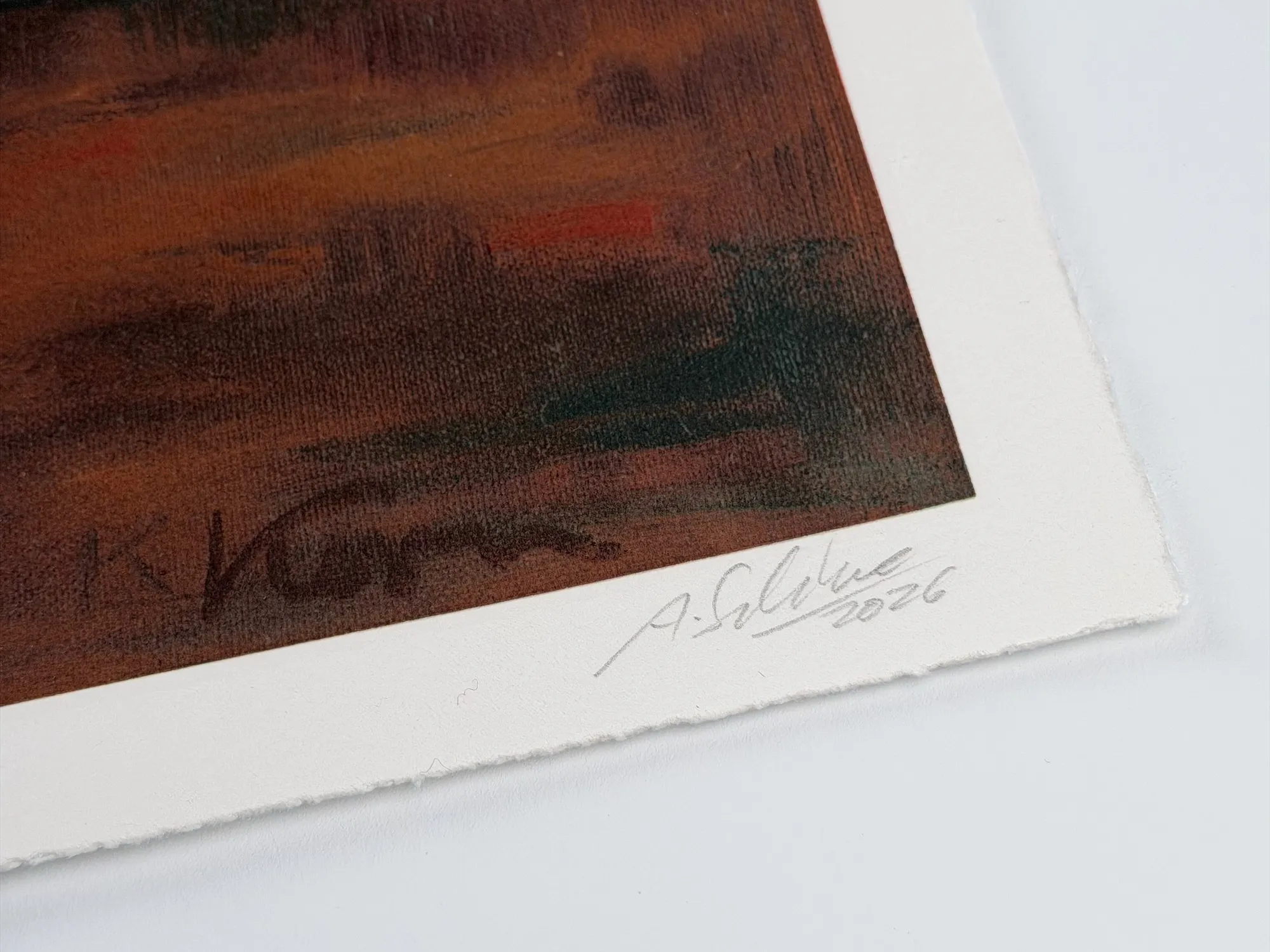
Two signatures sit a few centimetres apart in the lower right corner. Inside the image, painted in dark brown, is “K. Kern”, the signature of the painter who made the original still life. Below it, in pencil in the margin, is Schulze’s own: “A. Schulze 2026”. The title takes the first painter’s name, and other bouquets in the series carry surnames as titles in the same way. The edition number, 33/75, is pencilled at lower left inside the publisher’s blind stamp.
Why this print is in the collection
Kern Bouquet first appeared in a GraffitiPrints newsletter, and at first glance it read as an old painting. The surprise was the pixelation, a digital-looking grid laid over a traditional still life. Reading about how Schulze works made that collision make sense. The old picture is real, restored by his own hand, and the new layer is painted into it, not printed over it.
The second signature came later. Only after the print arrived did a closer look show that the name in the lower corner wasn’t Schulze’s. It was in a different hand, the original painter’s, surviving beneath his layers, with his own pencil signature just below. The two signatures make the sheet a record of two painters, and the question that raises, of whose work this is, deserves more room than a profile allows.
The print adds one more layer of its own: a 24-colour screen print of a painting that is already two paintings. Following how those layers are separated into screens and rebuilt on paper is the best way into how screen printing works, and into why a print like this is more than a picture of the painting behind it.
André Schulze’s wider practice
Schulze came to painting through graffiti. He started at twelve or thirteen, in the mid-1990s, and stayed in the graffiti scene until his early twenties, when an interest in fine art and graphic design took him to the academy. His interest in restoration came later, through the old paintings themselves. Many of those he bought were in poor condition, and wanting to preserve them, he taught himself to restore them. The process now runs in two stages. First the painting is restored. Only then does it become the ground for his own work.
Much of his best-known work starts from those existing canvases, and he approaches them in different ways. Sometimes he changes what the picture shows: a figure holds a smartphone instead of a book, or a car passes in the background. Sometimes he changes the picture as an object, overpainting flat areas while most of the original stays visible. The pixelated bouquets come from that second approach. He has said he often regrets painting over pictures he admires, but much nineteenth-century painting now goes unwanted at very low prices, and his intervention gives these works a reason to be hung again. Alongside the reworked canvases he also paints on blank canvas, with architecture among his most persistent subjects. What runs through all of it is humour, irony and small hidden messages over solemnity.
His work has been recognised with the Josef Hegenbarth Scholarship (2012), the Eb-Dietzsch Art Prize for Painting (2014) and two working grants from the City of Dresden. He is represented by Galerie FLOX in Dresden, Affenfaust Galerie in Hamburg, Paradigm Gallery in Philadelphia, and E30Gallery in Frankfurt, which showed Flamingo Paradox in 2025.
André Schulze’s own site gives a fuller picture of his painting, from reworked old canvases to work on blank canvas, along with his exhibitions and his restoration work, and his Instagram is the place to follow new paintings. New editions with GraffitiPrints are announced through the publisher, which is how Kern Bouquet came to us.